

Subscribe
to receive news by email

Poll
Will the Trump Administration Shift U.S. Policy in Favor of Palestine?
- No (87%)
- Yes (13%)
 Loading ...
Copyright © 2026 Arab America
Go topA Sit-Down with Director Cherien Dabis
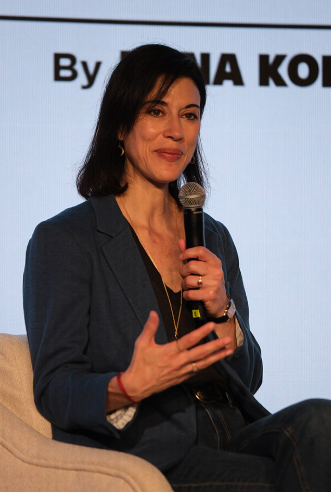
By Rena Elhessen/Arab America Contributing Writer
Following its world premiere at the 2025 Sundance Film Festival on Jan. 25, 2025, and its subsequent awards at international film festivals, All That’s Left of You has finally arrived in American cinemas.
The beauty of this film lies in the intertwining of history and deeply-rooted personal experience. A balance Palestinian-American director Cherien Dabis achieves, bringing to life a historical tragedy while leaving room for hope. In response to the recent release, our team had a sit-down interview with the creative mind behind the film.
About the Director
Cherien Dabis is a Palestinian-American director, producer, and screenwriter, whose Arab identity and experience shapes her work. Her father, having been exiled from the West Bank in 1967, immigrated from Palestine. Cherien was born in the U.S. and raised between Ohio and Occupied Palestine. She attended the University of Cincinnati and Columbia University. She has previously directed two short films, Make a Wish (2006) and Amreeka (2009). Dabis also works as a television screenwriter and has made acting debuts in Netflix’s Mo and her most recent project All That’s Left of You.
Why We Are Here
Inspiration
From the first five minutes of the film, a central question is introduced “Why we are here”. This line, introduced by Cherien’s character (Hanan), is answered by Cherien herself.
As a Palestinian-American born and raised in the diaspora, Cherien experienced first-hand the emotions she places at the forefront of this film. Her familial history is marked by a sense of displacement. Her father, having immigrated to the U.S. following an expulsion from the West Bank in 1967, carried this loss. Having been born shortly after this expulsion, Cherien became a witness to this struggle. By witnessing the battle that ensued for her father to gain foreign citizenship just to return to his homeland, Cherien “grew up with his heartache over his exile”.
Her Arab identity set the forefront for this story, but her American upbringing solidified the need to bring it to life. Growing up in midwest Ohio, Cherien found herself subject to being misdefined as an Arab. A sentiment too common among Arab Americans, being dehumanized through media and victim to stereotypes. However, the most pivotal inspiration for the film was the informational gap she recognized.
“In the midwestern town where I grew up in Ohio, they did not know where Palestine was, let alone who Palestinians were, let alone how Palestinians became refugees.”
This gap in taught history left a young Cherien feeling as though Palestinian history was not meant to be spoken. This spurred the inspiration behind the film to educate and promote the side of history not commonly seen. Most importantly, to humanize an Arab family that had been plagued by tragedy stemming from the Nakba.
“The Nakba is a collective trauma for all Palestinians and a trauma within my family. To tell a Nakba story, you would have to tell a multi-generational story because the Nakba never ended.”
Impact
The story begins with tragedy and follows a family’s journey in the fallout. In writing a story on the Nakba, Cherien emphasized the need to create a multi-generational epic. To fully show the impact of this tragedy, it has to be explored across generations. To this day, Palestinians are still unable to return to the land that was taken from them. The film aims to show the Western world this side of history, but for Arabs, the film has a different meaning entirely.
As an Arab American, Cherien centralizes a deeply familiar story. Through this representation, she aims to remind Arabs of their rooted identity. The distinguishing trait among Arab immigrants remains our resilience, a quality Cherien embodies as we follow this family’s grief.
Anchor of Emotion
The central goal of humanizing the Palestinian story is achieved through showing multiple emotions in the film, including the struggle of living in the West Bank. The most essential scene in replicating Palestinian life in the film is the humiliation scene. According to Cherien, this scene becomes an anchor for the story, showing “such a powerful example of the way in which occupation attempts to break Palestinians…through not just physical violence but psychological”.
“That’s a lot of what occupation is, it’s humiliation, it’s harassment”
In a movie about the emotional impact of occupation, of dispossession, of the ongoing violence in Palestine, one of the most important pictures Dabis paints is how the events of occupation emotionally impact Palestinian families.
In the whirlwind of emotions throughout this film, the central importance of love binds this family. The love of a family and the continuity of love through generations helps them survive. Perhaps the most impactful form of resistance and resilience throughout the film, and shared among Palestinians today, is the love of family.
“It was important for me to show who we are, and who we are is much more than just our pain and suffering”
Language
The beginning poem introduces a work of Hafez Ibrahim. When asked the significance of such a statement to the film’s directorial value, Cherien tells the double meaning of such a stanza.
“It’s about our language. It’s about the depths of our language, highlighting the beauty of who we are.”
The script was originally written in English and translated line by line into Arabic. Sometimes the lines would not translate word for word, so a new line of dialogue would have to be written. When the film was made, the film’s subtitles were then translated directly back to English.
“I wanted Western audience to be able to appreciate the beauty of our language and the depth and the nuance”
Want more articles like this? Sign up for our e-newsletter!
Check out our blog here!



.jpg)