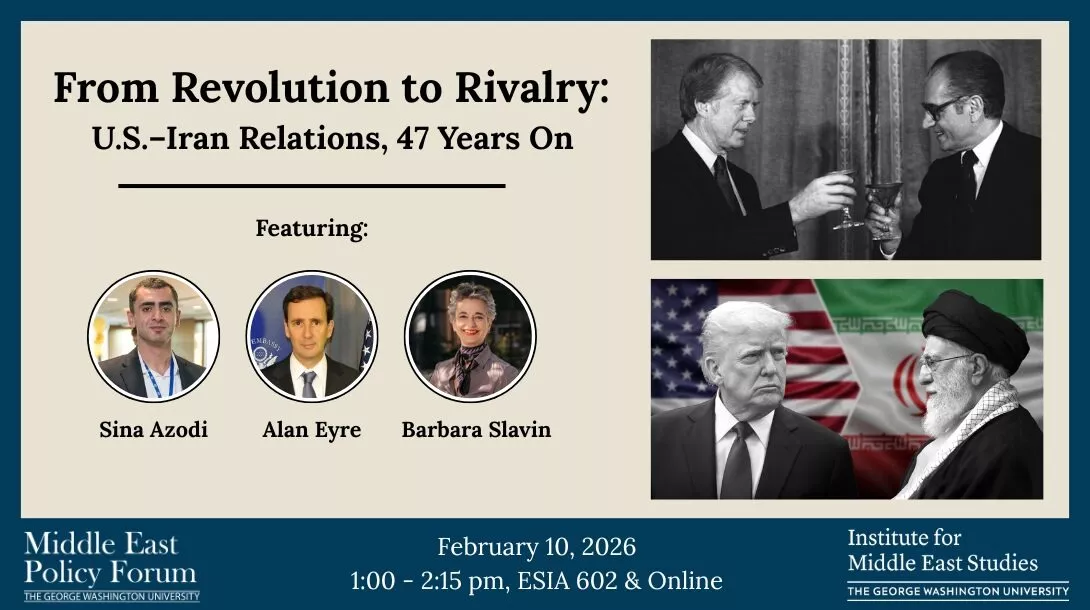
On the eve of the 47th anniversary of the Iranian revolution, the Middle East Policy Forum invites you to join Sina Azodi, Alan Eyre, and Barbara Slavin for their reflections on U.S.-Iranian relations today.
On February 11, 1979, the Pahlavi monarchy officially fell at the hands of revolutionaries, spurred by the triumphant return of the Ayatollah Khomeini ten days earlier. The moment marked the culmination of the Iranian Revolution, one of the most consequential popular movements in modern history. Shattering the Cold War alliance that had bound Washington and Tehran for decades, it transformed the relationship from a partnership to one defined by mutual hostility and persistent volatility. Our panel of experts will examine the revolution’s enduring legacy and why in the 47 years since, historical scars and contemporary failures have rendered reconciliation elusive.
All are invited to join the Middle East Policy Forum for this commemorative event with Sina Azodi, Alan Eyre, and Barbara Slavin. You can participate in this conversation in-person or virtually. This event is open to the public and media.
Sina Azodi Dr. Azodi’s research interests include international security, nuclear nonproliferation, Iranian politics and U.S.-Iranian relations. He previously worked as a research assistant at Princeton University’s Program on Science and Global Security and Woodrow Wilson International Center for Scholars. Dr. Azodi is a frequent commentator on both English- and Persian-speaking media, including BBC, Sky News, Al-Jazeera, TRT World, and i24. His analyses have appeared in Columbia University’s Journal of International Affairs, Bulletin of Atomic Scientists, Arms Control Association, Center for Strategic and International Studies, and Foreign Policy, and has been quoted by the New York Times, Washington Post, Spiegel, and Forbes. Dr. Azodi has published the chapter “The Fusion of Politics and Religion in Iran” in the edited book Political Islam in the Gulf Region. He is the author of forthcoming book “Iran and the Bomb: the United States, Iran and the Nuclear Question.” He earned his BA and MA in international affairs from the Elliott School of International Affairs at the George Washington University, and PhD from University of South Florida.
Alan Eyre is a Distinguished Diplomatic Fellow at the Middle East Institute and the founder and president of EyreAnalytics LLC. He retired from the US Foreign Service in September 2023 after a 40-year government career. Most of Alan’s government service related to the MENA region, with a focus on Iran. He was the sole US career diplomat to be a core member of the US nuclear negotiating team from its 2010 start to the 2015 Joint Comprehensive Plan of Action (JCPOA) agreement with Iran, serving as the team’s Iran subject matter expert and also as the State Department’s first Persian Language Spokesperson. He was also the first US diplomat to serve in the political section of the newly reopened US Embassy Kabul in late 2001. In addition, he served as Director of the Iran Regional Presence Office (IRPO) at US Consulate Dubai, the State Department’s main field office for monitoring Iran. His overseas tours include Nigeria, Syria, the UAE (twice), Azerbaijan, the United Kingdom, and Jordan, where in his final tour he served as Political Counselor. His only Washington assignment was as Director of the Office for Middle East and Asia in the Bureau of Energy Resources (ENR).
Barbara Slavin is a distinguished fellow at the Stimson Center in Washington and a lecturer in international affairs at George Washington University. Prior to joining Stimson, she founded and directed the Future of Iran Initiative at the Atlantic Council and led a bi-partisan task force on Iran. The author of “Bitter Friends, Bosom Enemies: Iran, the US and the Twisted Path to Confrontation” (2007), she is a regular commentator on US foreign policy and Iran on NPR, PBS and C-Span. A career journalist, Slavin served as a columnist for Al-Monitor; assistant managing editor for world and national security at the Washington Times; senior diplomatic reporter for USA Today; Cairo and Beijing correspondent for The Economist and as an editor at the New York Times Week in Review. She covered such key foreign policy issues as the US-led ‘war on terrorism,’ policy toward ‘rogue’ states, the Iran-Iraq war and the Arab-Israeli conflict. She has traveled to Iran nine times. Slavin also served as a public policy scholar at the Woodrow Wilson International Center for Scholars, where she wrote Bitter Friends, and as a senior fellow at the US Institute of Peace, where she researched and wrote the report, Mullahs, Money and Militias: How Iran Exerts Its Influence in the Middle East.



 Loading ...