
Subscribe
to receive news by email

Poll
Will the Trump Administration Shift U.S. Policy in Favor of Palestine?
- No (87%)
- Yes (13%)
 Loading ...
Copyright © 2026 Arab America
Go topPathbreakers of Arab America— Ralph Johns
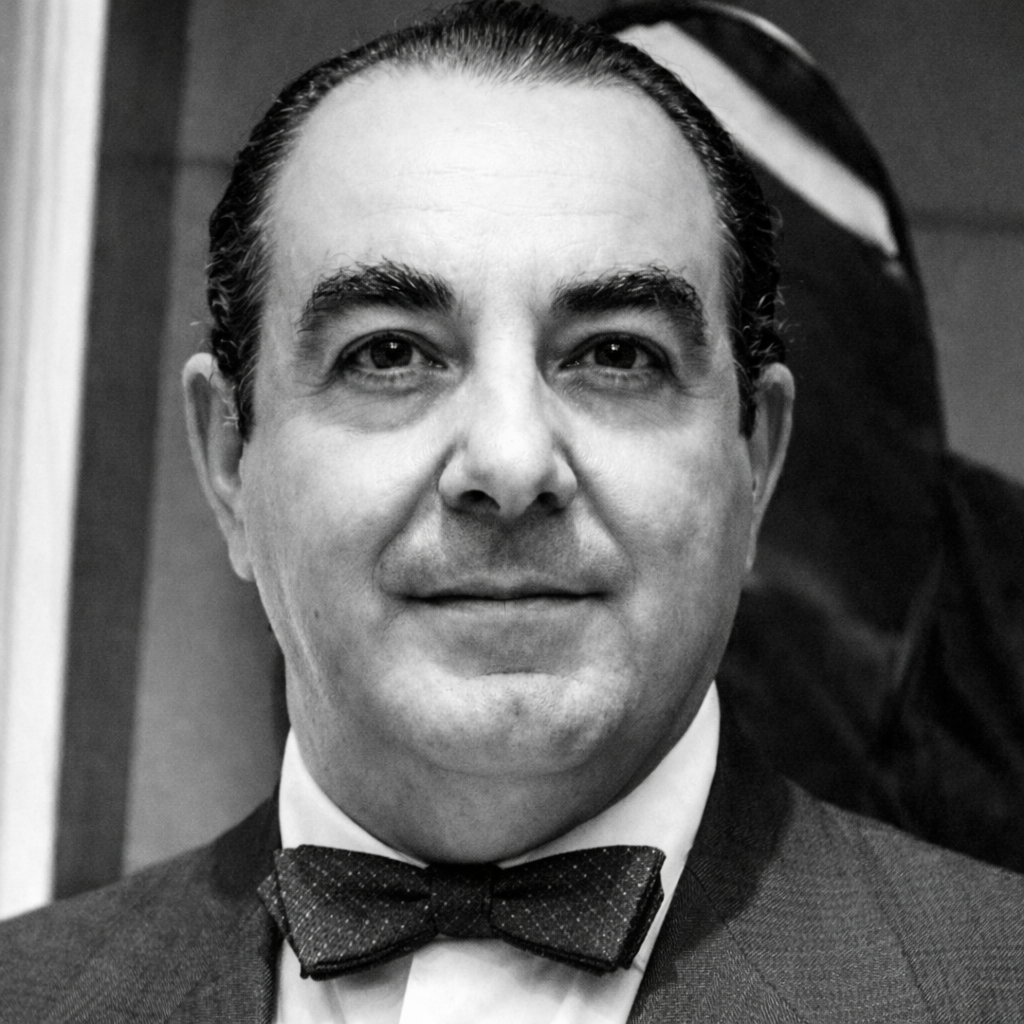
By: John Mason / Arab America Contributing Writer
This is the one-hundred and ninth in Arab America’s series on American pathbreakers of Arab descent. The series features personalities from various fields, including entertainment, business, sports, science, the arts, academia, journalism, and politics. Our one hundred and ninth pathbreaker is Ralph Johns, a son of Syrian Arab Christian immigrants who reached out and touched history through his role in the fight against segregation. Johns helped open a new front in the American struggle for civil rights by encouraging the 1960 Sit-in at a Woolworth’s store in Greensboro, North Carolina, by four Black students—known as “the Greensboro Four.” It is seen as a pivotal moment in the annals of the American Civil Rights Movement.
Johns contributed to a simple act of civil disobedience that galvanized the nation and accelerated the push for racial equality
Ralph Johns was born in New Castle, Pennsylvania, to Syrian immigrant parents on January 22, 1916. Details of his Syrian origin are sparse, except that his family was Christian, and his name was westernized. From high school, where he played football, Johns served in the Army Air Corps during World War II and was discharged at the Overseas Replacement Depot in Greensboro. He remained in Greensboro, where he opened Ralph Johns Clothier on East Market Street. Johns was a significant figure in the civil rights movement and a member of the NAACP, serving as vice president in the late 1950s.
Greensboro, home to North Carolina Agricultural and Technical State University, a public, historically black institution, meant that Johns’s store had black student customers. As early as the 1950s, he began posting messages opposing racism and segregation in his storefront window. He encouraged the black student customers to fight segregation and gave them advice and financial support during the 1960s.
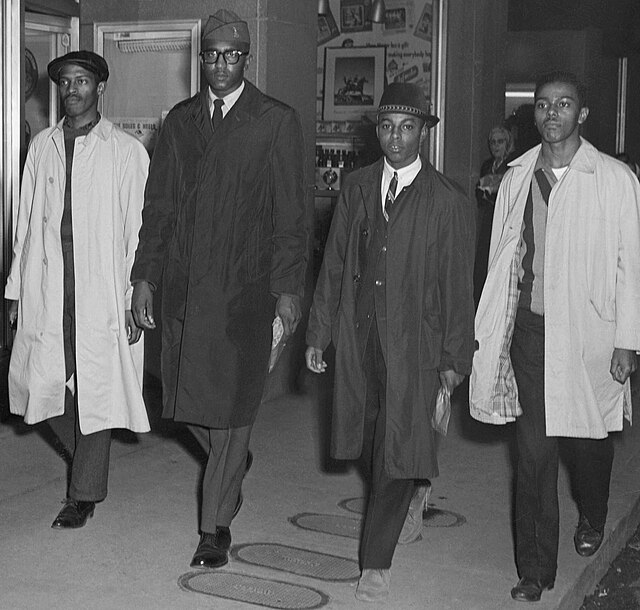
Among these students were the Greensboro Four. Johns is reported to have encouraged the students to challenge segregation and to have tipped off the press on the first day of the Sit-in at Woolworth’s. He was the first white person to join the local NAACP chapter. A news story in the mid-1960s reported that, with his business going broke and his marriage failing, Johns offered to exchange himself for American pilots being held in Vietnam. His offer made headlines all over the world.
When his store later went out of business, the Greensboro Voices Biography reported that Johns worked briefly as a reporter for the Carolina Peacemaker and for the Gate City Courier. He also worked with the Guilford County Office of Economic Opportunity. Johns remained active in the local civil rights movement until he moved to La Habra, California, in the mid-1970s. There, he worked as an associate publisher of a weekly newspaper, and refurbished his earlier,1930s period as a ‘bit’ actor. He returned to Greensboro in 1977 to help his second wife launch ‘The Courier,’ a tabloid publication. In commemoration of Johns’s role in the Greensboro civil rights movement, the community renamed a street in his honor. Johns died in California on October 2, 1997, at the age of 81.
Ralph Johns triggered a simple Sit-in at a ‘whites only’ lunch counter by the Greensboro Four, thus reaching out and touching history
The ‘Los Angeles Times’ wrote, “few know what Johns did in helping open a new front in the struggle for civil rights…Ralph Johns reached out and touched history. It was a fleeting caress, but we cannot forget the texture of the moment when he–a white merchant with a maverick streak wider than a freeway–helped four young black men walk into a Woolworth’s store in Greensboro, N.C., and sit down at the whites-only lunch counter.”
Johns encouraged his black student customers to fight segregation, and he provided financial support during the 1960 Greensboro Sit-in. His store was a focal point for the Sit-in. Johns’s involvement in the s and his advocacy for civil rights were instrumental in the movement’s success and the eventual desegregation of public facilities. For some time after the 1960s, Johns’s legacy continued to inspire and influence those who fight for civil rights and equality. As the ‘LA Times’ noted, “His story is a testament to the power of individual commitment and the collective efforts of the civil rights movement.”
In this story about Johns, it is of course important to know who the Greensboro Four were and to understand the moment in which their actions became critical to the civil rights movement. In the words of a ‘World History Edu’ report, “In the annals of the American Civil Rights Movement, certain events stand out as pivotal moments that galvanized the nation and accelerated the push for equality. The actions of the Greensboro Four in 1960 were one such moment, when a simple act of civil disobedience in a Woolworth’s store in Greensboro, North Carolina led to a wave of Sit-ins and protests across the South.”
When the four young men stopped by Johns’s store on the afternoon of Feb. 1, 1960, and told him they were going to Woolworth’s, Johns was surprised, he said. Again, according to the LA Times, “He had been proselytizing students from North Carolina Agricultural & Technical College and others about staging an action for about 10 years. There had never been any takers, and then, suddenly, he had the recruits he had sought for so long.”
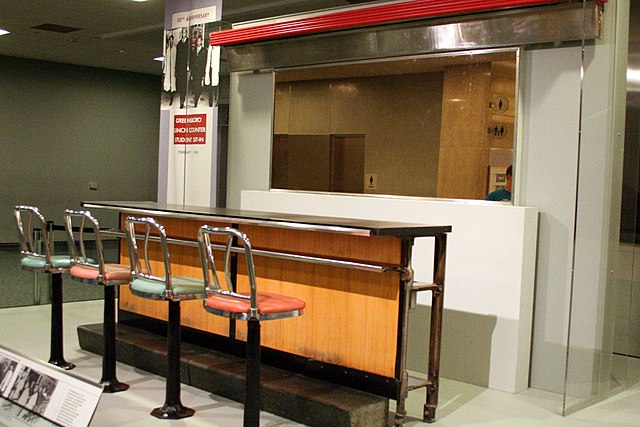
The Sit-in by the Greensboro Four itself is worth describing, both for its impact and its meticulous planning by Johns and the young men who became the Four. “On that fateful day, the Greensboro Four entered the Woolworth store in Greensboro. The young African American students from [the University] who took a bold step on February 1, 1960, were Ezell Blair Jr. (later known as Jibreel Khazan), David Richmond, Franklin McCain, and Joseph McNeil. After purchasing a few small items, they proceeded to the “whites-only” lunch counter and asked to be served.”
As expected, they were denied service due to their race. Rather than leaving, they chose to remain seated in peaceful protest, “drawing inspiration from the nonviolent resistance teachings of Mahatma Gandhi and Dr. Martin Luther King Jr.” Johns had already alerted local media, ensuring that their protest would be seen by a broader audience. As they remained seated, enduring harassment and threats, they became symbols of resistance against racial injustice.
John’s thinking about the underlying logic of a Sit-in was simple, though in its simplicity, brilliant. His explanation of it, again, according to the LA Times, was: “Every year from 1950, I used to ask the students who came into my store if they had any guts and they’d say, ‘ What do you mean?” Johns recounted. “Well, I say, at the Woolworth 5- and 10-cent store and at Kress (another retailer), you can walk in and buy pencils at one counter, you can buy all kinds of items at other counters, but right across, five feet away, there’s a lunch counter you can’t sit down and buy yourself something to eat. You have to buy (at the takeout window) but walk out. You can’t eat there; you’re not allowed to sit down and eat. And I say, this is supposed to be a public place, it’s not a private club. They’re taking your money at all the counters, but you can’t go to the lunch counter like a decent citizen.”
We end with what should be an account of a heroic Arab American but is in fact of someone who turns out to be a little-known persona who ran a men’s clothing shop in a southern city during what became a turbulent moment in American civil rights history. A few more quotes summarize the heroic part Ralph Johns and the Greensboro Four played in that historic moment:
–Who knew that “four naive students and a nonconformist retailer ended up setting their corner of the world on fire. Within days Sit-ins began in other cities and states as civil-rights organizations seized the tactic both as symbol and tool in the assault on segregation.”
–“Nationally, these and other protests ultimately led to the passage of the Civil Rights Act of 1964 and the Voting Rights Act of 1965, both of which assured the legal rights of blacks” and
–a quote from Johns himself: “All I want now is that someday the world will shake off this hypocrisy and this hate.”
Sources:
-“Johns, Ralph,” Greensboro VOICES Biography, 10/9/2008
-“Who were the Greensboro Four?,” World History Edu, 4/1/2024
-“Forgotten Rebel: Ralph Johns’ Stubborn Crusade for Civil Rights Cost Him Dearly, but Does Anyone Remember?” Los Angeles Times, 5/5/1989
-“How It All Began: The Greensboro Sit-in,” Miles Wilffa, 1970.
-“6 Ways Arab Americans Can Honor Civil Rights Activism on MLK Day,” Arab America, 1/16/2017
John Mason, Ph.D., focuses on Arab culture, society, and history and is the author of LEFT-HANDED IN AN ISLAMIC WORLD: An Anthropologist’s Journey into the Middle East, New Academia Publishing, 2017 and of his new novel, WHISPERS FROM THE DESERT: Zaki, a Little Genie’s Tales of Good and Evil (2025), under his pen name, Yahia Al-Banna. He has taught at the University of Libya in Benghazi, Rensselaer Polytechnic Institute in New York, and the American University in Cairo. John served with the United Nations in Tripoli, Libya, and consulted extensively on socioeconomic and political development for USAID and the World Bank in 65 countries.
The views and opinions expressed in this article are those of the author and do not necessarily reflect the position of Arab America. The reproduction of this article is permissible with proper credit to Arab America and the author.
Want more articles like this? Sign up for our e-newsletter!
Check out our blog here!