
Subscribe
to receive news by email

Poll
Will the Trump Administration Shift U.S. Policy in Favor of Palestine?
- No (87%)
- Yes (13%)
 Loading ...
Copyright © 2026 Arab America
Go topA Different Saudi Perspective
By: Emma Campbell / Arab America Contributing Writer
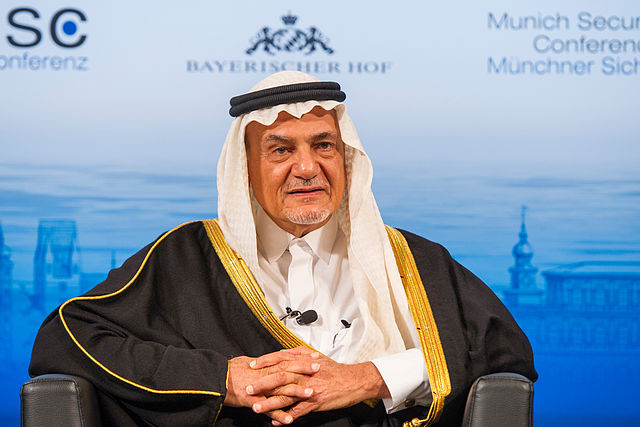
Saudi Arabia’s Crown Prince, Mohammed bin Salman, recently visited the White House on November 18. Their discussions ignited debates over the future of US-Saudi-Israeli cooperation. With the genocide in Gaza intensifying regional instability, political strains have rippled across the region. With the United States’ foreign policy narratives focusing on Israel, His Royal Highness Prince Turki Al-Faisal offers a different perspective. In this analysis, Arab America contributing writer Emma Campbell examines HRH Turki Al-Faisal’s alternative Saudi perspective on US-Saudi-Israeli relations amid worsening crises in Gaza.
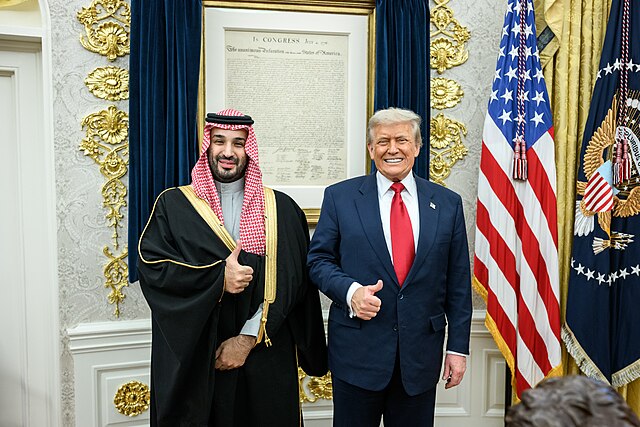
The Regional Stakes – MBS’s Visit with President Trump
With the Saudi Crown Prince’s visit to Washington, the agenda was packed and the stakes were high. The two sides created major security and economic deals, including Saudi Arabia’s commitment to buy nearly 300 US-made tanks and to deepen military cooperation. President Trump even declared Saudi Arabia a “major non-NATO ally,” giving the nation access to privileged US defense programs. Additionally, Crown Prince MBS pledged to boost Saudi Arabia’s investment in the US from $600 billion to $1 trillion.
This visit comes seven years after US intelligence implicated the Prince in the 2018 killing of journalist Jamal Khashoggi, during President Trump’s first administration. The controversial assassination has since strained US-Saudi relations. However, President Trump’s meeting with the Crown Prince signaled a willingness to overlook Saudi Arabia’s past human rights abuses in favor of security and economic cooperation.
Discussions on Israel and Palestine
The visit also led to questions from Israel. President Trump announced plans to sell F-35 stealth jets to Saudi Arabia. These military aircrafts could challenge Israel’s long-standing security edge; which is a key to US-Israeli relations. According to the Guardian, one of the most lasting principles of US-Israeli relations has been that “Israel will always get to buy the best military hardware, giving it a prized ‘qualitative edge’ over other US allies in the region”. President Trump dismissed the importance of this, making it clear that both Saudi Arabia and Israel will both get the best military equipment as they are both equally close to Washington. Additionally, President Trump insisted Israel was “aware” of the deal with Saudi Arabia and would be “very happy”. Despite this, Israel reportedly does not welcome this deal.
Amid these high-profile deals, the genocide in Palestine remains central. MBS emphasized that any normalization with Israel must include a credible path towards a Palestinian state. This stance signals that while Saudi Arabia is willing to increase relations with the United States and Israel, it still wants to keep Palestinian concerns central to its policy.
Prince Turki Al-Faisal’s Perspective
While MBS accelerated US-Saudi-Israeli engagement, HRH Turki Al-Faisal presents a different approach. Prince Turki has previously headed the General Intelligence Directorate (GID) and was Saudi Arabia’s ambassador to the UK and the Republic of Ireland. Following that, he was the ambassador to the US until his retirement in 2007. No longer holding any official government position, the Prince expressed his policy opinions more directly, as he demonstrated at the National Council on US-Arab Relations (NCUSAR) conference on November 18th.
During this conference, HRH stressed that strategic confusion and the absence of decisive global leadership compound regional instability from Gaza to Iraq, Syria, Lebanon, and Sudan. According to HRH, we need to bring back international order, and must frame the Middle East’s challenges as part of broader global governance failures – not isolated conflicts.
Gaza and Humanitarian Concerns
Central to Prince Turki’s analysis and opinions today is the genocide in Gaza, alongside Israel’s role as the oppressor. He describes this as the most dangerous challenge to the region, and frequently criticizes the decades of neglect Palestine has endured. Additionally, HRH blames the Western world’s double standards for this genocide, arguing that US support for Israel has eroded its credibility as a mediator. Through noting that “the people of the world do not accept the double standards of their leaders”, HRH warns that without a solution that recognizes Palestinian rights, the Middle East will remain exposed to ongoing crises.
HRH also frequently highlights the consequences of ignoring humanitarian law and international norms – particularly in Gaza. While condemning attacks by Hamas, he stresses that Israel’s “disregard for humanitarian values, norms, and laws” exacerbates instability and undermines peace efforts. For Prince Turki, long-term regional stability depends on principled diplomacy, respect for international law, and a two-state solution supported by the Palestinians themselves.
Prince Turki’s Thoughts
His perspective is one of restraint and long-term thinking: avoid transactional gains that deepen crises, insist on international legitimacy, and prioritize a stable, secure Middle East over rapid alignment with any single power.
Crown Prince Mohammed bin Salman vs. Prince Turki Al-Faisal: Policy Implications
The policy implications are clear. MBS’s meeting with Trump signals a shift in US-Saudi-Israeli relations. It emphasizes fast-tracked security, economic, and strategic gains. The approach raises questions about long-term stability and Palestinian rights. On the other hand, Prince Turki emphasizes that the complete responsibility for peace in the Middle East lies with the US. During the NCUSAR conference, he directly called on President Trump, stating “President Trump it is your turn to be that leader” and to lead the ceasefire to its 21st point, stopping the bloodshed. Looking ahead, Prince Turki signals that future US-Saudi-Israeli policy must balance strategic interests with principled diplomacy and offer a credible path toward Palestinian statehood to achieve lasting stability in the region.
Want more articles like this? Sign up for our e-newsletter!
Check out our blog here!