Subscribe
to receive news by email

Poll
Will the Trump Administration Shift U.S. Policy in Favor of Palestine?
- No (87%)
- Yes (13%)
 Loading ...
Copyright © 2026 Arab America
Go topA Way Out of the Iran War—Before It’s Too Late
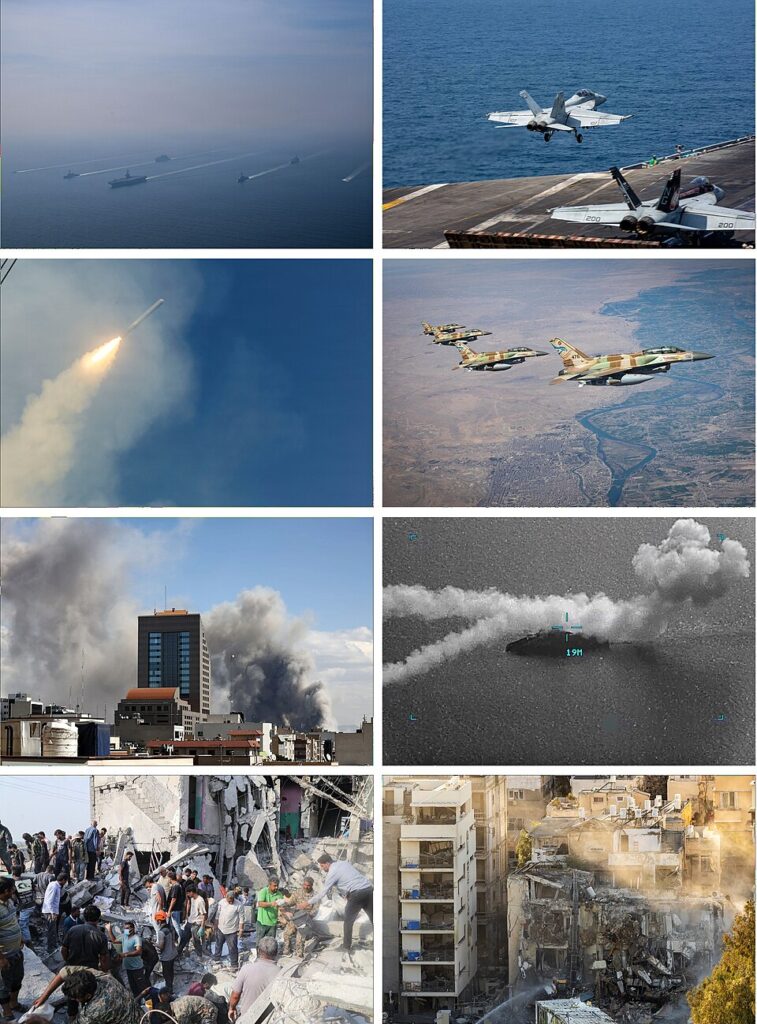
By: Ghassan Rubeiz / Arab America Contributing Writer
The war with Iran has entered a transitional phase, and Washington knows it — even if significant denial persists within Israel’s leadership. Vice President J.D. Vance has quietly emerged as the administration’s chief interlocutor with Iran’s parliamentary speaker M.B. Ghalibaf — a role that signals something important: the White House is searching for an exit from a conflict it can no longer sustain. Oil prices are punishing American consumers, munitions stockpiles are strained, and public opinion on both sides of the Atlantic is turning against the war. The question is no longer whether the United States and Israel can “win,” but whether they can avoid being dragged into a deeper quagmire in the Strait of Hormuz and beyond.
The commentariat is divided on what this moment means. In the Washington Post, Marc Thiessen insists that resolve will deliver victory — a view that reflects the shrinking but vocal minority of Americans who believe in unchecked national exceptionalism and have little patience for diplomatic compromise. Stephen Walt, writing in Foreign Policy, offers a darker verdict: Trump has turned the United States into a rogue state, practicing a mercantile militarism that is pushing the country toward the edge. Between these opposite opinions, Trita Parsi and George Beebe, also writing in Foreign Policy, propose a ceasefire scenario involving Russian mediation and phased Iranian sanctions relief. Their instinct is right, but their mechanism is flawed: Russia, mired in a grinding war in Ukraine, lacks both the legitimacy and the capacity to serve as a credible broker.
Washington’s own credibility has already taken a blow: its earlier 15-point proposal to Tehran — demanding the dismantlement of Iran’s missile program, the severing of all regional alliances, and sweeping restrictions on its sovereignty — read less like a negotiating opening than a demand for unconditional surrender. Iran rejected it, as any warring party with options would. If Washington and Israel are serious about an off-ramp, they must accept that a workable agreement looks nothing like capitulation — and that gambling with the future of the United States and the Middle East in pursuit of a maximalist fantasy is a risk no responsible leader should take. All three parties need a different path — one grounded in mutual concessions that allow each side to step back from the brink without humiliation.
A workable ceasefire must begin with the most urgent theater: the Strait of Hormuz. Iran’s intermittent closure of the waterway and its attacks on shipping have raised global energy prices and risked catastrophic escalation. In exchange for a verified halt to U.S. and Israeli strikes, Iran should commit to fully reopening the Strait and ending threats to maritime traffic, monitored by an international maritime task force or the United Nations. Washington and Israel would have a tangible achievement to present to their publics — restored global energy flows, without deploying additional ground troops.
A second key issue involves Iran’s nuclear program — ostensibly Israel’s highest concern. Tehran could agree to transfer its stockpile of enriched nuclear material to Russia or another mutually acceptable custodian under International Atomic Energy Agency supervision — not trusting Moscow as a political mediator, but using its existing technical role as a depository, with strict verification. In return, the United States and Europe would offer targeted sanctions relief conditioned on continued compliance. Washington gains a concrete nonproliferation win; Israel gains relief from what it calls an existential threat; Tehran can claim it preserved its nuclear infrastructure and avoided capitulation.
The third key component concerns Lebanon. Israel’s threat to reoccupy the south rests on the argument that Hezbollah’s military presence poses an unacceptable security risk — yet Israel itself continues to occupy Lebanese territory in violation of UN Security Council Resolution 1701, undermining any claim to be acting purely in self-defense. A credible ceasefire package must be reciprocal: Iran should commit to working with the Lebanese government on a phased integration of Hezbollah’s armed wing into the Lebanese Armed Forces or a newly constituted National Guard under state command, while Israel commits to a full and verified withdrawal from all occupied Lebanese territory. This would begin to normalize Lebanon’s security architecture, give the Lebanese state — for the first time in decades — genuine sovereignty over its own soil, and provide Israel with the border security it claims to seek.
The fourth and most consequential issue reaches beyond the Iran war itself. No regional settlement will hold if the Palestinian question remains an open wound. Writing in Jewish Currents, Jonathan Shamir argues compellingly that the Iran war is, at its core, about Palestine. A ceasefire agreement should include a commitment by all parties — Israel above all — to convene an international conference on the Arab-Israeli conflict, one that addresses Gaza’s reconstruction, the accelerating collapse of Palestinian civil life in the West Bank, and the future of the Abraham Accords. The Accords have become strategically hollow: normalization between Arab states and Israel cannot survive indefinitely while Gaza burns and the West Bank is steadily absorbed by Israel. Drawing Tehran into a multilateral process on this question reduces its incentive to play spoiler, while offering Arab states political cover to pursue normalization without abandoning their publics entirely.
The alternative is grim. Without a ceasefire, the United States and Israel risk sliding into a long war they cannot bear financially or politically. Iran will continue absorbing punishment while relying on asymmetric tools that neither Washington nor Jerusalem can easily neutralize. The region will remain trapped in a cycle of escalation that serves no one’s long-term interests. Vice President Vance’s emerging diplomatic role suggests that Washington understands the stakes, even if it cannot yet say so publicly — and even as Israel remains mired in denial of the quicksand it is approaching. A ceasefire built on achievable, mutual concessions is the only path that prevents disastrous escalation while allowing all sides to claim something real — and that opportunity will not remain open indefinitely.
Ghassan Rubeiz is the former Middle East Secretary of the World Council of Churches. Earlier, he taught psychology and social work in his country of birth, Lebanon, and later in the United States, where he currently lives. He has contributed to political commentary for the past twenty years and has delivered occasional public talks on peace, justice, and interfaith topics. You can reach him at rubeizg@gmail.com
The views and opinions expressed in this article are those of the author and do not necessarily reflect the position of Arab America. The reproduction of this article is permissible with proper credit to Arab America and the author.
Want more articles like this? Sign up for our e-newsletter!
Check our blog here!