Subscribe
to receive news by email

Poll
Will the Trump Administration Shift U.S. Policy in Favor of Palestine?
- No (87%)
- Yes (13%)
 Loading ...
Copyright © 2026 Arab America
Go topArab American Intellectuals in Early U.S. Universities
By: Laila Ali / Arab America Contributing Author
We live in an age of Arab American Studies, when ethnic and religious minorities are recognized for their influence on U.S. history and culture. We know the stories of waves of Arab migration to the United States, and the rich histories of Arab communities, such as in Toledo, Dearborn, and Chicago. But before mass migration transformed Arab American life in the 20th century, a small network of Arab scholars and writers gained access to American universities and literary circles. Their numbers were tiny compared to later generations, but their influence was not.
These Arab American intellectuals didn’t just shape Arab American history; they also changed the way the West studied history, religion, and culture, and their influence continues to reverberate today. You can find it in the fields and departments of Middle Eastern studies across U.S. universities, in world literature syllabi, and in channels of intellectual exchange between East and West. Here, I introduce five Arab intellectuals who influenced Arab and Western thought, primarily in the first half of the 20th century.
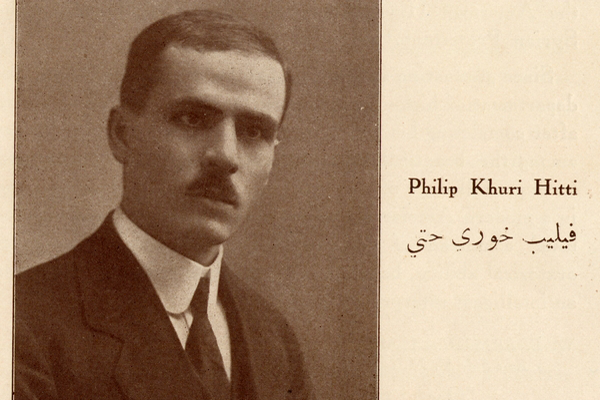
1. Philip Hitti (1886–1978)The Father of Arabic Studies in America
A “trailblazer” who is often referred to as the “father of Middle Eastern studies in America,” Philip K. Hitti was born in Lebanon and studied for his Ph.D. at Columbia University. He became a professor at Princeton University in 1919 and developed the leading American program in Arabic and Islamic studies over nearly 30 years. His classic History of the Arabs (1937) was the most influential English-language account of Arab history for generations, serving as a popular and scholarly reference for Western students. He also testified at a United States Congress hearing about Middle Eastern affairs and shaped the direction of U.S. foreign policy debates. Hitti’s professionalization of Arab history not only provided Arab Americans with academic authority and legitimacy, but also helped to dispel Western notions of a backward or stagnant “Orient.”
2. Ameen Rihani (1876–1940): The Bridge-Builder
Ameen Rihani may not have been a university professor, but he was part of the New York intellectual and literary scene of the early 20th century and a frequent lecturer at American campuses. He has been called the “founding father of Arab American literature.” His novel The Book of Khalid, published in 1911, is considered to be the first English-language novel written by an Arab American.
The Book of Khalid was innovative in ways that remain influential to this day. It mixed Arabic mystical Sufi traditions with Western literary forms and Rihani’s own brand of radical critique. Rihani traveled frequently between the U.S. and Arab East, and his lectures and essays called for democratic reform at home in the Arab world while also pushing Westerners to “look beyond the false picture of the Orient.” His impact can be felt as both an introducer of Arab thought to the West and as a shaper of Arab reformist philosophy with Western liberal ideals and educational training. He was a model for the Arab intellectual who offered important contributions to global modernity.
3. Abraham Mitrie Rihbany (1869–1944): Interpreter of the East Abraham
Rihbany was a less well-known figure, but he also came to the United States from Syria in the early 20th century. He was a professor of comparative religion and philosophy at the Meadville Theological School in Pennsylvania. Rihbany’s 1916 book The Syrian Christ focused on the cultural and linguistic context of the New Testament and served as an intervention in American Christianity. He argued that Western Christians had lost touch with the Semitic origins of their faith. His impact on American theology was significant.
Rihbany’s work also challenged Western Christians to read the Bible through an Eastern lens, reshaping their understanding of their own faith. The book was popular and influential, and Rihbany also gained public attention for speaking out on behalf of Arab independence at the Paris Peace Conference. He was a model for Arab Americans as an intellectual and a religious figure who could influence U.S. international politics in addition to academic life.
4. Evelyn Shakir (1938–2010): Founding Scholar of Arab American Literature
A slightly later generation but a direct inheritor of early Arab American intellectual life was Evelyn Shakir. She was the first scholar to articulate Arab American literature as a specific field of study and wrote and taught extensively on the topic. A professor of English, she was also born to Lebanese immigrant parents in Boston. Her works Bint Arab (1997) and Remember Me to Lebanon (2007) both analyzed Arab American women’s cultural negotiations and introduced her own personal narratives into those histories. In doing so, she helped to institutionalize Arab American literary studies in American academia and ensured that the intellectual contributions of the likes of Rihani would be recognized in the classroom. But Shakir’s work also had an impact beyond Arab Americans by expanding the study of U.S. ethnic literature and influencing feminist and postcolonial theory.
5. Mikhail Naimy (1889–1988): Philosopher of the Mahjar
The last important figure I am highlighting is Mikhail Naimy, a Lebanese émigré writer and critic who helped to found the first Arab American literary society, the Pen League, in 1920. Naimy was a close friend of Ameen Rihani, and the two men, with Elia Abu Madi, formed the nucleus of the Pen League. Educated in the U.S. and Russia in both theology and literature, Naimy had a very cosmopolitan perspective that he brought to his writings.
His best-known work, The Book of Mirdad (1948), a spiritual allegory that Naimy wrote in English, became a classic of 20th-century mystical literature, and was admired and read by non-Arabic speaking audiences as well. He also wrote and published essays and fiction in both English and Arabic, and he championed a literary modernism that departed from traditional forms. By articulating a distinctly modern philosophy of spiritual humanism, Naimy shaped Arab American literary identity and broader literary and philosophical trends.
A Lasting Influence
Each of these five figures, in their own way, was influential in both Arab and Western intellectual life, and they had a significant influence on American history. From Hitti’s professionalization of Middle Eastern studies to Rihani and Naimy’s literary modernism, Rihbany’s theological interventions, and finally Shakir’s institutionalization of Arab American literature, they transformed both Arab and Western thought. Together, these individuals remind us that Arab intellectual life has been central to shaping American ideas, institutions, and culture, an influence that continues to resonate far beyond their time.
Want more articles like this? Sign up for our e-newsletter!
Check out our blog here!