
Subscribe
to receive news by email

Poll
Will the Trump Administration Shift U.S. Policy in Favor of Palestine?
- No (87%)
- Yes (13%)
 Loading ...
Copyright © 2026 Arab America
Go topArab American Leadership on the Ballot: the November 4 Election
By: Laila Ali / Arab America Contributing Writer
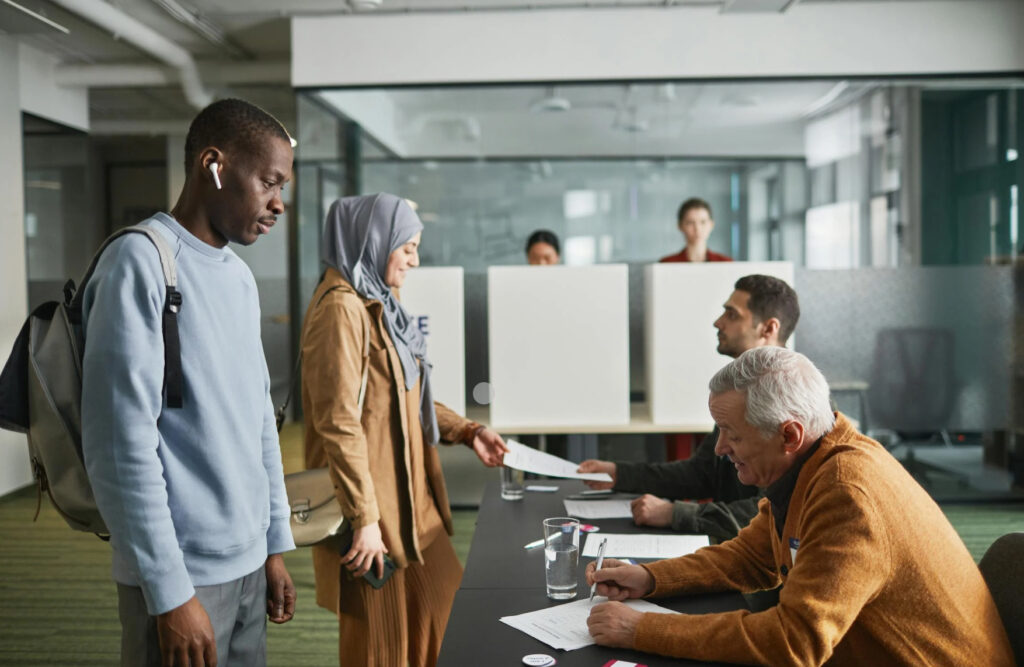
November 4 municipal elections are underway across Michigan, where two cities, Dearborn and Hamtramck, are currently center stage. Home to some of the largest Arab American populations in the country, the two neighboring municipalities have been an eco center for Arab American political life in the United States.
As local elections enter their final stretch, a new generation of candidates has emerged in both cities. Arab American community members are casting their votes and participating in the political process in droves, solidifying civic engagement as a driver of power and influence in years to come.
Dearborn and Hamtramck: Arab American Candidates to Watch
Dearborn
After a term of reform, Mayor Abdullah Hammoud, Michigan’s first Arab and Muslim mayor, is seeking reelection. A Lebanese American, former state legislator, and author of Dearborn’s first public health department, Hammoud has a record of retooling local government in Michigan’s Arab American heartland. His office has addressed long-standing flooding problems, expanded small-business development, and improved walkability and traffic flow in commercial areas. Hammoud’s mayoral candidacy, in some ways, is a referendum on four years of local government experience and an indication that Arab American mayors are becoming normalized in the country’s leading cities.
Hammoud is joined in Dearborn’s municipal races by a slate of other council candidates, including some who are also running for reelection. Council President Michael Sareini, and Councilman Mustapha Hammoud, both Lebanese American, are running and have been instrumental in pushing policy priorities on economic equity and transparent budgeting. City Clerk candidate Sami Elhady, also running, has drawn attention, showcasing how the local administration has been diversifying at all levels.
Hamtramck
In Hamtramck, a few miles away, Yemeni American engineer Adam Alharbi is running for mayor of the city. Hamtramck is known for electing the first Muslim-majority city council in U.S. history. Alharbi is running in a city that has become a national model of multicultural democracy. He is continuing a tradition of immigrant-driven public service, expanding the reach of Arab Americans. Someone often working on civic and policy discussions, Alharbi has also served as a council member on the city’s Sustainability and Affordability Advisory Board.
The Significance of these Races
This wave of Arab American candidates in Dearborn and Hamtramck mirrors a broader evolution of Arab American politics and identity. In the mid-to-late 20th century, when many of the first Arab immigrants settled in the Michigan cities, community members faced obstacles in access to representation at the state and national level. Now, they not only vote at some of the highest rates, but also sit at the table to lead policy decisions on topics from infrastructure to health to housing to education. In other words, Arab American politics is shedding the weight of symbolism and is instead centering on public service and results.
The role of city and town leadership may feel pedestrian to the broader politics of the country. But for those who live in local jurisdictions, it is those policies that make the difference in the streets where people live. Arab American community members, a multigenerational and often multilingual population, are directly affected by policies like police training and recruitment, street maintenance, economic development and investment, and language access in public meetings. For Arab Americans, they feel more included in the policy discussions directly impacting their lives.
Community Engagement & Representation
As is the case with the rest of the American electorate, a challenge for Arab American voters in local elections is low turnout. A range of community groups, including student coalitions and faith-based leadership, have been working to engage residents and encourage participation. “Our votes are our voice, and our unity is our power,” read an editorial this year in The Arab American News. As the newspaper added, Arab American voters are not only making a statement about their communities but also about broader issues that affect all residents.
On November 4, every ballot cast in Dearborn and Hamtramck will have a say in their city. For many young Arab American voters in the region, watching the leadership of Hammoud, Baydoun, Ahmad, and Alharbi, they have new role models to look up to: showing that civic engagement can begin at home and that representation has meaning not just for Arab Americans but for all who value equity and justice.
Arab American Civic Engagement: Dearborn and Hamtramck in a Broader Context
The broader significance of these municipal elections is that they mark a passing of the torch. No longer are first- or second-generation Arab immigrants fighting for representation in the diaspora. The children and grandchildren of factory workers, dry cleaners, engineers, grocers, community organizers, and small-business owners now have a seat at the table in the policy-making process that directly affects their hometowns.
As residents of Dearborn, Hamtramck, and cities across the country go to the polls on November 4, the choice may seem limited to candidates and administrative platforms. But voting on that day is also a vote on what kind of democracy residents want to build and what role heritage and service can play in shaping it. A democracy in which public servants are evolving to represent all Americans.
Want more articles like this? Sign up for our e-newsletter!
Check out our blog here!