
Subscribe
to receive news by email

Poll
Will the Trump Administration Shift U.S. Policy in Favor of Palestine?
- No (87%)
- Yes (13%)
 Loading ...
Copyright © 2026 Arab America
Go topArab American NGOs Fill Gap After UNRWA Aid Cut
By: Fayzeh Abou Ardat / Arab America Contributing Writer
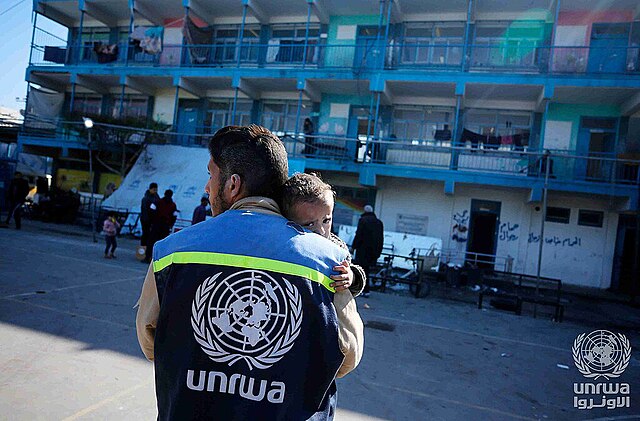
Aid to millions of Palestinian refugees was disrupted in 2024 when the United States stopped supporting the United Nations Relief and Works Agency (UNRWA). Important services including healthcare, food, and education were put in danger as a result of the decision. Nongovernmental organizations (NGOs) in the Arab American community swiftly stepped in and mobilized advocacy networks and resources in response. In addition to addressing pressing humanitarian needs, their work demonstrated the increasing power of activism led by diaspora members in American politics.
Community Mobilization and Emergency Relief
In order to meet pressing needs, Arab American NGOs quickly shifted their focus, including United Palestinian Appeal (UPA), American Near East Refugee Aid (ANERA), and the American-Arab Anti-Discrimination Committee (ADC). For instance, ANERA increased the scope of their food distribution initiatives in Gaza and Lebanon by obtaining donations from partner organizations and communities in the United States. By using existing infrastructure, ANERA was able to provide continuity of key services such as medical delivery, nutrition programs for children, and vocational training for young adults.
These organizations also profited from grass-roots financing. Local mosques, Arab cultural institutions, and student unions across the United States organized contribution drives, portraying the situation as both a humanitarian and a social responsibility. Social media campaigns boosted these efforts, with viral hashtags linking Palestinian problems to wider themes of racial justice and human rights.
Equally crucial was the reaction time. Whereas foreign bureaucracies can take weeks or months to adjust to new funding streams, Arab American NGOs may move quickly, using community trust and donor networks. Their reaction provides a brief lifeline for refugees whose existence is dependent on continuous assistance.
Advocacy, Political Pressure, and Visibility
While direct humanitarian aid was critical, Arab American NGOs also played a political role, opposing the United States’ suspension of financing. Advocacy organizations portrayed the decision as a moral and political move that unfairly harmed disadvantaged communities. The Arab American Institute (AAI) lobbied politicians, circulated petitions, and formed partnerships with faith-based and human rights organizations.
Arab American college students were particularly engaged in promoting these activities. They attempted to emphasize the humanitarian repercussions through university rallies, teach-ins, and solidarity activities, while also tying it to larger discussions about US foreign policy in the Middle East. These lobbying efforts did not necessarily reverse the funding freeze, but they maintained Palestinian concerns in the public eye when they might otherwise have gone unnoticed.
Arab American NGOs also tried to redefine narratives in mainstream media. They attempted to challenge representations of help to Palestinian refugees as support for extremism by writing op-eds, organizing webinars, and collaborating with the media. This narrative shift was critical because it emphasized the humanitarian character of UNRWA’s operations, including education, healthcare, and assistance, rather than security-driven discourse
Long-Term Implications and the Role of Diaspora
Arab American NGOs’ efforts extend beyond short-term aid. They underscore the growing importance of diaspora groups in influencing humanitarian environments. Arab American groups illustrated how diasporic generosity and activity may serve as a counterweight to state policy by stepping in where the US government had left off. This empowerment of civil society may inspire other diaspora groups to play a more active role in international issues.
At the same time, the strong dependence on Arab American NGOs highlights structural flaws. Governments and multilateral agencies provide vast resources, which community-based groups cannot entirely replace. Instead, their contributions serve as temporary measures, buying time and alleviating misery while larger political struggles play out. Leaders of these NGOs regularly emphasize that their work should not exonerate nations of their international legal obligations.
The incident also has consequences for US political politics. Arab Americans, who have generally been underrepresented in policy talks, are increasingly expressing their participation in humanitarian and political arenas. Their mobilization against UNRWA financing has strengthened a shared identity based on cultural heritage and civic involvement. For many, the effort to support Palestinian refugees overseas is related to movements for justice, fairness, and acknowledgment in the United States.
Conclusion
The suspension of US financing for UNRWA was more than a monetary setback; it was a political statement with far-reaching humanitarian implications. However, it spurred an extraordinary mobilization by Arab American non-governmental organizations (NGOs), whose efforts guaranteed that Palestinian refugees did not lose help abruptly. By delivering help, raising awareness, and contesting political narratives, these groups reinforced the value of diaspora-led humanitarianism during times of crisis.
Their work demonstrates a community’s resilience in the face of political desertion. While NGOs cannot alone address the structural reasons of relocation or underfunding, their participation serves as a reminder that when governments stand back, civil society can and does step forward. In the case of Arab American NGOs, that step forward was both a show of sympathy with Palestinians overseas and a proclamation of agency at home.
Want more articles like this? Sign up for our e-newsletter!
Check our blog here!