
Subscribe
to receive news by email

Poll
Will the Trump Administration Shift U.S. Policy in Favor of Palestine?
- No (87%)
- Yes (13%)
 Loading ...
Copyright © 2026 Arab America
Go topThe Rise of Arab and Muslim Political Power and Representation in 2024 and Beyond
By: Laila Mamdouh / Arab America Contributing Writer
In the wake of the 2024 U.S. election, one of the most definite outcomes was the undeniable rise in political participation and representation among Arab and Muslim Americans. Once perceived as marginal or politically fragmented, they are now emerging as an increasingly organized and influential group, especially among younger voters who are reshaping local elections and sending shockwaves through national politics. This shift did not come out of nowhere. Rather, it was driven by frustration with U.S. foreign policy, disillusionment with the two-party system, and the growing strength of community organizing and youth-led activism.
Disillusionment and Foreign Policy: Why Arabs and Muslims Mobilized
For decades, Arab and Muslim Americans leaned heavily Democratic, especially after the post-9/11 rise in Islamophobia and Republican foreign interventionism. However, by 2024, many felt that neither party was addressing their core concerns, particularly regarding the ongoing U.S. support for Israel in its war on Gaza. The Biden administration’s firm stance during the Israel–Hamas conflict deeply alienated Arab and Muslim voters. A September 2024 poll by the Arab American Institute found the community evenly split between Republicans and Democrats for the first time, 38% each, signaling a seismic shift in political alignment.
Voting as Protest: A Shift at the Ballot Box
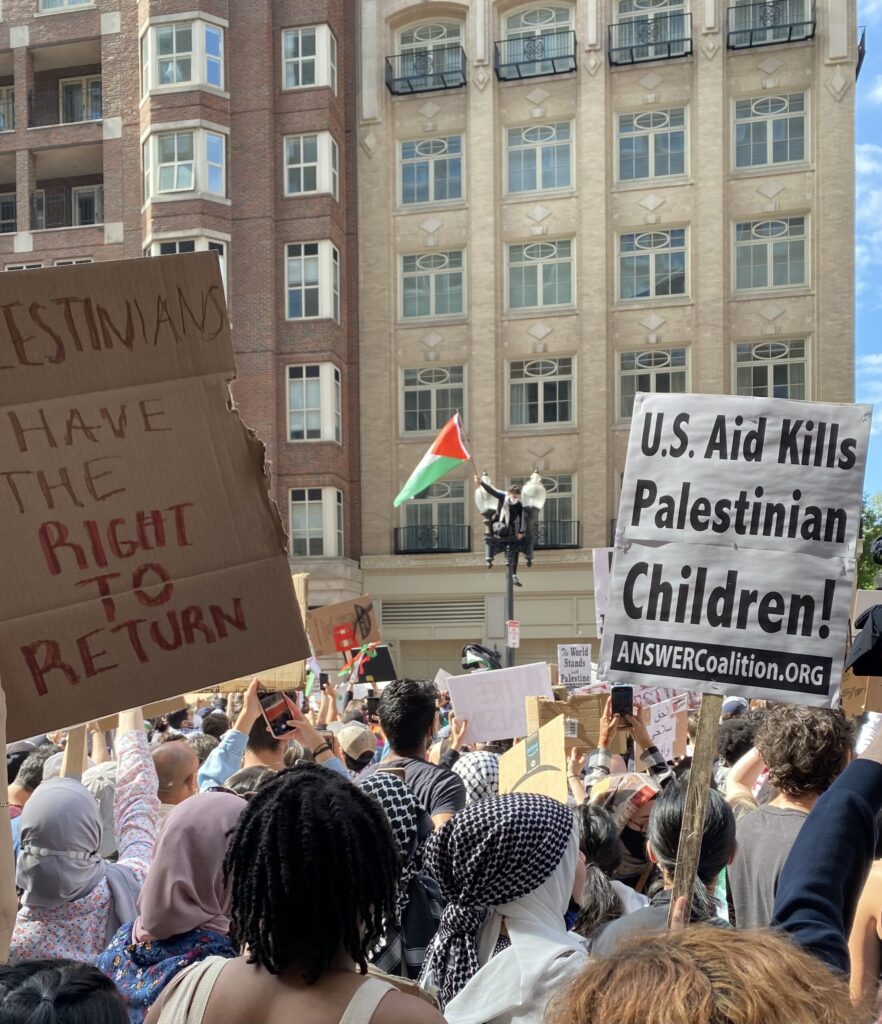
This wasn’t just theoretical discontent; it played out at the ballot box. In Michigan, home to one of the largest Arab American populations in the country, thousands voted “uncommitted” in the Democratic primary as a form of protest. In the city of Dearborn, nearly 42% voted for Donald Trump, and another 18% backed Green Party candidate Jill Stein, leaving Democratic support trailing behind. According to Emgage, a Muslim civic engagement organization, the 2020 election already saw record Muslim voter turnout at 71%, but 2024 marked a turning point in how and why they voted. Rather than being driven solely by domestic policy, the community responded powerfully to foreign policy failures, particularly those affecting Palestinians.
This growing disillusionment extended beyond just foreign affairs. As American political discourse became increasingly polarized and performative, many Arab and Muslim voters felt that the traditional Democratic and Republican frameworks no longer represented them. Voters began making choices rooted in values of human rights, international justice, and community empowerment rather than partisan loyalty. As one Yemeni-American voter told The Washington Post, “We’re not voting for the party anymore. We’re voting for the people who see us.”
Grassroots Power: Youth Movements, Organizing, and Mobilization
Much of this change has been driven by young Arab and Muslim Americans who have embraced political engagement as a tool for accountability and representation. Organizations like Yalla Vote and Million Muslim Votes helped lay the groundwork with extensive voter registration drives and education campaigns, creating a political environment that mobilized thousands of first-time voters.
At the same time, student-led protests across college campuses demanding a ceasefire in Gaza gave Arab and Muslim youth a powerful national platform. From New York to California, demonstrators not only raised awareness but also transformed into political actors themselves, hosting teach-ins, lobbying officials, and organizing local elections around these issues. While U.S. foreign policy may appear unchanged on the surface, the political cost of ignoring Arab and Muslim voices has grown significantly.
From Protest to Power: Local Wins and National Momentum
The impact of Arab and Muslim Americans is making its strongest mark in local elections, where change is growing rapidly. In a landmark moment, Zohran Mamdani, a Muslim, Ugandan-born South Asian progressive, won the 2025 Democratic mayoral primary in New York City. His campaign was powered by grassroots support from youth, immigrants, Muslims, and South Asians, and marked a turning point in the community’s relationship with political power. According to The Guardian, his victory is “a reflection of a city and country that is rapidly diversifying and demanding change.”
Mamdani’s candidacy wasn’t a coincidence; it was part of a broader movement. In Dearborn, Michigan, Mayor Abdullah Hammoud has already established a powerful model of leadership rooted in the Arab and Muslim community’s needs. Hammoud was among the first to back the “uncommitted” protest vote in Michigan, demonstrating how local leaders can use electoral power to challenge national policy decisions.
Meanwhile, national organizations such as CAIR and Emgage have significantly expanded their influence. CAIR’s 2024 exit polling presented not only shifts in voter behavior but also growing political awareness across generations. Even traditionally Republican-leaning groups like the Republican Muslim Coalition helped mobilize voters on both sides, ensuring that Muslim concerns were heard across the political spectrum.
A Slow but Growing Shift in American Politics
While America’s official stance on foreign policy has remained largely unchanged, the political landscape is shifting beneath the surface. Candidates like Mamdani are redefining what representation means, not just for Arab and Muslim communities but for all marginalized groups seeking a voice in U.S. politics.
The effects of this transformation aren’t limited to individual cities. They’re building momentum that could shape national politics in years to come. With a generation of politically engaged youth, rising community leaders, and increasing pressure on lawmakers to address foreign and domestic issues affecting Arabs and Muslims, the question arises: Could we see the first Arab or Muslim American president in our lifetime?
From Margins to the Mainstream
While that future remains uncertain, the groundwork is being laid today. Arab and Muslim Americans are no longer passive participants in American democracy. They are organizers, donors, candidates, and above all, voters. They are using their voice not just to protest, but to elect. And if 2024 is any indication, their influence is only just beginning.
The 2024 election cycle marked a turning point for Arab and Muslim American political engagement. Catalyzed by U.S. foreign policy in Gaza and fueled by deep dissatisfaction with both major parties, these communities have emerged more unified, organized, and determined than ever before. From grassroots mobilization to historic mayoral campaigns, the shift is no longer about visibility; it’s about power. And as the next generation continues to lead protests, run for office, and hold political parties accountable, the question isn’t if they’ll shape America’s political future; it’s how soon.
Want more articles like this? Sign up for our e-newsletter!
Check out our blog here!