

Subscribe
to receive news by email

Poll
Will the Trump Administration Shift U.S. Policy in Favor of Palestine?
- No (87%)
- Yes (13%)
 Loading ...
Copyright © 2026 Arab America
Go topAt Mar-a-Lago, Gaza Phase Two Announced with a Warning and an Embrace
By: Ghassan Rubeiz / Arab America Contributing Writer
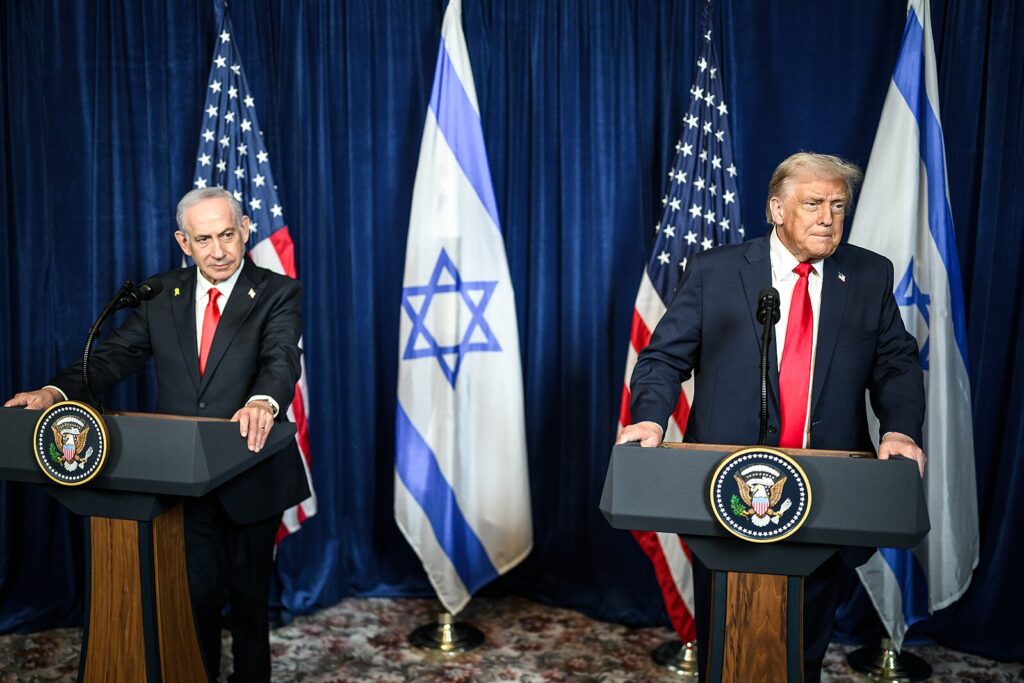
President Donald Trump operates under the assumption that American power can impose solutions across multiple global crises simultaneously – from Gaza and Lebanon to Ukraine and Venezuela. Today, during his Christmas break at Mar-a-Lago, he hosted Israeli Prime Minister Benjamin Netanyahu to discuss the Middle East, following yesterday’s inconclusive meeting on Ukraine-Russia that produced modest progress but no breakthrough.
The two leaders met with divergent tactical priorities but similar strategic objectives. Trump seeks diplomatic wins that demonstrate American influence and personal benefit without attention to fair dealing and justice. Netanyahu aims to secure American support for intensified military campaigns against what he terms “terrorist structures” across the region, in particular Iran, Hamas, and Hezbollah. Both agree on promoting Arab-Israeli normalization while sidelining Palestinian political rights and self-determination. Both have undermined their neighbors yet have claimed to champion peace.
The two leaders operate under severe geopolitical constraints. Trump faces mounting domestic pressures over trade and immigration policies, starting to lose key Republican advisors and supporters (such as popular commentator Tucker Carlson and ex-US Representative Marjorie Taylor Greene). His foreign policy activism contradicts his “America First” campaign promises. His relationships with Arab Gulf states complicate unconditional support for Israel. Midterm electoral concerns loom as his economic policy falters.
Netanyahu confronts his own political troubles. Domestically, he’s blamed for prolonging the war, failing to secure hostage releases efficiently, and falling short of his promises to eliminate Hamas and Hezbollah. International war crimes indictments shadow him. With October elections approaching and criminal investigations ongoing, he cannot afford to lose Trump’s support. Moreover, he is blamed for Israel’s deepening global isolation.
What has the meeting produced?
The Mar-a-Lago encounter restored near-perfect alignment between the Trump administration and Netanyahu’s rightwing government in line with their mutual benefit. Trump has chosen to ignore Israel’s foot-dragging on the latest Gaza ceasefire, which started three months ago. In a press conference, Trump declared Netanyahu to be indispensable, claiming that without his leadership and Washington’s support, Israel “might not have existed any longer.” In return, Netanyahu announced Trump will receive Israel’s highest honor for his “contributions to the Jewish people.”
Yet beneath the mutual praise, diplomatic substance remaines thin. Trump announced vague plans for Gaza’s “second phase” of the US-sponsored ceasefire agreement – a Multinational Stabilizing Force, a Palestinian technocratic committee to govern the enclave’s western half, and a forthcoming “Board of Peace” to supervise Gaza’s transition. No timetable for Israeli withdrawal was mentioned, leaving only 47% of the Strip to 2.3 million Palestinian residents while construction of housing and infrastructure proceeds on the Israeli-controlled side. Hamas “will have a very short time” to disarm.
Critical questions were left unanswered: how will Hamas be disarmed? Trump warned that the intended stabilizing forces “will be eager to wipe out Hamas” if it refuses to surrender arms – hardly a formula for sustainable peace. On the West Bank, where violence and annexation accelerate, the two leaders simply “agreed to disagree” without elaboration. Is Palestine’s future lost?
Trump urged Netanyahu to “get along” with Syria’s new regime, though details remained undisclosed and Israel’s violations of the ceasefires in Syria, Lebanon, and Gaza were ignored. Iran received threats to halt its nuclear program and long-range missile development, with warnings that Washington would join Israel in strikes against the Islamic Republic if Tehran refuses to engage in peace talks.
In the press conference there was a veiled threat to Lebanon’s Hezbollah, but for the moment the focus of Trump-Netanyahu’s rage seems to be on Iran and Hamas.
The outcome of this year-end warm encounter-the fifth this year- was discouraging: restoration of self-serving relations with threats to forces of resistance. Palestinian rights were blatantly ignored. Pacification stood for real peace. Ceasefire revival was proclaimed dramatically yet remains procedurally hollow – heavy on pronouncements, light on enforceable, feasible mechanisms.
Two embattled leaders have shored up their political flanks while deferring the hard work of genuine diplomacy. Gaza phase two is revived with a warning and an embrace.
Ghassan Rubeiz is the former Middle East Secretary of the World Council of Churches. Earlier, he taught psychology and social work in his country of birth, Lebanon, and later in the United States, where he currently lives. He has contributed to political commentary for the past twenty years and has delivered occasional public talks on peace, justice, and interfaith topics. You can reach him at rubeizg@gmail.com
The views and opinions expressed in this article are those of the author and do not necessarily reflect the position of Arab America. The reproduction of this article is permissible with proper credit to Arab America and the author.
Want more articles like this? Sign up for our e-newsletter!
Check our blog here!