

Subscribe
to receive news by email

Poll
Will the Trump Administration Shift U.S. Policy in Favor of Palestine?
- No (87%)
- Yes (13%)
 Loading ...
Copyright © 2026 Arab America
Go topBreaking the Bench: Arab Americans in Law
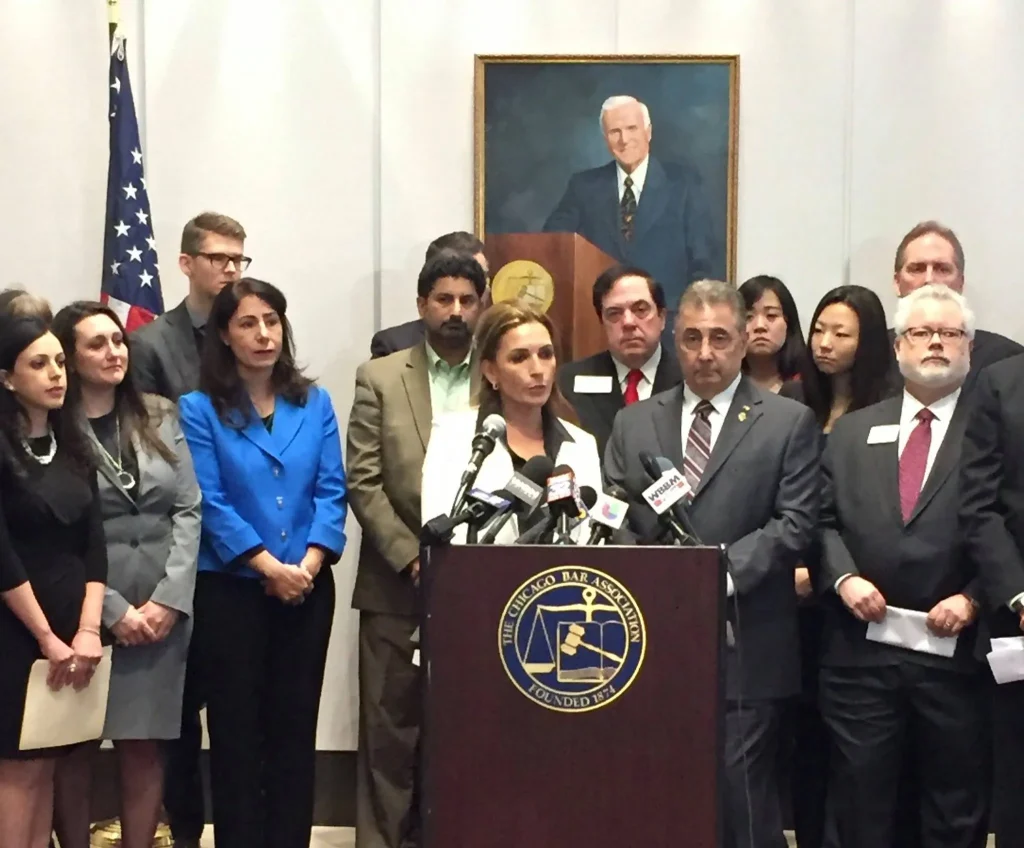
Photo Credit: National Arab American Bar Association
By: Laila Ali / Arab America Contributing Writer
In over 150 years of civic participation in American life, Arab Americans have fought long and hard to find our collective voice. As business leaders, physicians, academics, and community activists, we have made profound contributions to the United States. But for years, the field of law was a glaring exception to that trend. In America’s courtrooms, among its law books, and in the marble halls of Congress, Arab Americans were once a rarity. Not anymore. From the nation’s first Arab American judges to the recent founding of the Palestinian American Bar Association in the U.S., Arab Americans are making our voices heard in law and justice. We are breaking the bench.
Early Barriers and Trailblazers
As the first Arab immigrants to arrive in the United States in the late 19th and early 20th centuries, pioneers often came with nothing more than the clothes on their backs and hope in their hearts. They arrived, and eventually settled, in Michigan, New York, California, and other hubs where they laid the foundation for the Arab American communities of today. But finding careers in law, in fields that demanded cultural capital, advanced education, and acceptance from the professional establishment, was challenging.
Arab Americans eventually began to break the glass ceiling in law. One of the most notable early Arab American judges was Charlene Medley Elder, appointed to the Wayne County 3rd Circuit Court in 2006. As the first Arab American and first Muslim woman to serve on that bench, her appointment was more than just personal; it was symbolic of Arab Americans’ growing place in the fabric of American civic life.
Later on, figures like George Kasem, one of the first Arab Americans elected to Congress in 1958 and a lawyer by training, brought their legal knowledge to public life with a rare combination of legal savvy and political courage.
In recent years, Arab American judges like the late Judge Rosemary Barkett, of Syrian descent, have carved out their own legacies. Barkett, appointed by President Bill Clinton to the U.S. Court of Appeals for the Eleventh Circuit in 1994, became one of the most prominent Arab American judges in U.S. history. Judge Barkett’s career is a testament to Arab American legal professionals that not only belong in the system, but can rise to its highest levels and shape it. Each of these pioneers opened the doors a little further for a new generation of Arab American legal professionals.
Arab American Bar Associations: A New Chapter
One of the most exciting recent developments has been the creation of national organizations that give Arab American legal professionals a collective voice. In 2023, the National Arab American Bar Association (NAABA) was formally launched as the first nationwide professional association dedicated to Arab American attorneys. NAABA builds networks, supports young lawyers, and represents the growing presence of Arab Americans in the legal field across the country.
Shortly afterward, the Palestinian American Bar Association (PABA) was established, marking another milestone. PABA provides Palestinian American legal professionals with a collective, official voice in the American legal system. It mentors and supports Palestinian American law students and young lawyers who often lack role models in their own community, advocates for legal issues affecting Palestinians in the United States and abroad, and highlights the visibility of Arab American legal professionals.
For Arab Americans, especially Palestinians, these organizations arrive at a particularly poignant moment in U.S. history. In 2023, Americans were engaged in unprecedented conversations about identity, and belonging. For Arab Americans, presence in the field of law is not only about symbolism. It is about representation and having lawyers, judges, and policymakers who understand our communities and can fight for justice through the systems of American democracy.
Arab American Lawyers and Judges: Increased Visibility and Expanding Influence
Today, Arab American legal professionals are more visible in American life than ever before. Across the nation, attorneys of Arab descent work as prosecutors, public defenders, civil rights lawyers, immigration specialists, and corporate counsel, and judges now preside at municipal, state, and federal levels. Law schools such as Duke and Stanford University host Arab or MENA-focused student groups, creating spaces for mentorship, networking, and community on campus.
That visibility is backed by growing numbers. The Arab-American Bar Association of Illinois alone counts over 100 attorney members, while the National Arab American Bar Association (NAABA) has already grown into the hundreds with practicing attorneys and law student chapters nationwide. Taken together, these groups reflect a profession where hundreds—and likely thousands—of Arab American lawyers are now practicing across the United States, with strong concentrations in states like Michigan, California, Illinois, and New York. This is more than presence; it is a sign of real influence and leadership in the legal field.
Breaking the Bench, Building the Future
For years, as Arab American pioneers struggled to enter law schools and graduate programs, the field of law was one glaring exception to the growing participation of Arab Americans in civic life. In the courtrooms, law books, and marble halls of Congress, there were few of us. Today, that picture is changing. Arab American attorneys and judges are leading bar associations, presiding in courtrooms, and making law and policy that shape the country we all live in.
From the first Arab American judges in the 20th century to the formation of the Palestinian American Bar Association in the U.S., the story of Arab Americans in law is one of breaking barriers and forging new paths. That story is not just about individual accomplishments. It is about collective action and progress. It is about making sure that Arab American communities are not just defended and represented, but understood and respected by the systems of American democracy.
By amplifying the voices of the Arab American legal professionals and judges who have paved the way, we can celebrate the progress we have made and the work we still have left to do. Arab Americans are not just a part of American justice. We are defining it.
Want more articles like this? Sign up for our e-newsletter!
Check out our blog here!