
Subscribe
to receive news by email

Poll
Will the Trump Administration Shift U.S. Policy in Favor of Palestine?
- No (87%)
- Yes (13%)
 Loading ...
Copyright © 2026 Arab America
Go topCairo Tower - A Hidden History
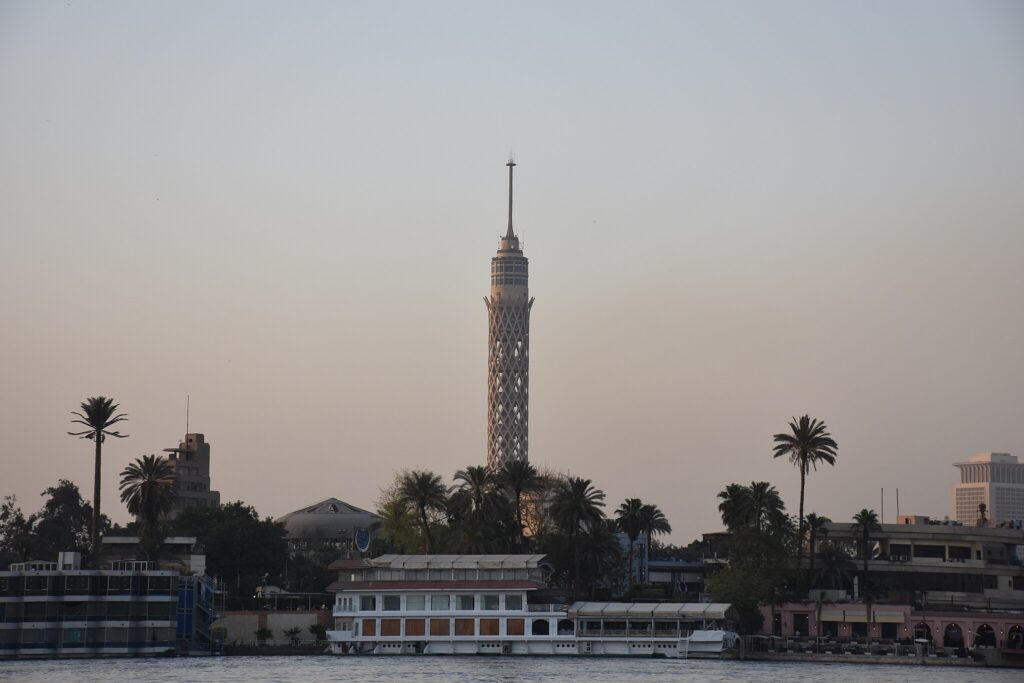
Photo Credit: Wiki Commons
By: Taim Al-Faraje/Arab America Contributing Writer
Embedded in Cairo’s Gezira Island stands one of Africa’s most intricately designed buildings, namely the Cairo Tower. Standing 614 feet tall, a stunning 160 feet taller than the Great Pyramid of Giza, it at one point served as Africa’s tallest structure. It features an open lattice-work design that’s meant to mimic a lotus flower, a renowned symbol of ancient Egypt. It’s even built on the same Aswan granite stones that the ancient Egyptians used to build their monasteries. A beautiful building indeed, it serves as a national pride of Egypt; but that’s not the only purpose it serves. In fact, at one point, Cairo Tower was a symbol of the Global South’s fight against imperialism, and it serves as a remnant of President Gamal Abdel Nasser’s efforts to make the Arabs prosperous and independent of foreign powers.
Algerian War
When Algeria began their war for independence against France in 1954, Gamal Abdel Nasser, an Egyptian revolutionary, almost immediately sent money, aid, and manpower to help the Algerian National Liberation Front (FLN). Nasser was no stranger to revolution as he was part of the Egyptian Free Officers, a group of relatively low-ranking officers in the Egyptian Army who had overthrown the King two years prior. By 1954, Nasser had quickly become the most important and popular leader in the Arab world. He was swiftly establishing himself not only as the leader of Egypt, but of the Arabs as a whole. In the effort to legitimize his position, it became necessary to support the Algerian revolution; it was anti-imperialist, supported the liberties of Algerians, and it was an Arab cause -right up Nasser’s alley. Prior to this time period, Nasser had received American economic support, such as through the Point Four Program, a “U.S. policy of technical assistance and economic aid to underdeveloped countries.” Although they weren’t allies, America was in the process of trying to sway Nasser in its direction as a means to prevent the spread of Communism.
CIA Money
In their effort, America, staunchly siding with the French, offered Nasser between 1 and 3 million dollars to stop his support for Algeria and to encourage him to join the Middle East Treaty Organization (METO). METO was a pro-Western pact between countries in the Middle East whose main goal was to stop the spread of communism and contain the Soviet Union’s sphere of influence. This offer was a major insult to Nasser as, having described before, he was a highly successful leader among the Arabs. Offering him a bribe made him appear like a mercenary, a puppet who could be bought —a joke. Seeing that this would directly declare his support for the western side in the Cold War, and it would prevent him from gaining support from the Soviet Union, and more importantly, result in a loss of credibility among other non-aligned countries, he declined the offer. However, before formally declining the offer, he took the CIA’s money. Although he may not have known how he was going to use it, he knew that he’d use it to resist America’s attempt at pursuing him, and more importantly, he knew he wouldn’t stop backing the Algerian resistance.
Cairo Tower
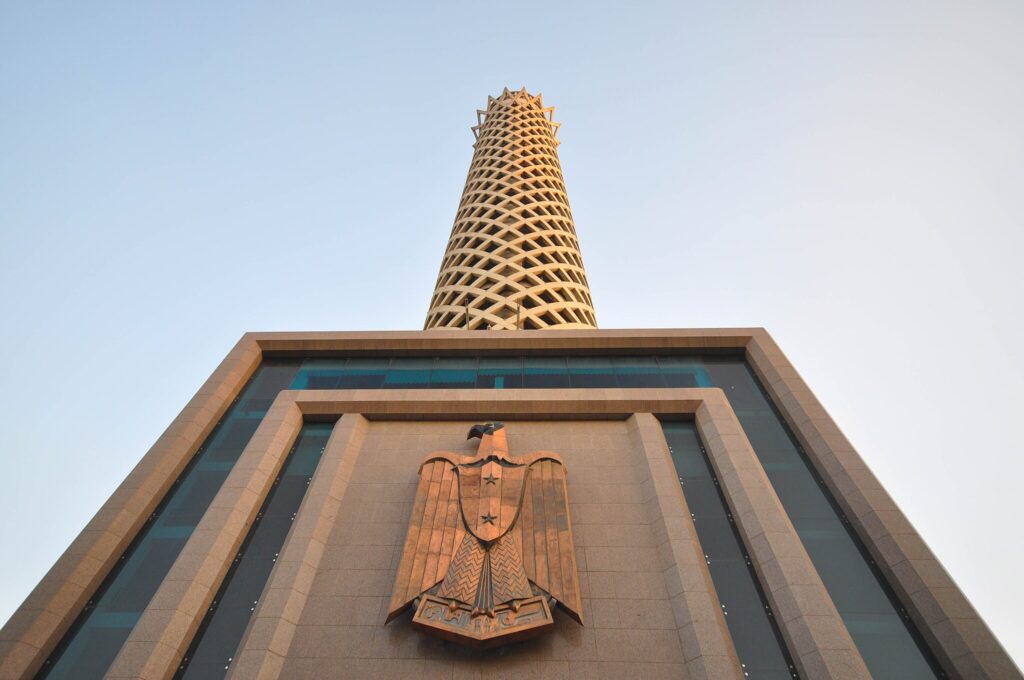
Photo Credit: Wiki Commons
Upon receiving the money, he transferred it to the Egyptian Government, and ordered the construction of the tower. To Nasser, there was nothing to lose. It was simply one power mistaking another power for a puppet- a mistake he wouldn’t accept. Nasser purposely facilitated the construction of the tower to be across the US embassy in Cairo as a taunting gesture to send a message to America; that message being that if they didn’t respect his influence and authority, he would refrain from working with them as he didn’t need the help of a power to build his people -he was the power.
Cairo Tower Controversy
Once the tower was completed, people in Egypt began calling it “Waqf Rooselevt,” or “Roosevelts Endowment.” Egyptians called it this because what was meant to be a way to buy Nasser’s loyalty and secure relations with Egypt turned into a charitable donation to Egypt’s pride. In Islam, the largest religion in Egypt, a “Waqf” is a charitable or state-mandated donation, typically made by someone with wealth, to benefit the community, often used to build schools, mosques, or similar institutions; and the Egyptians characterized this as such. However, the workers at the Egyptian embassy in Washington D.C. caught wind of this, and either out of ignorance or as part of some devious joke to deteriorate relations between the countries more than they had already been strained, they began calling it “Waqef Roosevelt,” or“Roosevelt’s erection.” Because of this, Americans started calling it “Nasser’s prick,” and ultimately, it changed Americans’ perception of Nasser to be arrogant and untrustworthy.
Conclusion
The Cairo Tower stands as a reminder of Egypt’s once pivotal role in Arab politics. Although it may no longer serve its original purpose, it remains a beautiful monument with a rich and hidden history. To this day, Arabs across the Arab World remember Nasser for his resilience and ability to remain strong and uplift his country from tough times.
Want more articles like this? Sign up for our e-newsletter! Check out our blog here!