Subscribe
to receive news by email

Poll
Will the Trump Administration Shift U.S. Policy in Favor of Palestine?
- No (87%)
- Yes (13%)
 Loading ...
Copyright © 2026 Arab America
Go topCan the Gaza Ceasefire Hold?
By Ghassan Rubeiz / Arab America Contributing Writer
The Gaza ceasefire faced its first serious threat over the weekend with violations, blame, and casualties on both sides. Yet U.S. pressure on Israel appears strong enough to save the 20-point Trump plan — for now. Trump’s personal investment is providing crucial momentum, but the near-absence of Palestinian input remains a fundamental weakness. Two critical issues stand out: the full return of hostages and Hamas’ disarmament. Hamas cannot immediately return all deceased hostages, prompting Prime Minister Netanyahu to consider resuming military operations.
Hostage families deserve closure, with their faith in humanity hanging in the balance. These families, like thousands of Palestinian families who have lost loved ones, need our full attention and sympathy. Their grief reminds us that every life is sacred. Yet this principle — the sanctity of all life — also demands we consider the broader humanitarian catastrophe. This war has traumatized millions and killed tens of thousands, with devastation falling disproportionately on Palestinian civilians. Blaming Hamas for delays in returning bodies may be unfair. With an estimated 10,000 bodies buried beneath Gaza’s rubble, locating the missing requires time and specialized technology. Hamas, which is desperately seeking to justify a future role for itself, would not be gaining anything by deliberately withholding the bodies of deceased hostages.
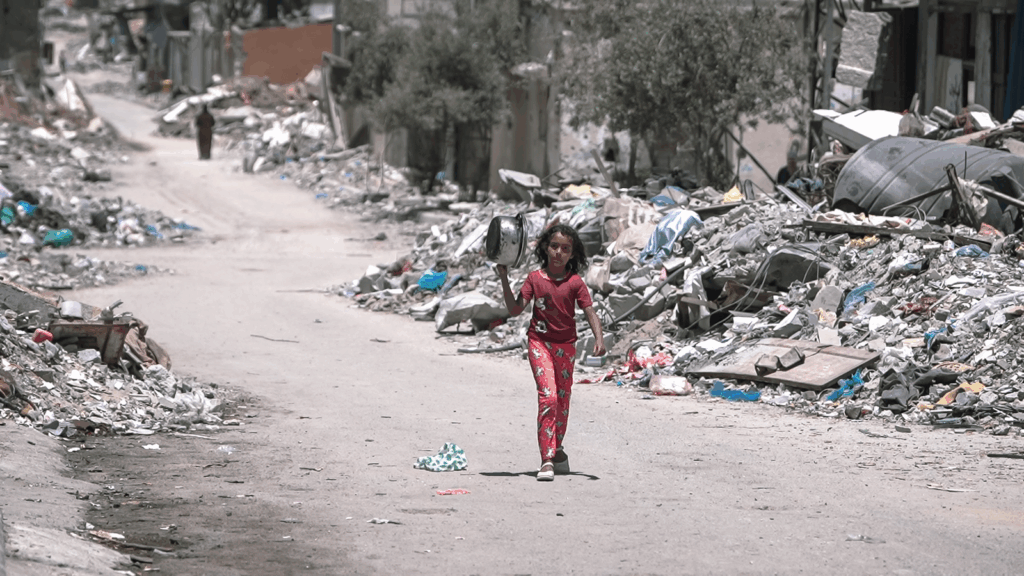
And restarting the war would be catastrophic. With two million Palestinians having returned to devastated neighborhoods, avoiding civilian casualties would be impossible. World opinion has turned decisively against Israel’s aggression and its refusal to withdraw from conquered territory. Even within Israel, the public is growing exhausted with the futile attempt to eliminate Palestinian resistance by force. Israelis might eventually realize that leaving Gaza entirely does serve their interests. The toxic environmental and health consequences of the two-year war could become Israel’s nightmare: a broken ecosystem and evidence of war crimes everywhere. President Trump would likely block any resumption of hostilities over the near future, if only to preserve his image as a peacemaker. Meanwhile, the US Congress, including many Republicans, are showing signs of shifting away from reflexive Israel-first positions.
The deeper challenge remains addressing armed resistance in Gaza. You can disarm a militia, but not a movement rooted in legitimate grievances. As long as occupation persists, resistance endures. The only sustainable way to diminish Hamas’s influence is through alternative ideas and opportunities. On Sunday, U.S. Middle East envoy Jared Kushner asserted that the Trump plan will offer a suitable alternative to Hamas in the form of a new Palestinian leadership. Is it that simple? Can Trump’s real-estate experts like Kushner and Steve Witkoff truly empower a new generation of Palestinian leaders?
Israel and its US backers stand at a historic crossroads. They can use this ceasefire to open authentic dialogue with Palestinians about shared futures, or continue a doomed attempt to impose unilateral solutions through force: a wall that grows more slippery with each attempt to climb it. This ceasefire’s evolution into a lasting peace depends on several critical factors: guaranteed full Israeli withdrawal from Gaza; Palestinian governance of the Strip; international leadership replacing U.S.-dominated mediation; and rapid establishment of an effective peacekeeping force. Resuming war would only compound existing war crimes and deepen Israel’s diplomatic isolation. This ceasefire offers a rare opportunity to break the cycle, but it remains in the hands of political figures with a questionable record and a high tolerance for ambiguity.
Ghassan Rubeiz is the former Middle East Secretary of the World Council of Churches. Earlier, he taught psychology and social work in his country of birth, Lebanon, and later in the United States, where he currently lives. He has contributed to political commentary for the past twenty years and delivered occasional public talks on peace, justice, and interfaith subjects. You can reach him at rubeizg@gmail.com
The views and opinions expressed in this article are those of the author and do not necessarily reflect the position of Arab America. The reproduction of this article is permissible with proper credit to Arab America and the author.
Want more articles like this? Sign up for our e-newsletter!
Check our blog here!