by ERIC BENSON0
Texas Monthly
Every single time there’s a terrorist attack, what is the first thing that a Muslim thinks?”
Imam Omar Suleiman let the question hang as he looked out across the prayer hall at the 75 Muslim men and women who had gathered to hear him. There was a brief pause, then a few murmurs.
“We hope it’s not a Muslim. Right?” Suleiman said. “That’s almost always the case: we hope it’s not a Muslim.”
Two weeks earlier, ISIS-affiliated suicide bombers had killed 32 civilians in Brussels, and Suleiman didn’t intend to dismiss the carnage. But recent history had taught American Muslims that violence committed in the name of their faith could ripple toward them in the form of suspicion, hate, and attempts at reprisal.
“If it turns out to be a Muslim, immediately Islam is the culprit,” Suleiman continued. “It feeds that idea that all Muslims are secretly part of this conspiracy—what Ben Carson called ‘civilization jihad’—where they’re all going to plant themselves in different places and overthrow the government and implement sharia law. We always fear that tack.”
It was a Friday night in April at the Valley Ranch Islamic Center—a small mosque tucked into a subdivision a few miles northeast of Dallas–Fort Worth International Airport—and after observing the sunset Maghrib prayer the faithful had lingered. They had stayed to hear Suleiman, one of the center’s two imams, give a lecture on a secular topic: America’s history of racism, religious persecution, and hard-won civil-rights progress. Not many Muslim leaders—better versed in scripture than in civics—could have delivered such a presentation, but Suleiman is a new kind of American imam. Six feet five inches tall, with sleepy eyes and a close-cropped beard, he is native-born, speaks Arabic and English, and is as comfortable opining on the Super Bowl prospects of his beloved New Orleans Saints as he is analyzing obscure passages of the Quran. This bicultural fluency has made the 29-year-old a natural leader in his community. He is an in-demand teacher. He is a friend to prominent American Muslims, from former White House adviser Dalia Mogahed to retired NFL defensive back Husain Abdullah. And he is a wildly popular social-media presence, with more than a million likes on his Facebook page and tens of millions of views for his YouTube sermons.
Among the crowd gathered to hear Suleiman on that Friday night were old and young, immigrants and native-born, Arab Americans and South Asian Americans and African Americans. Recently they had been united not only by their religion but by a shared experience of Islamophobia. Many had personally faced threats and degradations: taunts of “go back home” yelled from the windows of passing cars, online trolls spewing accusations of terrorist ties and jihad-driven hearts, confrontations in parking lots and Walmart aisles. All of them had at least heard about the increase in violent attacks—dozens of assaults around the country, mosques set on fire in California and Washington, execution-style killings in Chapel Hill, North Carolina, and a Christmas Eve shooting right there in Dallas, in which a man targeted a Muslim-owned rim and tire shop and a customer was killed.
In 2015 American Muslims faced more incidents of religiously charged violence and vandalism than in any year since the September 11 attacks, according to a study from Georgetown University’s Bridge Initiative, and the trend has continued into 2016. All too often, the Dallas area has been at the epicenter. Early last year, an “anti-sharia” campaign by Irving mayor Beth Van Duyne grabbed national headlines. Then it was the arrest of “Clock Boy” Ahmed Mohamed, last September. Then came the rise of the so-called Bureau of American Islamic Relations, a militia group that protests outside mosques wearing tactical gear and wielding AK-47s.
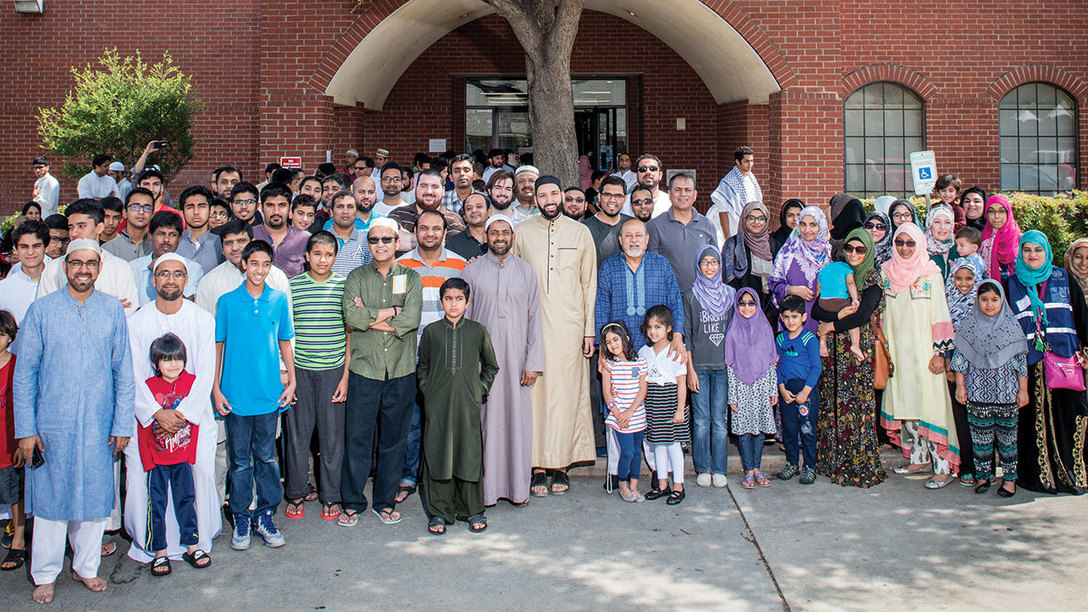
Dallas doesn’t have a history of open-armed religious tolerance, and it remains the home of people like the prominent Baptist preacher Robert Jeffress, who responded to the Paris attacks last fall by declaring that Islam was “inspired by Satan himself.” But that’s an incomplete picture. The Metroplex is now home to more than 150,000 Muslims, and it has become known nationwide as a magnet for some of the most successful, well-educated, and progressive-minded.
Suleiman is one of them. In 2012 he moved from New Orleans to the Dallas area, which he saw as an ideal place to build his career. There, he could preach at the Valley Ranch mosque, deliver online lectures for the Irving-based Bayyinah Institute—a school for Arabic and Quranic studies—and fly conveniently around the globe to teach classes about Islamic values and the life of Muhammad. (In April and May alone, he visited Malaysia, Sri Lanka, Canada, and Chicago.) And Suleiman and his wife could raise their two children in a robust, forward-looking religious community.
Suleiman has been a vigorous champion of Muslim outreach for his entire career. At the age of eighteen, he coordinated a Muslim Hurricane Katrina relief effort, and soon after co-founded the East Jefferson Interfaith Clergy Association in the New Orleans suburbs. On that Friday night at the Valley Ranch mosque, Suleiman had invited Michael Waters, the founding pastor of Joy Tabernacle A.M.E. Church, in South Dallas, to speak with him. At the mosque’s entrance, a flyer with a photograph of interlocked black and white hands announced the program: “Walking With Those Who Have Dealt With Bigotry.”
As the men in the prayer hall knelt on the floor in blue jeans and dress shirts and the women sat on the other side of the room in loose-fitting abayas and brightly colored hijabs, Waters described in vivid, horrible detail the 16th Street Baptist Church bombing in Birmingham, Alabama, in 1963, and the June day last year when Dylann Roof gunned down nine members of Emanuel A.M.E. Church in Charleston, South Caro-lina. Suleiman spoke about the Japanese internment camps during World War II, the persistent whispers about the compromised loyalty of Catholics, and Franklin D. Roosevelt’s contention that Jewish refugees represented a national security threat. “But guess what?” he said. “Five Catholics and three Jews make up the Supreme Court today, meaning the tide turns quickly in this country.”
A middle-aged man in the crowd raised his hand and asked how the Muslim community should deal with its anger in the face of prejudice. “I would suggest that one of the angriest persons to ever walk the face of this country was the Reverend Martin Luther King Jr.,” Waters answered. “He hated hate. He despised racism with a passion. That hate of hate, that anger, became the fuel for a nonviolent direct-action movement. Anger is an important thing—it’s something we feed off of.”
Suleiman nodded. For too long, he believed, the American Muslim community had responded to hatred with fear and timidity. It was fine to have Muslims “that are going to smile and say, ‘We forgive you, and we love you, come to our mosque, and let’s talk about Islam a little bit,’ ” Suleiman told the congregation. But the imam had been inspired by more aggressive forms of activism.
He had been in Sanford, Florida, on the day a jury acquitted George Zimmerman in the shooting of Trayvon Martin, and the outrage pouring into the streets convinced him that America was “at a turning point.” The Black Lives Matter movement that would follow had compelled him to spur his own community into action. He wanted Muslims to mobilize around their anger, to vote out the politicians who had demonized them, to elect the ones who would see their value, and to run for office themselves. Suleiman wanted them not only to stand up for hot-button causes that involved other Muslims—like the Israeli-Palestinian conflict or the Syrian civil war—but to participate in struggles that reverberated through other minority communities.
“Right now,” he said, “we’re very well integrated economically, moderately integrated socially, and incredibly poorly integrated politically.” When Suleiman looked at Dallas’s Muslims—particularly the generations that came before his—he saw high achievers who had worked hard, built American businesses and schools and families, yet all too often didn’t feel welcome in their own country. He believed the time had come to demand more than that.
Forty minutes southwest of the Valley Ranch mosque, I visited another imam who had eagerly taken on the role of ambassador, serving on interfaith councils, hosting his own radio show on KZEE-1220, and working to boost the stature of the area’s Muslim community. But Imam Moujahed Bakhach had arrived in Texas from Lebanon in 1982, and he could remember a time when not only was there no one in the community demanding justice, there was hardly a community at all.
I met the 61-year-old Bakhach at the Islamic Association of Tarrant County’s mosque, which he had led until he stepped down, in 2005 (he still oversees one Friday prayer per month), and he was eager to show me the congregation’s mix of Islamic devotion and Americanness. On the second floor, where the mosque holds religious classes, he strutted about like a proud grandfather, pointing out the American flag, where Muslim students recite the Pledge of Allegiance, and the plaques commemorating their achievements in Quran memorization and flag-football. In the prayer hall, he made sure that I met one of the mosque’s congregants, a Marine veteran who had served in the Iraq war and who was loudly reciting the afternoon prayer. “General, your voice is very strong!” Bakhach laughed, before peppering the man with questions about his service. As “the general,” who had actually been a hospital corpsman, described pushing into Iraq during the invasion of March 2003, Bakhach beamed at him: “That is good! We are very proud of you.”
When Bakhach arrived in Fort Worth, the Metroplex’s Muslim population was barely a statistical blip. In October 1965, Lyndon Johnson signed the Hart-Celler Act, which overturned strict, decades-old national immigration quotas that privileged Northern Europeans. Almost immediately, Muslims from around the world began to arrive in the United States, and a few of them trickled into North Texas. By the late seventies, the community numbered an estimated five thousand and worshipped at just a handful of prayer spaces. In Richardson the Islamic Association of North Texas held services under a thirty-by-fifty-foot canvas tent while awaiting the completion of what would become the area’s largest mosque. Attracting congregants had been tricky at first. “They couldn’t get enough people to leave work and pray on Friday, so they held the congregational prayer on Sunday, which is religiously not allowed,” Khalid Hamideh, a Dallas lawyer whose father helped lead the early Richardson services, told me. “When they started, the prayers were, like, twelve people under a tree.”
Bakhach himself had been assigned to Fort Worth partly because of his language skills—it was hard to find an English-speaking imam—but he was not a fluent speaker. “I had to use an English dictionary, an Arabic–English dictionary, and an English–Arabic dictionary to know what I was reading about,” he said. His best English teacher was the televangelist Jimmy Swaggart. “I like his enthusiasm and his spirit!” Bakhach said. “Remove that Trinity and the divinity of Jesus, and the religious language is the same.”
In those years, Bakhach remembers, the idea of an imam listening to Swaggart wouldn’t have struck many people as strange, because so few people he encountered knew what an imam was. He was more likely to face befuddlement than prejudice. “Someone would see my wife in the bank and say, ‘Are you a nun?’ ” Once, a young boy stopped Bakhach—bearded, wearing a traditional kufi cap and a white shawl—in the greeting-card aisle of a pharmacy. “He called out, ‘Mom,’ and I said, ‘Uh-oh, what’s going on here?’ He said, ‘Mom, Jesus is here.’ ”
By 2000, Dallas Muslims were no longer curiosities. The community had grown to around 48,000, according to the Association of Religious Data Archives, with 28 Muslim congregations. It had also grown more diverse, welcoming refugees driven out of their homes by the conflicts of the nineties—Palestinians from Kuwait, Kurds from Iraq, Bosnians, Kosavars, and Somalis. By 2010, the population had more than tripled from its 2000 numbers, and Texas had become home to the largest number of Muslims in the country, with 422,000 statewide. Although there have been no surveys of Texas Muslims since, all evidence indicates that the population continues to grow. Drive around Richardson and Irving and you’ll see new houses of worship and young Muslim families moving into brick-facaded McMansions. Go to Dallas’s Klyde Warren Park on a weekend afternoon and you’re all but guaranteed to spot groups of women in hijabs chatting over coffee or a few smiling young men from an outreach organization called Islam in Spanish passing out flyers about the teachings of El Corán.
For many early members of the community, the rapid growth has been welcome. “Pre-2000, the community was tiny, it was gossipy, and you had gatekeepers,” said Mohamed Elibiary, a former Department of Homeland Security adviser who moved to Irving from Egypt in 1982, at the age of seven. “By the 2000s, the community was so big, everyone could start their own project.”
But the blooming of the area’s Muslim population coincided with the international rise of Al Qaeda. Before September 11, 2001, Dallas Muslims had attracted little notice. Afterward, they became targets for the first time. In the days after the attacks, a stonecutter named Mark Anthony Stroman went on a shooting spree around the Metroplex, targeting men he believed were Arab, and murdered an Indian-born Hindu and a Pakistani-born Muslim. (The state executed Stroman in 2011.) Later that year, the federal government declared the Richardson-based Holy Land Foundation for Relief and Development to be a funder of terrorism, resulting in the conviction of five men. Ever since, local “jihad watchers” have inferred a wide-ranging Muslim conspiracy involving radical mosques, extremist imams, and creeping sharia.
Bakhach had steered clear of controversy in the post–September 11 period, but he’s been hit by the recent wave of Islamophobia. In January 2015 he was offered a chance to become the first imam to deliver a benediction at the Fort Worth Stock Show and Rodeo, and he accepted happily. Before one evening’s festivities, Bakhach delivered a brief nondenominational prayer “for the cattle and the sheep” that made no mention of Muslim theology. At the event itself, the prayer didn’t cause a stir. But later, the response on the stock show’s Facebook page was so hostile that he and the event’s organizers decided to scrap his second scheduled appearance. “I said to the general manager, ‘I don’t want to cause you problems. I’m already in the history of Stock Show Rodeo.’ ”
It wasn’t just the stock show trolls who had put Bakhach and the Muslim community on the defensive that month. In Garland the New York–based anti-Muslim activist Pamela Geller had led a group of more than one thousand protesters outside the Curtis Culwell Center, heckling attendees of a conference called Stand With the Prophet in Honor and Respect, which had been convened to counter Islamophobia. In Austin a protester had disrupted a presentation during the seventh annual Muslim Capitol Day, while state representative Molly White instructed her staffers that Muslim visitors to her office must “renounce Islamic terrorist groups and publicly announce allegiance to America and our laws.” And on January 26 the right-wing website Breitbart Texas had “confirmed” the presence of an Islamic tribunal operating in North Texas. In fact, the tribunal, on which Bakhach serves as a judge, is a nonbinding religious-arbitration panel for marriage and business disputes, similar to ones that exist in the Jewish and Catholic communities. That didn’t stop politicians and commentators from sounding the alarm about “the first sharia court in America” and conjuring up fantasies of ISIS-style jurisprudence. (The Houston Chronicle would later call the witch hunt the “2015 Texas Hoax of the Year.”)
The tribunal is based in Dallas, but its opponents pegged its location as Irving (Imam Zia Sheikh of the Islamic Center of Irving is also a judge), and that city’s mayor, Beth Van Duyne, was happy to capitalize on the error. Van Duyne put herself forward as the face of the anti-sharia campaign, taking to Facebook to declare that she would “fight with every fiber of my being against this action,” then hitting the conservative-TV circuit. Back at home, Van Duyne sponsored an Irving City Council resolution to declare her community’s support for a Texas House bill that targeted the nonexistent primacy of foreign laws in U.S. courtrooms.
As a piece of political theater, this was a tired revival. The bill hewed closely to American Laws for American Courts, known as ALAC, a piece of model legislation written during the summer of 2009 by an anti-Muslim activist named David Yerushalmi. ALAC had already served as the template for dozens of bills nationwide, most of them ignored.
On March 19 the Irving City Council met to consider Van Duyne’s resolution. Testifying against it were Suleiman and Alia Salem, the executive director of the Dallas-Fort Worth chapter of the Council on American Islamic Relations (CAIR). But the city council wasn’t swayed and gave its assent to the resolution, five votes to four. At the meeting, Van Duyne declared herself flabbergasted that anyone would think her measure was Islamophobic. “Why people feel that that is hatred or bigotry is absolutely beyond me.”
Three weeks later, the Irving Police Department increased its patrol activities in the area of the Islamic Center of Irving—the supposed home of North Texas sharia—to protect congregants after the mosque received a string of phone calls and emails offering messages like “Quran pigs take Obama and your pig book [and] get out of here.”
In Fort Worth Bakhach found himself ensnared in the phony controversy. Glenn Beck had invited him onto his Las Colinas–based online television show, and Bakhach—who says he didn’t know who Beck was—accepted. Beck talked briefly with Bakhach about the tribunal, but the host really wanted to air Muslim conspiracy theories and point to passages from Islamic scripture as evidence of the religion’s ingrained intolerance. Bakhach floundered under the grilling, and a year later, as he sat in his office at the mosque, he still seemed shell-shocked. A 34-year veteran of the community, he was used to being treated with respect as a loyal American. Beck, in the spirit of the times, had treated him like an object of suspicion. “He came to crush us,” Bakhach said. “How did I accept myself to be humiliated like this, by this man?”
A few months after the Irving City Council vote, the city’s police department had to step up its presence once again, thanks to an unassuming Garland contractor in his early forties named David Wright. The previous fall, Wright, a longtime member of the Three Percenter militia movement, had formed his own outfit, BAIR—the Bureau of American Islamic Relations (an attempt to mock CAIR)—and soon he was leading small groups of men to protest so-called radical Islam outside the area’s largest mosques, in Irving and Richardson. For reasons of self-defense, Wright explained, he and his group members demonstrated wearing body armor and carrying semiautomatic rifles and 12-gauge shotguns.
I met Wright in April at a Grandy’s in Rockwall, and he wasted little time in proclaiming his group’s rationale. “It was about time for radical Islam to realize that there is a resistance, at least in Texas,” he said. “They’re not going to treat Texas like they do Paris or Brussels. They’re going to get dropped quick, ’cause we’re waiting on them, and we’re all over the place.” He nodded toward the restaurant’s front door, as if anticipating the arrival of an ISIS assassin. “I could end a terrorist attack in about twenty seconds.”
Wright didn’t fit the profile of an intimidator. Average height and average build, he had jug ears and gelled brown hair and wore a blue-and-white-gingham shirt and artfully torn designer jeans. He had grown up in Garland and spent his entire life in North Texas save for a post–high school stint working in a Tomahawk missile factory in Virginia. Wright fondly recalled spending summers boating and fishing at his grandfather’s property on Lake Tawakoni. He still spent plenty of lazy afternoons on the water, he told me.
Wright hadn’t paid much attention to Islam before September 11, but he did vividly remember his first encounter with Dallas’s Muslim community. When he was a teenager, he was driving around the north suburbs one afternoon and stopped at a red light in front of the mosque in Richardson. “Out of the corner of my eye, I see about thirty or forty Muslim women wearing all black from head to toe,” Wright said. “I’d never seen anything like that before, and it just freaked me out. They looked like cult members. Wearing all black—it seemed oppressive, it seemed dark. It’s not like that was the moment I went, ‘Oh, Muslims are horrible,’ but it was my introduction.”
Three decades later, Wright’s views on Islam had hardened. The summer before he created BAIR, he watched as the anti-Muslim climate around him intensified. In May 2015, Pamela Geller had returned to Garland’s Curtis Culwell Center, but this time she had rented it out to stage her own event, the Islam-mocking Jihad Watch Muhammad Art Exhibit and Cartoon Contest. The Metroplex’s Muslim community ignored the provocation, but two American-born radicals, Nadir Soofi and Elton Simpson, did not, driving from Phoenix to Garland with a plan to shoot up the crowd inside. (After the two men opened fire in the parking lot, Garland police officers shot and killed both of them.) The Muslim community was quick to disavow the act, even as it condemned Geller, but to many in the area, anyone wearing a hijab or praying to Mecca was now guilty by association. In July hundreds of protesters attended a town meeting in tiny Farmersville to declare their vehement opposition to plans by the Islamic Association of Collin County to build a 35-acre cemetery on the shore of Lake Lavon. A local pastor suggested the site would be used as a “mosque or madrasa training center.” Another resident encouraged community members to dump pig’s blood on the cemetery land.
In September, not long after agricultural commissioner Sid Miller shared a Facebook post that called for nuclear attacks against the Muslim world, fourteen-year-old Ahmed Mohamed brought a homemade clock into MacArthur High School, in Irving, and was detained by police for having a “hoax bomb.” (Glenn Beck, with Van Duyne sitting next to him, speculated that the clock incident showed that “for some reason Irving is important to the Islamists.”)
Wright staged his first armed demonstration the following month, in front of Dallas Central Mosque, in Richardson, the same place he’d been puzzled years earlier by women wearing hijabs. The gathering was small and attracted little attention. In November Wright’s group set up outside the Islamic Center of Irving and this time drew national headlines. A few days later, Wright posted on Facebook the names and addresses of “every Muslim and Muslim sympathizer that stood up for sharia tribunals in Irving.” (He had copied them from publicly available city council minutes. Facebook promptly removed his post.)
In early 2016, BAIR staged two more demonstrations in Irving and Richardson—to protest the embrace of Syrian refugees—and in April, traveled to the Nation of Islam’s Muhammad Mosque No. 48, in South Dallas, where a dozen BAIR members were met by a much larger group of armed counter-protesters that included members of the Huey P. Newton Gun Club and the New Black Panther Party. The scene quickly became tense, and the police ordered BAIR to leave soon after they arrived. I met Wright in Rockwall less than a week after the standoff, and he wasn’t interested in playing down the situation.
“If they had advanced on us, we could have killed them all, and we wouldn’t have gotten charged with anything,” Wright said. “It would have been mob assault under the law. There were twelve of us—one squad. I had an AK-47 with a seventy-five-round drum mag on it. I could shoot seventy-five bullets without reloading. Semiautomatic, fast as I can pull the trigger. Two other guys had the same thing. Two guys had AR-15s with slide fire stocks. It would have been ugly if we had to defend ourselves.”
Wright is well aware that BAIR is just one small part of a national wave. Around the time he and his group were standing stone-faced outside the mosques in Richardson and Irving last fall, Donald Trump was floating the idea of a national Muslim database, proclaiming that he would “strongly consider” closing down Islamic houses of worship and calling for a “total and complete shutdown of Muslims entering the United States until our country’s representatives can figure out what is going on.” (Polls in 2016 have shown a slim majority of Americans support Trump’s proposed Muslim ban.) Wright told me he thought Trump was a “moron.” He was against the Muslim ban and had been an ardent Ted Cruz supporter. But Wright’s views on the nation’s Muslim population are nonetheless not far from those of the GOP presidential nominee. When Wright conceives of American Muslims, he imagines frequent honor killings and hundreds of thousands of secret violent extremists (“These people are very sneaky”) and plans for an ethno-religious war in which “they’re just going to hit the street and start killing people.” The targets would not be indiscriminate, he believes. “It’ll be white conservatives, mainly.”
When I first met Suleiman, in March, the wariness was palpable. After Wright published Suleiman’s home address on Facebook, the imam installed security cameras, fearing BAIR or its supporters might target his home. “I think many Muslims have done that,” he said. “My six-year-old asked me, ‘When Obama dies, are we going to get kicked out?’”
Suleiman hasn’t been the direct target of anti-Muslim violence, but through him I met a 22-year-old named Omair Siddiqi, who has been. Driving home after a vigil at the University of Texas at Dallas for the Chapel Hill shooting victims, Siddiqi had been run off the road by a “big white dude, tattoos all over,” who got out of his car, kicked Siddiqi’s bumper, and launched into an anti-Muslim rant.
Later that year, not long after the Paris attacks, another man, this one with a gun on his hip, confronted Siddiqi in a Kroger parking lot. “He goes off: ‘Are you part of ISIS? Are you a recruiter for ISIS in America?’ ”
As Siddiqi stood silently, the man lifted his jacket, unbuckled the lock on his holster, and said, “If I could, I would shoot you right now and kill you.”
In an earlier era, such incidents might have driven a young Muslim man like Siddiqi into hiding. Instead, they emboldened him. After the second confrontation, Siddiqi put his studies on hold to take a position as outreach coordinator with CAIR’s Dallas–Fort Worth chapter. For most of its history, the American-Muslim community has been majority immigrant, and its religious leadership has been even more heavily foreign-born. (A study published in 2012 on U.S. mosques found that 85 percent of full-time, paid imams migrated from abroad.) But as the Muslim population continues to become more entrenched in this country, its demographic profile is shifting toward the American-born, and Suleiman believes that the community’s attitudes are changing accordingly.
“The immigrant mentality is one of fear, and that doesn’t resonate with American Muslims, including me,” Suleiman said. “People want to see confidence and courage in their leadership. They don’t want to see fear and insecurity. Look at the way the Nation of Islam responded to BAIR. I don’t suggest that at all, but you could tell there was a sense of dignity, a sense of ‘We’re not going to let ourselves be pushed around and bullied.’ I use the word ‘swag’ a lot in my sermons. I tell people, ‘I want you to have that swag.’ ”
It’s not just Suleiman. Dallas has become something of the “swag” capital of Islamic America. AbdelRahman Murphy, a Chicago-born, Irving-based Islamic teacher and Muslim community leader, told me that around the country, other U.S.-based Muslims now refer to Dallas—with tongue slightly in cheek—as “the Medina of America.” “Muhammad went from Mecca to Medina. It was the promised land—it was the place where his community could grow,” Murphy said. “When I travel, everyone says, ‘Oh, my God, man, there are so many Muslims there, it’s like the new Medina.’ ”
It’s become a magnet for scholars in particular. Nouman Ali Khan, a German-born, New York–raised teacher of Islamic studies, moved to Dallas in 2009 and soon after founded the Bayyinah Institute. Abdul Nasir Jangda, an Arlington native who was one of Bayyinah’s first teachers, founded the Qalam Institute in 2009 as a traditional Islamic seminary with a stated goal of developing a thousand-person student body of aspiring Muslim religious leaders. Suleiman has been talking about forming his own institute too, where he hopes Muslim intellectuals will study Islamic history and culture with an eye toward inspiring young people.
These scholars—whom CAIR’s Alia Salem calls “superstar imams”—aren’t radical reformers. They’re not looking to overturn prescribed gender roles or upend prohibitions against alcohol or abortion or premarital sex. Suleiman advocates what he calls “compassionate orthodoxy”: respecting the diversity and life choices of others, even as one pursues traditional Islamic practice. Still, leaders like Suleiman and Murphy represent a departure.
When Murphy—who has a convert father and an Egyptian-born mother—first came to the Dallas area, he took a job as youth director for the Islamic Association of North Texas, in Richardson. He lasted only a year and a half. His mosque sleepovers and come-as-you-are ethic didn’t endear him to some elements in the community.
“The old guard—and some of them aren’t that physically old, but they have an old mentality—they felt very threatened by the new ideas,” Murphy, who is 28, told me.
After he left Richardson, Murphy started his own organization, the Roots Program, as a kind of “spiritual halfway house” designed to welcome back the twenty- and thirtysomethings— young families, “people with tattoos and piercings,” Muslims questioning their faith—who felt that they didn’t belong in traditional mosques.
“It causes a lot of cognitive dissonance when the conservatives who like my work as a seminarian see that I’m not separating the genders during Quran study,” Murphy said. “I tell them, ‘I get that you don’t get it. What I’m asking of you is to trust me. I know my people.’ ”
While Murphy has focused on young Muslims who feel alienated from their religion, Suleiman has found himself—on about twenty or thirty occasions, he says—in discussion with a different kind of young Muslim: one who is grappling with supporting ISIS. “They would come to me and say, ‘We trust you, we can tell that you care about the ummah’ ”—the worldwide Muslim community—“ ‘so why aren’t you on board with this type of stuff?’ ” Suleiman told me.
In May NBC News obtained a list of fifteen American residents who had traveled to Syria in 2013 and 2014 to fight for ISIS. Two of them, Omar Kattan and Talmeezur Rahman, had lived and attended college in the Dallas area. When faced with men and women considering such an action, many imams would offer a simple admonishment that “ISIS is not Islam.” As Elibiary, the former Homeland Security adviser, told me, “Ninety-nine percent of imams have no experience with jihad world. You’re not taught about the jurisprudence of jihad in most Islamic universities.” But Suleiman—who likens ISIS to the Muslim KKK—has studied ISIS propaganda and belief, and when he has been contacted by young Muslims drawn to extremist ideology, he has sparred with them intellectually, taking Quran passages like the so-called “verse of the sword” (“Slay the idolaters wherever ye find them”) and analyzing them historically and spiritually.
“You can’t shy away from their arguments. You have to acknowledge the texts that extremist groups use, and you have to contextualize them,” he said. “Most people pretend they’re not there. Believe me, they’re there.”
Suleiman appeals to the heart as well as the head. “Each and every one of those people who approached me was going through some deeply personal stuff,” he said. “What you have to do is teach them how to be angry instead of telling them ‘Don’t be angry.’ You have to teach people to channel their emotions properly. If you’re a really passionate antiwar advocate, then do something about it. Don’t create more war.”
Approaching Islam as Suleiman and Murphy do carries graver risks than admonishments from community elders. In April the ISIS propaganda magazine Dabiq published a kill list of Western Muslims. The two Dallas scholars were not on the list, but Elibiary and Boston-based Suhaib Webb, another young American-born imam who has taught at Bayyinah, were. Dabiq held up Webb as an example of the “all-American imam” who is “seen by many crusader supporters as an important tool for taming Muslim youth in the West.”
When the holy month of Ramadan began on June 5, the Dallas-Forth Worth Muslim community had been enjoying a couple months of relative calm. BAIR had gone quiet after the South Dallas standoff. No local politicians had tried to gin up controversies about sharia tribunals or Islamic cemeteries. After the boxer Muhammad Ali died in early June, praise had come from all corners. For once, even Donald Trump, who remembered Ali as a “terrific guy” and an “amazing poet,” did not see being a Muslim and being an American as contradictory. Suleiman—who had told me in March that he’d always wanted to meet Ali—flew to Louisville for Ali’s janaza rites, joining 14,000 other mourners for the largest Muslim funeral ever held on U.S. soil. “ I was surprised by my own grief,” Suleiman wrote on Facebook about attending Ali’s funeral. The imam was also plainly hopeful about what such a memorial could mean. “Here you have one of the greatest Americans of the last one hundred and fifty years, who was inspired by Islam to be that great American and great humanitarian,” Suleiman told me. “I thought, maybe there’s a recognition now about what Islam really is. Maybe people will come to their senses.”
And then, two days later, Omar Mateen stormed into the Pulse nightclub in Orlando and perpetrated the worst mass shooting in American history. Suleiman learned the news as he stepped off a plane the next morning at DFW Airport, and it returned him to that all-too-familiar place, mourning the victims, fearing reprisal, and feeling frustration at how the actions of one “lunatic Muslim” would vilify an entire religion in a way that the faith of Dylann Roof never would.
That night, Suleiman drove to Dallas for a vigil. Surrounded at the podium by gay and lesbian activists, Muslims, Christians, Jews, Buddhists, Dallas chief of police David Brown, and Dallas mayor Mike Rawlings, Suleiman addressed the crowd. With raw eyes and a faltering voice, he thanked the LGBTQ community for standing with Muslims against Islamophobia in the past. He asked for remembrance of the victims and the hundreds of loved ones who will be scarred forever by the killings. And he vowed that those gathered would help defeat ISIS.
“We won’t give them the world that they want,” Suleiman said. “We won’t allow them to turn America into a place of paranoia. And we’re not going to give Donald Trump—or people like Donald Trump—the America that they want. They might think that their voices might be amplified by today’s manifestation of hatred, they might think that they now have fuel, but this here is America, this right here is the future of America.”
When Suleiman had spoken at the Valley Ranch mosque in April with Waters, the South Dallas pastor, he’d encouraged his congregants to make “common cause” with other like-minded groups in fighting bigotry. Now, the devastation of the Orlando attack had brought together such a coalition, but Suleiman knew that feelings of solidarity could prove short-lived. Once the vigils had ended and the cameras had shut off, his community would be back on guard, waiting for those familiar shouts of “go back home.” American Muslims were used to that now, and few of them saw an end in sight. But in the “Medina of America,” they had already done the hard work of building a home in which they could thrive and grow. They weren’t going anywhere.
Source: www.texasmonthly.com



 Loading ...