
Subscribe
to receive news by email

Poll
Will the Trump Administration Shift U.S. Policy in Favor of Palestine?
- No (87%)
- Yes (13%)
 Loading ...
Copyright © 2026 Arab America
Go topFifteen Years After the Arab Spring: Between Hope and Reality
By Aziz Hellal / Arab America Contributing Writer
Fifteen years later, did the Arab Spring deliver anything close to what people had hoped for? The protests that began in Tunisia soon spread to Egypt, Syria, Yemen, and Libya. Millions of people took to the streets, demanding freedom, dignity, and a better future. What started as social and economic demands soon turned into calls for regime change. What happened over the next 15 years tells a very different story.
Tunisia
Tunisia is where the Arab Spring began, after Mohamed Bouazizi set himself on fire in protest against humiliation and economic hardship. The protests spread quickly and soon shifted from demands for reform to demands for the fall of the regime. Ben Ali, the thun-ruler, fled, and many Tunisians felt they were beginning to write a new chapter in their country’s history.
At first, Tunisia appeared to be the one success story, with a more open political system and peaceful transfers of power. But over time, many of these gains began to fade, raising new concerns about the future of democracy in the country. That changed in July 2021, when President Kais Saied suspended parliament and took power into his own hands. Many critics saw that as a major setback for Tunisia’s democratic transition.
Unfortunately, Tunisia’s problems did not stop there and continue today. Currently, unemployment is higher than it was in 2010 and stands at 15.1% in 2025, according to World Bank data. Inflation has also risen, and the country’s freedom score — which improved sharply after the uprising — has fallen back again in recent years.
Still, Tunisia’s story may not be over. There is still a chance for the country to return to a more democratic path and recover some of the hopes that shaped the uprising.
Egypt
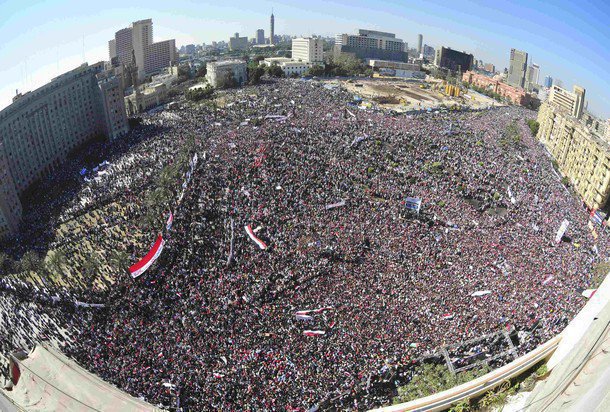
Back in January 2011, Egyptians took to the streets under the slogan “Bread, Freedom, and Social Justice.” After Mubarak stepped down, many Egyptians felt that real change had finally begun, but that initial wave of hope quickly gave way to a “fast-track” transition that many say moved too fast for its own good.
Instead of taking a breath, Egypt quickly entered a non-stop cycle of constitutional changes, parliamentary elections, presidential elections, and later a new constitution. On paper, it looked like progress. But in reality? That “fast-track” transition ended up being the problem. It was a rush to the finish line that didn’t actually fix anything.
Fifteen years later, that “new start” feels more like a memory than a reality. The unemployment rate may be lower than it was in 2010, but ask anyone on the street, and they’ll tell you a different story. Prices have gone through the roof, and the cost of living has put heavy pressure on most families.
The freedom Egyptians had hoped for appeared temporarily after Mubarak was removed, but it did not last. Egypt is still ranked ”not free”, and that reflects how many people see the situation today. The uprising removed Mubarak, but it didn’t fix the deep problems behind it. Even now, Egyptians are still asking the same question: will “Bread, Freedom, and Social Justice” ever be more than just a slogan on a wall?
Syria
If Egypt showed how fast political change could lose its meaning, Syria showed what happens when an uprising turns into a long and devastating war.
Syria slipped into civil war in 2011, and Bashar al-Assad did not fall until the end of 2024. Even after the regime ended, the country is still suffering from the effects of the civil war and the economic sanctions that have been imposed on it for many years.
While a new diplomatic alignment with Saudi Arabia, Qatar, and Turkey has helped thaw relations with Washington—pushing the Trump administration to begin easing sanctions that have been in place for decades—the country is nowhere near “normal.” For a population that has spent years under fire and under pressure, the fall of the regime was just the beginning of a much longer, harder road home.
The effects of the war can still be seen. Many families lost loved ones, and millions were displaced, either inside the country or abroad. The war damaged the economy, raised prices, increased unemployment, and deprived millions of children of education and health services.
Syria is still far from recovery — and no one can seriously pretend that rebuilding a country after so much destruction will be quick or easy. However, if a measure of stability begins to hold and Syria continues to reopen itself to the outside world, then the next five or ten years may yet bring part of what so many once demanded in the streets: dignity, opportunity, and the chance to build a normal life again.
Yemen
Yemen’s path lookes more like Syria’s than Tunisia’s or Egypt’s. The country has been trapped in a civil war since 2015, a war that has torn Yemen apart and left its people suffering from hunger and poverty over the past ten years. Yemen is still stuck in the middle of that war, and no one knows when it will end.
The war not only brought fighting, it also divided the country into different areas, with more than one authority trying to govern. This made the situation more complicated to manage.
Today, Yemen is one of the poorest places on earth, and for most families, just getting through the day is a massive struggle. In many areas, healthcare and schools have basically folded, leaving millions of kids to grow up without the simplest things they need to survive. The war didn’t just break the country; it hollowed it out.
It is hard to know what many Yemenis are thinking today. Is this what they hoped for 15 years ago? Is this the future they wanted for their children? After years of conflict and division, many are still waiting for the day the war ends — a day when the country can come together again and begin to rebuild what has been lost.
Libya
Unlike the previously mentioned countries, Libyans did not protest primarily for economic reasons. They wanted freedom — not only of speech, but also to take part in political life after years of tight control under Gaddafi. They wanted a system that would allow them to choose their future and the future of their children. But the regime responded with force, and what began as protests soon turned into civil war.
In the years that followed, Libya fell deeper into conflict. By 2014, the country had become divided between rival authorities, one in the East and another in the West. That division has made it harder to rebuild the state or move forward after years of conflict.
Even now, many questions remain. Is this the future Libyans had hoped for when they asked for freedom and a voice in political life? After years of war and division, many still hope the country can become more stable and begin moving forward again.
In the end, much of what people hoped for in 2011 did not become reality. Years later, the reality of these countries is often more complicated — and in many cases worse — than what many had imagined at the start of the uprisings. The question now is not only why these demands were never fully achieved, but also why events moved in such a different direction. Did regional and international factors help shape that outcome?
Even so, the demands that filled the streets in 2011 — dignity, freedom, and a voice in shaping the future — did not simply vanish. They remain part of the region’s unfinished story.
Want more articles like this? Sign up for our e-newsletter!
Check out our blog here!