
Subscribe
to receive news by email

Poll
Will the Trump Administration Shift U.S. Policy in Favor of Palestine?
- No (87%)
- Yes (13%)
 Loading ...
Copyright © 2026 Arab America
Go topFrom Ports to Classrooms, Italy Strikes for Gaza
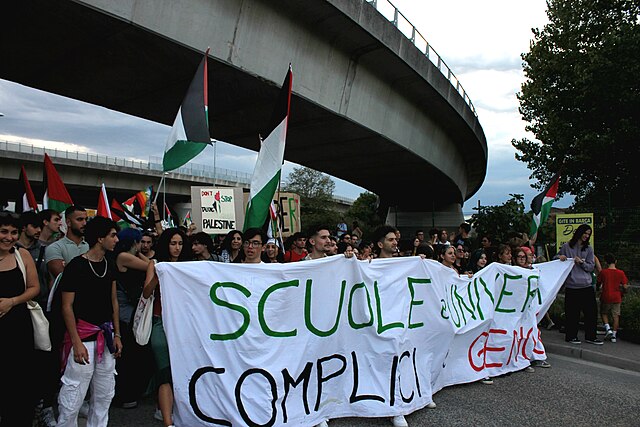
By: Fayzeh Abou Ardat / Arab America Contributing Writer
A nationwide general strike and large-scale protests in support of Palestine occurred last week in Italy, marking one of the country’s most coordinated mobilizations in recent memory. The strike, which was led by activist networks and grassroots unions, brought tens of thousands of people to the streets and interfered with port, transit, and educational operations nationwide. The extent of the strike, the protesters’ demands, and its wider political importance for Italy are all examined in this article.
Italy’s continued diplomatic and armaments relations with Israel, as well as the worsening humanitarian situation in Gaza, prompted the measure. Schools closed down, ports delayed or shut down, and public transportation stopped in a number of cities as activists, workers, and students united in calling for a ceasefire and more robust humanitarian efforts. Coordinated actions of solidarity with Palestinians disrupted normal routines throughout Italy for a day.
Demonstrations, Key Demands, and Government Response
The strike affected logistics, education, and transportation in both the public and commercial sectors. Widespread disruption was felt in major cities such as Rome, Milan, Bologna, Genoa, Livorno, Turin, Florence, Naples, and Cagliari. In ports like Genoa and Livorno, dockworkers staged sit-ins that obstructed or impeded shipments. Schools suspended classes, and train and metro services were cancelled or delayed.
The strike was accompanied by protests in over 70 cities. One of the biggest crowds was in Rome, where squares and main streets surrounding Termini station were packed. Major marches were also held in Milan, Bologna, Turin, Florence, Palermo, and Cagliari. Where people held banners demanding an end to the violence in Gaza and waved Palestinian flags.
Protesters called for a ceasefire right away. An end to Israel’s arms sales, the acknowledgement of Palestinian statehood, and more humanitarian help. Support for the Global Sumud Flotilla, an effort to transport supplies to Gaza by sea, was also voiced at numerous rallies.
The response from the government was conflicting. Prime Minister Giorgia Meloni denounced violent conflicts in several places as “shameful,” but she acknowledged the freedom to demonstrate. While stressing that peaceful protests were protected, the Interior Ministry issued a warning about property destruction, blocking vital infrastructure, and clashing with law enforcement. Protests turned into altercations that led to arrests and injuries in a few towns, most notably Milan and Bologna.
Disruption, Impact, and Broader Significance
The impact of the strike was felt across the country. Due to rail and metro lines closing or operating at reduced capacity, commuters in Rome and Milan experienced lengthy delays. There were backlogs in transportation as a result of the considerable slowdown in port operations. Public offices and health services were also impacted in some areas. While schools and universities either closed or functioned with fewer employees. The number of participants was especially impressive in Cagliari. Between 15,000 and 20,000 people reportedly joined one of the biggest protests in Sardinia in recent memory.
The strike’s magnitude highlighted the general dissatisfaction of the citizens with Italy’s stance on the war. Many saw the mobilization as highlighting not only resistance to Israel’s military activities but also political alignment with EU and NATO policy and Italy’s cooperation through arms sales. The protests exposed a gap between the public’s call for swift action on humanitarian grounds and the government’s cautious diplomacy.
The strike had symbolic significance in addition to causing immediate disruptions. Echoing previous mobilizations like the 2003 anti-Iraq War rallies, it was one of the most obvious manifestations of Italian civil society’s support for the Palestinian cause. The incidents showed how strikes and street protests can still influence political discourse. Particularly in a nation where taking direct action has long been a symbol of civic engagement.
All things considered, the strike last week was a strong show of solidarity. It made it evident that for many Italians, the fate of Gaza is inextricably linked to the principles of justice and peace at home by tying local labour disputes and student activity to global humanitarian issues.
Want more articles like this? Sign up for our e-newsletter!
Check our blog here!