Subscribe
to receive news by email

Poll
Will the Trump Administration Shift U.S. Policy in Favor of Palestine?
- No (87%)
- Yes (13%)
 Loading ...
Copyright © 2026 Arab America
Go topIraq’s Ongoing Sunni-Shia Rift

Photo Credit: Fire and Thick Black Smoke on the Road via Pexels.
By: Amir Kobeissi / Arab America Contributing Writer
Iraq’s ongoing Sunni and Shia rift remains one of the country’s most unique and conflicting aspects of its social and civil landscape. Rooted through conflict of political and religious divides, this deepened even further after the U.S invaded the country in 2003. This forced a major shift in power, further deepening the sectarian divide in the country. Violence, and instability became widespread in the country. How the government manages the sectarian divide has effected and will continue to shape Iraq’s future.
A History of Division
Despite Sunni and Shia Muslims coexisting in Iraq for decades, relations between the two groups have been widely influenced by rulers and foreign powers. Before Saddam Hussein’s regime in Iraq collapsed, Sunnis held political dominance, while Shias were subject to oppression and denial of basic human rights. Saddam Hussein’s fall in 2003 shifted the structure in the country. It gave Shias great political power and influence across the country. What also followed was a strained relationship with the Sunni population in the country.
This signifiant change in power not only created issues politically, but also made it difficult to have full control and grip over the entirety of the country. Groups such as Al-Qaeda and ISIS manipulated Sunnis in the country who felt marginalized. The extremist groups began committing violent atrocities around the country which didn’t align with the peoples values or ideology. This split the country up even further and distributed power around the country in an uncontrolled way.
Identity and Belonging
The Sunni and Shia Split in Iraq is so much more than just a religious and ethnical debate, it plays a major role in employment, education, and safety. Iraqis have a hard time expressing their identity, and their religion may determine how they are viewed by others and the state. While the fairly new Shia led government promises inclusion for all, Sunnis still face discrimination and misjudgment. This has shown how prominent the sectarian divide is in the country. Trust in the government is still lost through corruption. National unity is often difficult as strong political actors use unfair narratives to gain influence and loyalty among the majority.

Photo Credit: Gathering in Holy Shrine of Abu Fadhl Al Abbas via Pexels.
Regional Influence and Non-State Actors
Division in Iraq is highly influenced by its neighboring countries in the Middle East. Iran, a Shia majority country supports Shia militias in Iraq, and plays a huge factor in the countries political landscape. On the other hand, Sunni majority countries such as Saudi Arabia and Turkey have shown support for, and funded Sunni actors in the region. This further complicates Iraq’s landscape and increases competition, as many different groups reside in the country and are funded separately. Hope for national unity is limited. Races for influence in the country by regional powers have made this dream seem almost impossible.
The Future For Iraq
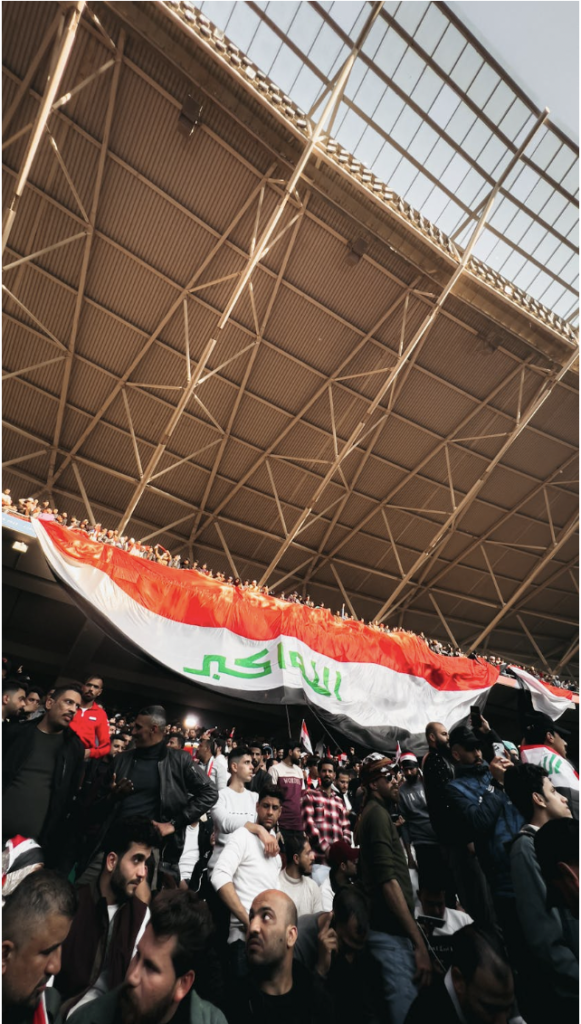
Photo Credit: Iraqi Soccer Fans in the Stands of a Stadium via Pexels.
There has been a great loss of hope amongst Iraqis, especially within the country’s youth, as division, violence, and war has been a never ending conflict for decades. The future for Iraq heavily depends on whether it could move past the sectarian debates and hierarchy, and come closer together in putting these differences aside and embracing national unity. Youth movements and groups are making strides in pushing for change, bringing hope for a new generation in Iraq where division is diminished. Without strong backing and reform this progress will remain very slow. Stability will require support from the Iraqi people. The government should prioritize Iraq its people’s needs to above sectarian and political interests.
Want more articles like this? Sign up for our e-newsletter!
Check our blog here!