
Subscribe
to receive news by email

Poll
Will the Trump Administration Shift U.S. Policy in Favor of Palestine?
- No (86%)
- Yes (14%)
 Loading ...
Copyright © 2026 Arab America
Go topIsrael’s Demographic Trap
By: Ghassan Rubeiz / Arab America Contributing Writer
In the Middle East, religion is less about faith in God than about trust in people: a lens for deciding who is friend and who is foe. Israel’s October 27 election may reveal where its sectarian politics is heading.
In an October 15 New York Times essay, Garry Kasparov, world chess champion from 1985 to 2000, frames the vote as a choice between “a secular Hebrew republic or a rigid rabbinical theocracy.” Ultra-Orthodox political power, he argues, is corroding the social compact that once held Israel together. The ultra-Orthodox, or Haredim, are about 14 percent of the population. They receive generous public funding, largely avoid military service, and shape daily life far beyond their numbers. With women averaging about six children, they are the fastest-growing community in the developed world.
The election matters. But no outcome will settle Kasparov’s question or easily slow Haredi influence. If Prime Minister Netanyahu survives the election and forms the new government, Israel stays its course: entrenched policies, corruption trials, recurring wars, and shrinking space for Palestinians on their own land. If the opposition wins, it may end draft exemptions and restore the Supreme Court’s authority. That would be reform at home, not a political horizon for Palestinians. Either way, Israel will keep what many call an apartheid system.
Israel is caught between two demographic pressures. One is internal: a growing Haredi population. The other is external: millions of Palestinians under Israeli control.
The internal pressure was built in at the founding of the state. In 1948, David Ben-Gurion exempted from military service a few hundred yeshiva students in order to reinvigorate Torah learning destroyed in the Holocaust. The rabbinate received authority over marriage, divorce and personal status. Today the exemption covers tens of thousands of Haredi men. A state founded on the Labor Zionist ideal of shared burden now faces a fiscal drain, a wartime manpower shortage, and a widening cultural rift. Secular Israelis increasingly feel like strangers among compatriots whose worldview they do not share.
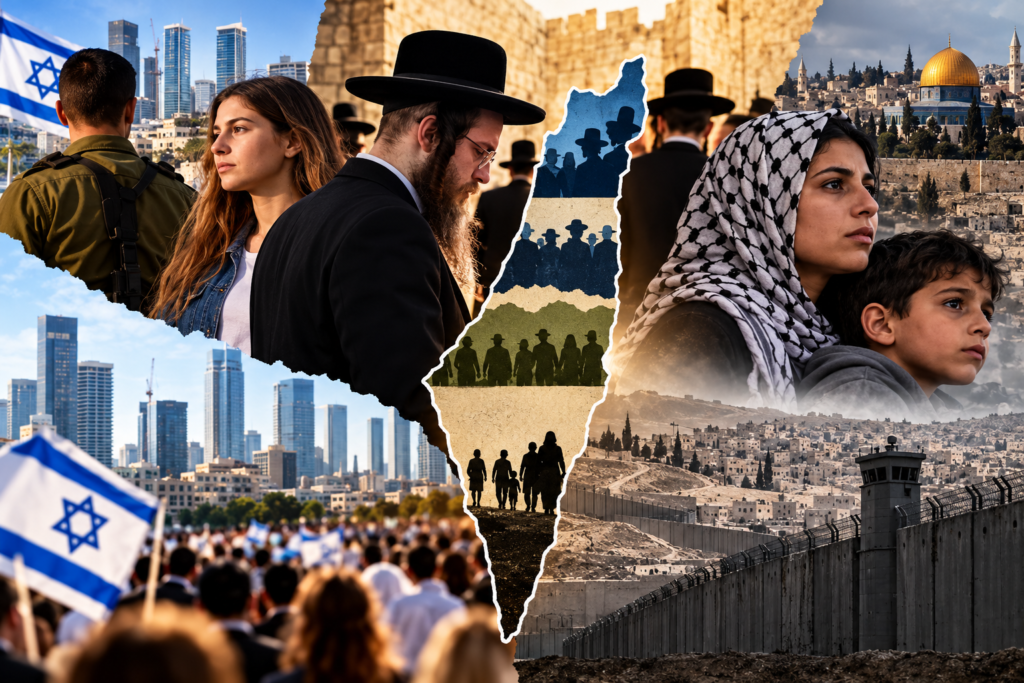
Currently there are four communities under four regimes in a state with undefined borders. Secular Jews carry full rights and full duties. Haredim enjoy full rights and fewer duties. Arab citizens vote and serve in the Knesset but hold second-class standing, coded by the 2018 Nation-State Law. Palestinians under occupation have few rights, little security, and no guarantee they can stay in their homes.
This sectarian orchestration resembles Lebanon’s sectarian order more than Israelis admit. Neither country allows the performance of civil marriage; Lebanese and Israeli couples alike travel to Cyprus to wed secularly. One difference is salient. Lebanon shares power among its communities, however dysfunctional. Israel manages its deepest divide, with the Palestinians, through force, surveillance and technology.
Israel’s failure to reconcile secular and religious Jews mirrors its inability to reconcile Jews and Arabs. Both are failures of identity politics, in which religion decides who is friend and who is enemy. Behaviorally, a secular Jew from Tel Aviv may have more in common with a secular Palestinian from Ramallah than with a Haredi from Mea She’arim.
Palestinians have long been among the more secular societies in the Arab world. I know this from experience: an international career working and living alongside Palestinians and Jews. Hamas complicates the picture, but religious militancy has never defined daily life for most Palestinians. Most never attend religious schools. Many speak Hebrew, work in Israeli housing and industry, and some serve in Israeli professions as doctors and pharmacists.
What largely divides the two peoples is not culture but elements of poor leadership and zero-sum politics. Israelis, occupying Palestinian land and scarred by October 7 and its aftermath, equate security with control. Palestinians experience that control as dispossession. As long as one people’s security requires the other’s loss of self-determination, no election or judicial reform will end the conflict.
What would change it? A new prime minister could open discussion of Palestinian self-determination. A new cabinet could improve policing in Arab towns to curb crime. It could replace the Citizenship and Entry into Israel Law, which bars most West Bank and Gaza Palestinians from living in Israel even when married to Israeli citizens, with a clear path to residence and work permits. It could give East Jerusalem Palestinians secure status that cannot be revoked at will. It could introduce civil marriage, freeing secular Jews from the rabbinate and sparing mixed couples the trip to foreign countries for marriage. And it could set a firm, public date for full withdrawal from Gaza. Each step would replace control with shared stake.
Arabs and Jews need not learn coexistence from scratch; history of past coexistence is clear. Jewish and Arab citizens already march together in movements such as Standing Together. In 2021, Ra’am became the first independent Arab party to join a governing coalition. After this election, Arab parties may again help decide who governs Israel. Partnership in power is the first step toward partnership for peace. Strategic steps in reform would might lead to avenues of peace making.
History may have placed Jews and Palestinians where they could show the wider region what coexistence looks like. The question is whether their leaders will allow it.
Ghassan Rubeiz is the former Middle East Secretary of the World Council of Churches. Earlier, he taught psychology and social work in his country of birth, Lebanon, and later in the United States, where he currently lives. He has contributed to political commentary for the past twenty years and delivered occasional public talks on peace, justice, and interfaith subjects. You can reach him at rubeizg@gmail.com
The views and opinions expressed in this article are those of the author and do not necessarily reflect the position of Arab America. The reproduction of this article is permissible with proper credit to Arab America and the author.
Want more articles like this? Sign up for our e-newsletter!
Check our blog here!