
Subscribe
to receive news by email

Poll
Will the Trump Administration Shift U.S. Policy in Favor of Palestine?
- No (87%)
- Yes (13%)
 Loading ...
Copyright © 2026 Arab America
Go topIsrael's Denial Syndrome: How Language Obscures Reality
By: Ghassan Rubeiz / Arab America Contributing Writer
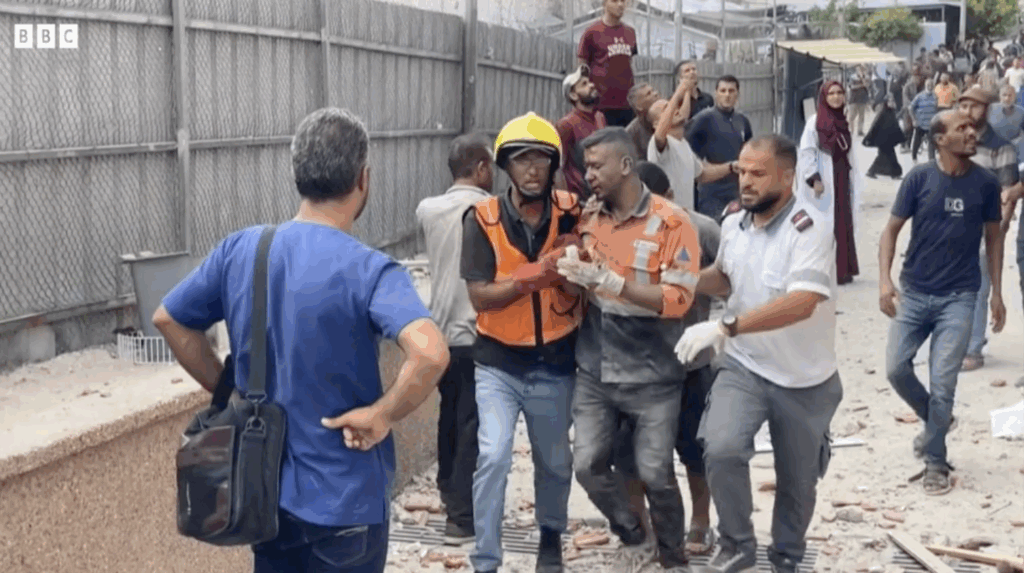
Last week, when five Palestinian journalists were killed in an Israeli bombing campaign that included Nasser Hospital—one of Gaza’s few remaining health facilities—Prime Minister Benjamin Netanyahu dismissed their deaths as a “tragic mishap.”
According to the Oxford Dictionary, a mishap is an “unlucky accident.” This linguistic sleight of hand reveals something far more troubling than poor word choice: it exposes a systematic pattern of denial that has become essential to maintaining Israel’s occupation and military campaigns.
The behavioral pathology of reframing avoidable tragedy as an accident is not isolated. Israeli leaders exhibit a cluster of symptoms—a denial syndrome—that constantly minimizes the impact of violence against those who refuse subjugation or dare to document it.
The War on Truth-Tellers
Israel’s targeting of those who bear witness to its actions follows a clear pattern. Over the past two years of war in Gaza, Israel has killed over 200 Palestinian journalists—an unprecedented record. This systematic elimination of media voices serves a strategic purpose: mass casualties among innocent populations require the silencing of those who report the news.
The assault on documentation extends beyond individual journalists. Not long before launching its Gaza offensive (in 2021), Israel closed the offices of six major human rights organizations that had been effective in exposing oppressive practices maintaining the occupation.
Teachers, doctors, nurses, and rescue workers—those whose professional duty involves preserving life and education—have faced particular targeting, their deaths later dismissed as “collateral damage” or “human shields” being used by Hamas.
Institutional Denial and Delegitimization
Israel’s denial mechanisms operate on multiple levels. When international legal institutions demand accountability, they too become targets of delegitimization. The International Court of Justice and International Criminal Court are dismissed as “antisemitic agencies” simply for charging Israeli leaders with unlawful behavior. Netanyahu accuses ICC of “antisemitic hatred” over arrest warrant.
European countries expressing willingness to recognize Palestinian statehood are accused of “rewarding Hamas.”
Even humanitarian agencies face systematic dismantling. UNRWA, the UN agency serving Palestinians displaced since 1948, has been forced to close its operations—not due to any proven widespread misconduct, but because its very existence acknowledges the Palestinian refugee crisis that Israel intends to deny.
Rewriting Identity and History
The denial syndrome extends to fundamental questions of identity and belonging. Israel’s two million Palestinian citizens are systematically labeled “Arab Israelis,” linguistically erasing their Palestinian identity. This nomenclature serves to disconnect them from the broader Palestinian experience and struggle.
Perhaps most audacious, Israel has attempted to monopolize the term “Semitic,” despite the fact that Arabs and most Israelites are both Semitic peoples with a shared ancient heritage. By claiming exclusive ownership of this identifier, Israel considers “antisemitic” any criticism of its policies, effectively diluting the term’s meaning and historical significance.
The Campus Front
Israel’s pressure in the US to stop expression of opposition to its occupation has expanded to American university campuses, where massive campaigns seek to silence academic discussion of the Arab-Israeli conflict or Palestinian liberation. Student organizations and professors face coordinated pressure whenever they attempt to examine Israel’s policies critically.
Language as Weapon
Throughout its military operations, Israel employs euphemistic language designed to obscure reality. Military campaigns become “operations” rather than wars. Assassination becomes “targeted elimination of evil.” The destruction of entire neighborhoods becomes “precision strikes.” Civilians become “human shields” when killed, transforming victims into co-conspirators in their own deaths.
The systematic use of the passive voice further distances Israeli actions from their consequences. Buildings “collapse,” children “die,” and hospitals “cease functioning”—as if these outcomes occurred through natural disasters rather than deliberate military action.
The Price of Denial
To maintain an occupation, Israel must deny its habitual excessive use of force. This requires constant reframing: disproportionate violence is necessary “defense of the right to exist,” collective punishment is security measures, and systematic oppression is temporary intervention for peace. Each denial becomes a building block in constructing an alternative reality: the occupier becomes the victim; resistance becomes terrorism.
Israel’s denial syndrome represents more than political spin or wartime propaganda. It constitutes a comprehensive system for maintaining a favorable international image in the face of overwhelming evidence of deviance from law and norms. By controlling language, delegitimizing witnesses, and rewriting history, Israel attempts to make the unconscionable appear reasonable.
However, denial has its time limits. The systematic nature of these mechanisms—from killing journalists to redefining identity—reveals their nefarious purpose. Truth has a way of emerging despite the most sophisticated denial systems: growing international recognition of Palestinian rights suggests that even the most persistent denials cannot indefinitely obscure reality.
The question facing the international community is not whether these denial mechanisms exist, but how long they will be allowed to substitute for accountability.
Ghassan Rubeiz is the former Middle East Secretary of the World Council of Churches. Earlier, he taught psychology and social work in his country of birth, Lebanon, and later in the United States, where he currently lives. He has contributed to political commentary for the past twenty years and delivered occasional public talks on peace, justice, and interfaith subjects. You can reach him at rubeizg@gmail.com
The views and opinions expressed in this article are those of the author and do not necessarily reflect the position of Arab America. The reproduction of this article is permissible with proper credit to Arab America and the author.
Want more articles like this? Sign up for our e-newsletter!
Check our blog here!