

Subscribe
to receive news by email

Poll
Will the Trump Administration Shift U.S. Policy in Favor of Palestine?
- No (86%)
- Yes (14%)
 Loading ...
Copyright © 2026 Arab America
Go topIsrael’s Politics of Military Strength Meets the Arab Vote
By: Ghassan Rubeiz / Arab America Contributing Writer
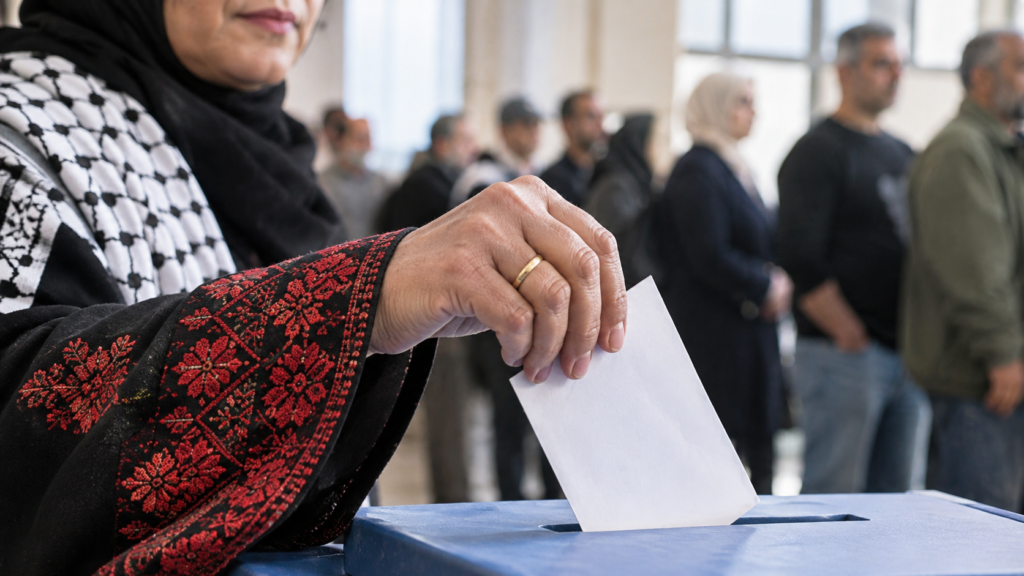
One of the most striking results of Israel’s October 27 election was not who won but who voted.
Palestinian citizens of Israel, nearly one-fifth of the population, turned out at an estimated 80 percent, likely higher than Jewish citizens, in an election whose overall turnout, nearly 78 percent, was the highest since 1999. Arab-led parties won 19 of the Knesset’s 120 seats, almost double their previous ten Knesset seats. Netanyahu’s bloc won 53 seats; Gadi Eisenkot’s opposition bloc won 48. Short of a national unity government, which President Isaac Herzog openly favors as he opens consultations, neither are expected to reach 61 without the Arab parties.
The Joint List and Ra’am are expected to recommend Eisenkot for prime minister, giving him 67 potential Knesset seats. Whether the Arab parties help make a government remains uncertain. That they matter is no longer in doubt.
Ahmad Tibi, a leader of the Joint List, an alliance of Arab-majority parties, explained the surge in the Arab vote: “Our community wanted to bring down this criminal government, to change the grave reality caused by the policies of Netanyahu, Smotrich and Ben-Gvir.” Rising crime in Arab towns, long neglected by Israeli police, added urgency.
Likud’s response was swift. It called the election “stolen by Arab parties that support terrorism and the elimination of the Jewish state,” and seized on a narrow Shin Bet inquiry into alleged foreign funding. Officials were unmoved. On Sunday, the head of the Central Elections Committee, flanked by the Shin Bet chief and the attorney general, declared that the results stand even if the suspicions prove true.
The reaction is revealing. Much of the Jewish public lives in a different political space from its Arab compatriots. Security is not understood as the product of equality, minority protection, or regional reconciliation. Rather it is understood as strength: demographic advantage, military superiority, territorial control, technological edge, and alliance with the world’s superpower.
Netanyahu ran on the slogan “Either the Right or Palestine.” Eisenkot, a former army chief, kept Arab parties at arm’s length. His camp includes Naftali Bennett and Avigdor Liberman, who reject any partnership with Arab lawmakers. He now demands that any partner recognize Israel as a Jewish state, accept national service for all, and brand Hamas a terrorist organization. The real contest was never Netanyahu versus the opposition but over who could best preserve Israel’s dominance.
Yet the results point to another possibility: that sharing power with Arab citizens could reinforce Israel’s strength, in a broad sense and not threaten it. Many Arab voters have concluded that influence requires engagement, not abstention. They no longer merely protest the system. They intend to change it from within.
A few Jewish leaders have noticed. “Netanyahu lost. I know how to count to 120,” wrote Yair Golan, head of the left-wing Democrats , an opposition party, calling for an alliance with the Arab parties. Thousands have since rallied for a Jewish-Arab government. Palestinian’s enthusiasm for voting is sending a positive message.
Arab leaders are realistic. The Joint List’s Yousef Jabareen says his party will not join a coalition while the Gaza war and West Bank settlement policy continue, but could support an alternative government from outside. Tibi asks for no ministries, only commitments to fight crime in Arab communities and stop the demolition of Bedouin homes. On the other hand, Ra’am’s Mansour Abbas says Eisenkot’s conditions pose no obstacle.
There is precedent. In 2021, Abbas brought Ra’am into the Bennett-Lapid government, the first independent Arab party to join an Israeli coalition. The partnership delivered: a $9.4 billion plan for jobs, health, housing, and infrastructure in Arab communities, and recognition of several Bedouin villages. The state did not weaken. It governed more of its citizens.
A government that depends on Arab votes would establish a principle: Arab citizens are legitimate partners in governing the state. It would not resolve the issues of Gaza, West Bank settlements, Palestinian refugees in neighboring countries, or Israel’s national identity. It would change who sits at the table.
Partnership is not a concession to a minority. It is an investment in the state, and in an alternative idea of security, rooted in legitimacy, equality, and mutual recognition.
Washington matters too. Last Saturday, Netanyahu pressed Trump to resume the war on Iran immediately after Tuesday’s midterms; Trump prefers to give talks time. Mitchell Plitnick, writing in MondoWeiss on October 1, warned that both elections could tempt the two leaders to renew the war to save themselves politically. A White House less eager for war would leave Israel’s opposition with less to fear, and more room to think beyond strength.
The politics of strength still dominates Israel. The deeper question is whether strength alone can secure its future. No election, military campaign, or fragile coalition will answer that. Only the slow work of partnership will. Neither Israelis or Palestinians can build a stable future without the other.
Whatever coalition emerges, Palestinian citizens of Israel made the right choice: voting with hope.
Ghassan Rubeiz is the former Middle East Secretary of the World Council of Churches. Earlier, he taught psychology and social work in his country of birth, Lebanon, and later in the United States, where he currently lives. He has contributed to political commentary for the past twenty years and delivered occasional public talks on peace, justice, and interfaith subjects. You can reach him at rubeizg@gmail.com
The views and opinions expressed in this article are those of the author and do not necessarily reflect the position of Arab America. The reproduction of this article is permissible with proper credit to Arab America and the author.
Want more articles like this? Sign up for our e-newsletter!
Check our blog here!