
Subscribe
to receive news by email

Poll
Will the Trump Administration Shift U.S. Policy in Favor of Palestine?
- No (87%)
- Yes (13%)
 Loading ...
Copyright © 2026 Arab America
Go topKilling of “Palestinian Pele” Leads to Reckoning in European Soccer
By: Jake Harris / Arab America Contributing Writer
Suleiman al-Obeid, labelled by Palestinian Soccer fans as the “Palestinian Pele” was killed by the IDF on August 6th, 2025 while awaiting humanitarian aid in Gaza. Suleiman was one of Palestine’s national team regulars throughout the prime of his career. Sadly left behind is his wife and five children. Al-Obeid was a regular in the Palestinian Football Association’s two major domestic competitions. He was the top scorer in the Gaza Strip Premier League for the 16/17 season. He also played in the West Bank Premier League as well.
UEFA “Palestinian Pele” post
Two days after his murder, al-Obeid was mentioned in a tweet by UEFA, the governing body for soccer in Europe. He was mentioned in an X post honoring his life and career with no mention of how he died or who killed him. While this was done presumably to avoid backlash from the Israeli FA, a member of UEFA, it was still widely criticized around the soccer world. Egyptian player Mohamed Salah, one of the best players in the history of the English Premier League quoted the post saying “Can you tell us how he died, where, and why?”.
UEFA, and the Gaza War
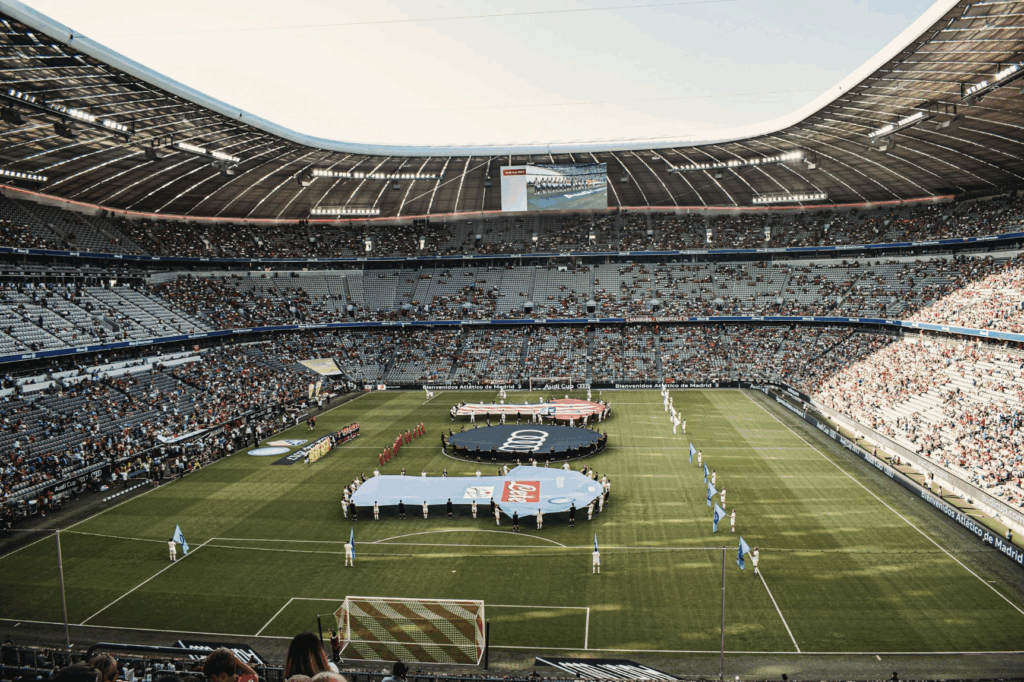
Celtic, a Scottish soccer club with a strong pro-Irish, pro-catholic, political, and religious identity has a fanbase that overwhelmingly resonates with the Palestinian cause. The club was fined over 15,000 pounds for pro-Palestinian banners and flags displayed by fans. This occured during Celtic’s Champions League match against Atletico Madrid in 2023.
A conversation among fans and journalists was reignited by the controversy. That conversation being the question as to whether Israel should be banned from major competitions by UEFA and FIFA. Following the 2022 Russian Invasion of Ukraine as well as the state-sponsored doping scandal, Russia’s national team was banned from qualification for the European Championship, and the World Cup. This comes just four years after Russia hosted the World Cup. Israel were originally members of the Asian Football Confederation until 1974. Multiple boycotts and a vote of expulsion led by Kuwait led to Israel being out of AFC. Israel joined UEFA as full members in 1994. Relations with Europe were significantly warmer than relations with the Muslim World, many of the latter being Asian countries.
Possibility of a Ban
The BDS movement, (Boycott, Divest, Sanction) called for Israel to be banned from competition.
UEFA President Alexsander Čeferin, in a recent interview with a Slovenian TV network, opened the door to a possible ban. Čeferin called the question of allowing Israel to compete a “legitimate question”. This is a noticeable shift in UEFA’s attitude towards the controversy.
UEFA Super Cup Banner Controversy
A few days prior to the interview, an unprecedented show of solidarity to innocent victims of armed conflict everywhere occurred before the UEFA Super Cup match between Europa League winners Tottenham Hotspur, and Champions League winners Paris Saint Germain. A banner was held prior to the match on the field that displayed the words “Stop Killing Children. Stop Killing Civilians”.
The banner has faced backlash on both sides of the issue. Amnesty International criticized the banner as showing “cowardice” for mentioning the crime but not the perpetrator. Campaign Against Antisemitism accused UEFA of selective outrage and not acknowledging Jewish victims as well as the hostages kidnapped on October 7th. UEFA president Alexsander Čeferin actually condemned the October 7th attacks 5 days after on October 12th, 2023. Čeferin called the attacks a senseless act of violence. He also wrote a personal letter of condolence to the chairman of the Israeli FA.
Politics and Sports: Forever Intertwined
The phrase “politics need to stay out of sports” is a commonly used argument among sports fans who believe there should be an impenetrable barrier between current events and sports. The truth is politics and sports have always been intertwined. Muhammed Ali’s refusal to fight in Vietnam led to him being banned from Boxing. Colin Kaepernick never played a snap of professional football again following the aftermath of his national anthem protest. Athletes in team sports may seem like robots in a well oiled machine on the field of play, but they are human beings. They are aware of the life, and death decisions governments and militaries make in the world each day. Global Politics have an impact on citizens across the globe, including the athletes we see as stoic heroes. The death of the “Palestinian Pele” has made Soccer and Gaza inseperable.
Want more articles like this? Sign up for our e-newsletter!
Check our blog here!