
Subscribe
to receive news by email

Poll
Will the Trump Administration Shift U.S. Policy in Favor of Palestine?
- No (87%)
- Yes (13%)
 Loading ...
Copyright © 2026 Arab America
Go topNazi Spies in Egypt: Operations SALAM and CONDOR
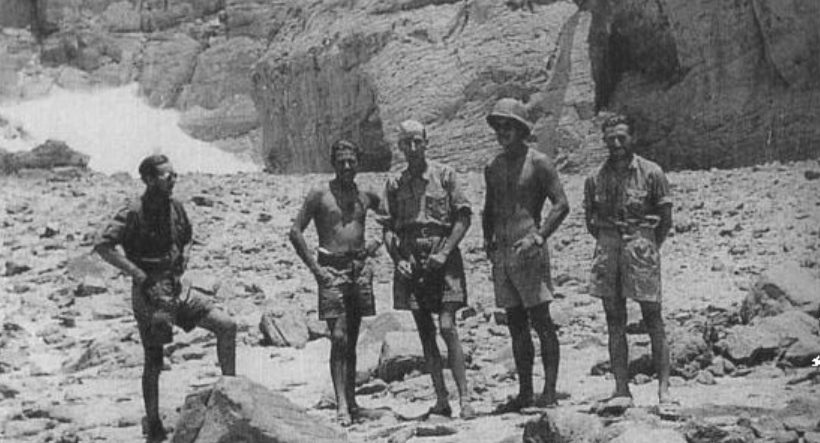
See page for author, Public domain, via Wikimedia Commons
By Liam Nagle / Arab America Contributing Writer
1942. The world is in the midst of the Second World War. Axis powers are working together in North Africa. They seek to dislodge Britain and the Allies from colonial holdings in Egypt and beyond. The British were reeling from their attacks. It was becoming unclear whether or not the Axis might reach Cairo and the Suez Canal. During this time, two German intelligence agents infiltrate British-held Egypt. Their goal? To record Allied troop movements while Egypt was in a period of crisis. After having driven across the desert, the two spies integrated themselves into Egyptian society and attempt to find friendly informants.
Sources differ on the effectiveness of the operations, but the spies were ultimately unsuccessful. They were more keen to spending their funds on riches rather than actually accomplishing their mission. This is an interesting account of a spy operation in Egypt during World War II. It involves deception, nightclubs, and even a young Anwar Sadat.
Operation SALAM
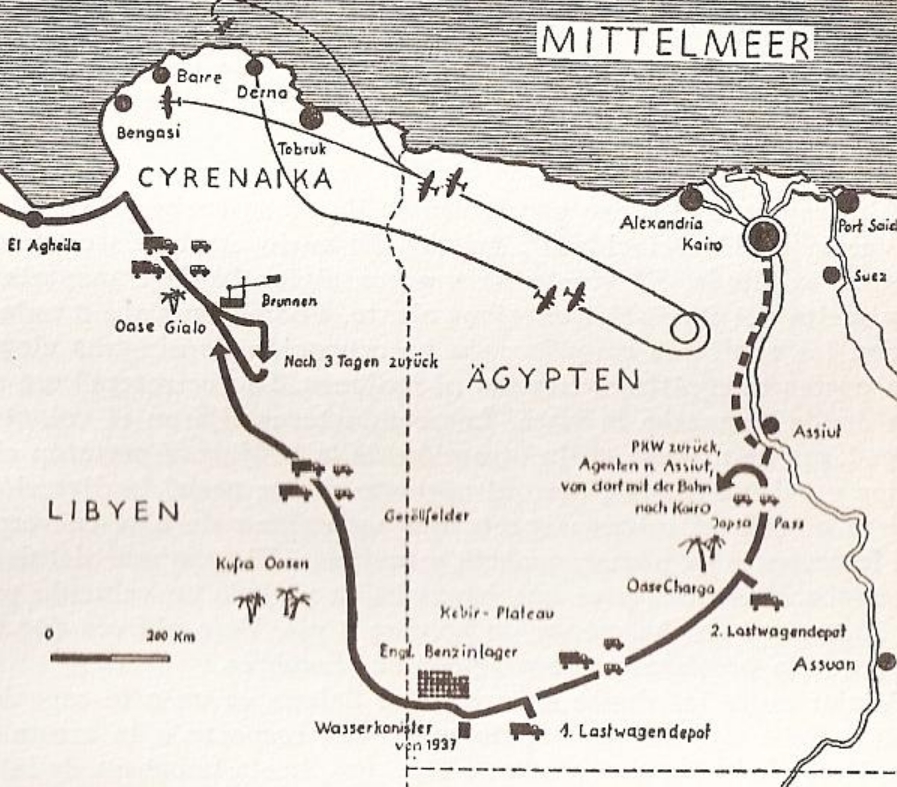
It would be easy to misinterpret that Operation SALAM was a reference to the Arabic word “Salaam”. However, this doesn’t appear to be the case, as well official documents refer to the operation with two, single a’s. Nevertheless, the origin of the term itself appears unknown, with some believing it was an anagram of one of the people involved in the operation, László Almásy. Operation SALAM was used to refer to the infiltration into British Egypt. Operation CONDOR was used to refer to the actual spy work and reports. SALAM would see a small convoy of cars travelling across parts of the open desert, passing through or near some oases, before eventually reaching the Nile River to drop off the spies.
Almásy was one of three key figures in Operation SALAM. A Hungarian explorer who had trekked through the Libyan and Egyptian deserts before, he would be tasked with delivering the two German operatives to Egypt for their mission. The two operatives themselves were Johannes Eppler and Hans Gerd Sandstede. They were tasked with infiltrating Egyptian society, establishing contact with informants, and collecting information about Allied troop movements via radio. These movements would then be sent back to the German command in North Africa. Eppler and Sandstede were both experienced radio operations, and the radio equipment they carried was no less complex. Having been built by Sandstede himself, the equipment was installed within a gramophone cabinet. The radio operator would sit near the cabinet and send morse code transmissions, while the gramophone itself continued to play music.
Initial Infiltration
The first attempt at getting the spies into Egypt was made on the 29th of April, 1942. The convoy departed and reached the Jalo Oasis in Libya. They travelled east from here, where maps detailed a firm and flat gravel desert. Instead they encountered several low dunes that were unmarked on the map. Several members of the convoy fell sick, and one of the cars’ axels was broken due to the rough terrain, forcing the team to withdraw and try again.
The convoy would attempt the operation a second time, instead following a new route that Almásy had explored ten years earlier. They travelled across the Gilf Kebir, bluffed their way through the Kharga Oasis, and then dropped Eppler and Sandstede off near the city of Asyut. While the convoy itself turned back towards friendly lines in Libya, the two operatives moved north to Cairo by train. Operation SALAM was successful.
Operation CONDOR
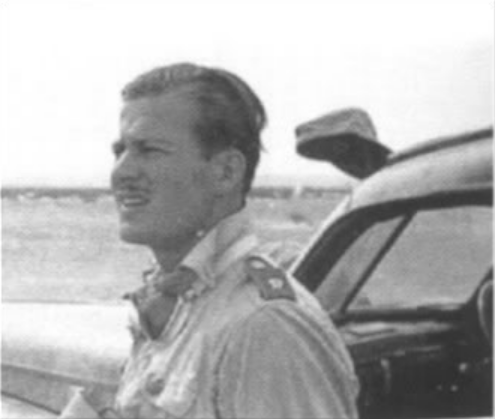
Now, it was time for the spies to settle down and begin finding informants. Making it to Egypt and on their way to Cairo, Eppler and Sandstede took up false identities. Eppler went under the name Hussein Gaffar, their false identity stating that he had grown up in Alexandria and Cairo and whose mother had remarried into a wealthy Egyptian family. He also took up another false identity on occasion, stating that he was a lieutenant in the British military that was on leave. Sandstede took the name Peter Monkaster, posing as an American because Sandstede had worked in the U.S. petroleum industry before the war. Once in Cairo, the two rented a houseboat on the Nile. They installed the gramophone cabinet to establish contact with the German command in Africa, and went to work trying to find information.
Conflicting Stories
This is where sources get tricky, with there being conflicting stories. Eppler himself wrote a book about the operation. In it, he claims that he and Sandstede received information from dancers and escorts in Cairo’s various nightclubs. Among these was Hekmet Fahmy, a belly dancer and Egyptian nationalist who had known Eppler when the two were younger. The dancers and escorts were prime informants for the two spies, as the nightclubs were frequented by various Allied soldiers who were on leave. From here, Eppler and Sandstede were briefly able to report troop movements to their commanders, until communication issues developed and necessitated contact with the nascent Free Officers Movement in Egypt. The Free Officers sent a young Anwar Sadat – the future president of Egypt – to assist in fixing their radio. However, the two operatives would eventually be captured by the British some time later.
However, other sources seem to point in another direction. Eppler’s account seems flawed, not least because of the results of their interrogations by the British. In truth, Eppler and Sandstede would never make contact with their German commanders; following an Allied counterattack, the German forward headquarters had been overrun, and the radio operators that would receive Eppler and Sandstede’s transmissions would be captured by the British. Meanwhile, Eppler and Sandstede were not nearly as dedicated to their mission as it might seem. Instead, the two spent the funds allocated to them – most of which were forgeries – on living in luxury. Anwar Sadat himself stated that after he had been sent to fix the spies’ radios, he came to his own conclusion; Eppler and Sandstede had deliberately sabotaged their own radio because they wanted to continue enjoying themselves while living with two prostitutes.
British authorities catch on
Various leads, including the use of forged currency, led to the British authorities raiding the spies’ houseboat hideout. The two attempted to flood the boat but failed, followed by Sandstede attempting to commit suicide before being stopped by the British arrested. The interrogations conducted after this raid seemed to conform to Sadat’s recollections – the two spies, in order to spare themselves from execution, cooperated with the investigators. This eventually led to the arrest of Hekmet Fahmy and Anwar Sadat, with Sadat even sharing a cell with Eppler. After being imprisoned, all of them would be released some years later. Operation CONDOR was a failure. Later in the war, the Axis forces in North Africa would be pushed out of the continent, resulting in Britain and France’s colonial holdings remaining secure – at least, until after the war.
Check out our Blog here!