
Subscribe
to receive news by email

Poll
Will the Trump Administration Shift U.S. Policy in Favor of Palestine?
- No (87%)
- Yes (13%)
 Loading ...
Copyright © 2026 Arab America
Go topNUSACC Welcomes Oman’s New Ambassador to the USA
Roundtable Focuses on Oman – U.S. Relations, Including the Sultanate’s Role as Peacemaker and Trusted Mediator
“Our longstanding partnership, built on mutual respect and shared interests, continues to be a source of strength and unity.” – H.E. Talal Al-Rahbi, Oman’s Ambassador to the United States
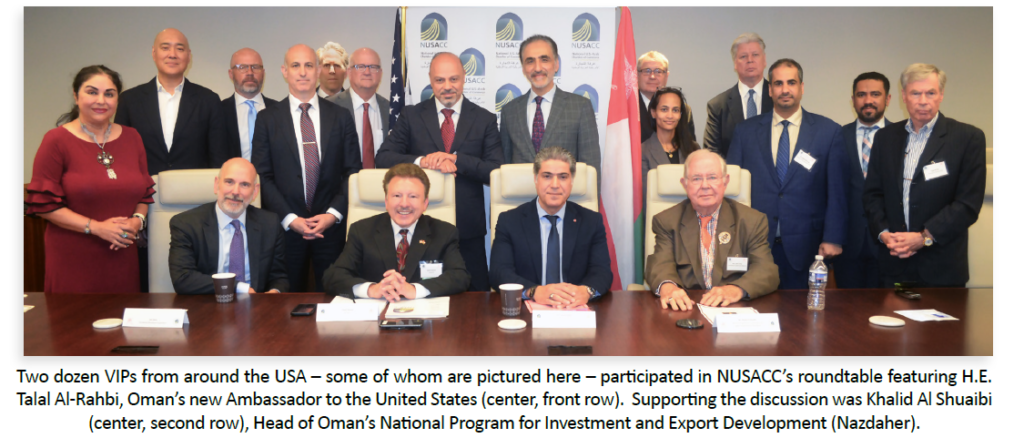
This past week, the National U.S. – Arab Chamber of Commerce (NUSACC) – America’s #1 commercial gateway to the Middle East and North Africa (MENA) region – organized an off-the-record roundtable to welcome Oman’s new Ambassador to the United States, H.E. Talal Al-Rahbi. Held in partnership with the Embassy of the Sultanate of Oman, and hosted by Occidental Petroleum, the roundtable included 25 select companies that are exploring Oman as a regional market.
“It was an honor to participate in such a dynamic exchange of ideas and to be part of
the ongoing dialogue on promoting Oman’s economic and tourism potential,” noted Al-Rahbi. “The event provided a meaningful platform for constructive engagement and reaffirmed the
deep and historic ties between the Sultanate of Oman and the United States. Our longstanding partnership, built on mutual respect and shared interests, continues to be a source of strength and unity.”
Al-Rahbi, who began his term in Washington DC in March 2025, has played an instrumental role in all of Oman’s major development initiatives in the past 20 years. (To access his bio, please click here.) As such, he has held a “front row seat” to Oman’s growing role as a regional hub for business.
“Our Chamber is pleased to welcome Ambassador Al-Rahbi to Washington DC,” noted David Hamod, President & CEO of NUSACC. “His arrival comes at a particularly important time for Oman – U.S. relations, including the vital role that the Sultanate plays as a peacemaker and respected mediator in the region.”
At the behest of His Majesty Sultan Haitham bin Tariq Al Said, H.E. Badr bin Hamad Al Busaidi – Oman’s Foreign Minister – is playing a lead role in efforts to de-escalate the current crisis in the Gulf region.
Oman’s Visionary Plans
Oman Vision 2040 is the cornerstone of the Sultanate’s capacity-building initiatives. This national development strategy focuses on economic diversification, building human capital, enhancing social welfare, ensuring environmental sustainability, and strengthening public – private partnerships. It is designed to make Oman more competitive globally and less reliant on hydrocarbons.
An implementing arm of Oman Vision 2040, Renaissance 2.0, revolves around institutional accountability and long-term economic sustainability. This is a driving force behind efforts to strengthen the private sector in Oman by creating jobs, attracting investment, and fostering innovation.
With a special focus on such non-oil sectors as logistics, tourism, manufacturing, and green energy, Oman is inviting local and international companies to participate in public-private partnerships (PPPs), which frequently include business investment of around 20 – 30 percent. In this same spirit, Oman is paving the way for privatization initiatives in industry, infrastructure, utilities, and service sectors.
Oman’s 11th Five-Year Development Plan (2026 – 2030), led by the Ministry of Economy, will emphasize decentralized development by empowering Oman’s governorates and reinforcing institutional and fiscal reform. The plan is expected to launch in early 2026, highlighting a shift toward non-oil revenues and enhanced public-private coordination.
The coming phase of Oman’s development marks a generational transition in economic governance, shifting from state-led development to a more decentralized, competitive, and innovation-driven economy.
Oman as a Global Leader in Green Hydrogen?
Oman’s most ambitious initiative is its green hydrogen strategy, designed to make the Sultanate a global leader in the production of hydrogen. According to Hydrom, the Sultanate’s hydrogen master planner, Oman is on track to produce one million tons/year by 2030 and 8.5 m. tons/year by 2050.
These volumes will position Oman among the top ten global producers by mid-century, roughly on par with larger economies:
Australia – Targeting up to 10 m. tons/year by 2050
Saudi Arabia – NEOM’s “Helios” project is targeting 1.2 m. tons/year by 2030
EU (27 nations) – Targeting 10 m. tons/year by 2030
Oman is on track to be the largest hydrogen exporter in the MENA region and among the top five globally (by export volume) by 2050. According to the International Renewable Energy Agency (IRENA), the Sultanate is top-ranked globally for cost competitiveness of green hydrogen.
By 2050, according to the International Energy Agency (IEA) and the Hydrogen Council, Oman’s 8.5 m. tons/year would represent roughly 12 – 15 percent of projected global trade volumes (assuming that global demand is on track to hit ~70 m. tons/year).
H.E. Salim Al Aufi, Oman’s Minister of Energy and Minerals, said recently, “We are not looking at hydrogen as just a trend. We are building a full-scale, future-facing industry for export and domestic use.”
Oman has already awarded over 3,000 km² for green hydrogen production to international consortia. Some of the Sultanate’s competitive advantages include:
• Low-cost solar and wind resources, among the highest capacities globally
• Extensive land available, especially in Duqm and Dhofar
• A dedicated hydrogen entity (Hydrom), which streamlines permitting, infrastructure, and offtake agreements
• Export infrastructure – pipelines and ammonia terminals – designed for European and Asian markets
According to Hydrom, the Sultanate’s hydrogen projects could attract $140 billion in investment over 25 years.
Multi-Modal Infrastructure
H.E. Qais Mohammed Al Yousef – Oman’s Minister of Commerce, Industry and Investment Promotion – recently characterized business development with the Sultanate this way: “In Oman, we believe investment is not a transaction, it’s a partnership . . . Opportunities open doors, but relationships build bridges.”
Building bridges – literally and metaphorically – is what Oman is all about. The Sultanate has prioritized multi-model infrastructure in a variety of ways:
• GCC Rail – The first leg of the 2,177-kilometer Gulf Cooperation Council (GCC) rail network broke ground one year ago. Stretching from Sohar (Oman) to Abu Dhabi (UAE), about 238 km, a trip on the initial Oman – UAE line will take approximately one-and-a-half hours. While Oman’s national rail network (~2,135 km) is still in the planning stages, the basics of GCC-wide rail integration are on track for 2030.
• Oman’s Five Economic Zones – Managed by Oman’s Public Authority for Special Economic Zones and Free Zones (OPAZ), the five economic zones include: Three Free Zones (Sohar, Salalah, Al Mazunah), which offer 100 percent foreign ownership, tax exemptions, and customs incentives; Two Special Economic Zones – Duqm & Knowledge Oasis Muscat – with a focus on manufacturing, logistics, technology, pharmaceuticals, and energy.
These zones provide one-stop services and investor-friendly conditions to boost local content and attract foreign direct investment (FDI). H.E. Ali Al Sunaidy, Chairman of OPAZ, says this about Oman’s evolving multimodal and clustered industrial growth strategy: “OPAZ policies are aligned with Oman’s industrial strategy, which focuses on sectoral clustering – grouping complementary industries in dedicated zones to deepen value chains and boost economic resilience.”
In Sohar, for example, Vale S.A. (Brazil) has created an iron ore pelletizing plant in partnership with the Government of Oman. (Vale holds a 70 percent stake, while 30 percent is owned by OQ, Oman’s national energy company.) At full capacity, the plant will produce 9 m. tons/year of direct reduction pellets, while a distribution center will manage 40 m. tons/year of iron ore and pellets. This facility supports Vale’s global seaborne iron ore business by creating a blending and distribution node that is close to end-users and markets.
In Duqm, the Special Economic Zone Authority (SEZAD) was established by Royal Decree in 2011. Facing the Arabian Sea, it is growing rapidly as an industrial and logistics hub, including oil and gas.
The Ras Markaz crude oil storage and export terminal at Duqm, for example, is composed of eight tanks with a 200 million‑barrel capacity, connected to the Duqm refinery by an 80 km. subsea pipeline.
Tourism & Hospitality
Tourism in the GCC countries is surging. While some of Oman’s neighbors are getting most of the limelight – especially Saudi Arabia and the UAE – the Sultanate has quietly established itself as a niche destination, especially in high-end and luxury segments, including eco-tourism.
Thanks to publications like Travel + Leisure and Conde Nast Traveller , Oman’s tourism profile in the United States is rising. And across the MENA region, the Omani port city of Sur served as the 2024 Arab Tourism Capital.
According to the World Travel & Tourism Council (WTTC), Oman’s hospitality sector is poised to reach unprecedented heights with strong government support and a variety of strategic initiatives.
In the first quarter of 2025, for example, international arrivals are up five percent over the same period in 2024, outpacing the broader Middle East region. Recent data show stable growth throughout 2025, especially visitors from regional markets like the UAE.
Tourism has doubled over the past decade to more than four million tourists per year, with a number of high-end hotel properties opening in recent years. According to Oman’s Ministry of Heritage and Tourism, the hospitality sector is expected to receive total investment of $31 billion by the year 2040.
According to Cavendish Maxwell, Oman has 270 hotels with a combined 24,000 rooms. About 5,800 more rooms are expected by 2030 across 35 new projects. While these numbers are modest by some standards, they represent a significant uptick in tourism and hospitality in the Sultanate.
The United States and Oman share an Open Skies agreement, which allows for unrestricted service by airlines of both countries. Oman Air is in the process of joining the OneWorld alliance, which is expected to pave the way for nonstop air service to the United States.
Concluding Words
Occidental Petroleum (Oxy), which hosted the Oman roundtable, has been operating in Oman since 1979. Oxy is the largest independent oil producer in Oman, as well as the top U.S. investor in the Sultanate.
“Occidental was very pleased to host this roundtable to welcome Ambassador Al-Rahbi to the USA,” noted Ian Davis, Oxy’s Vice President for Government Relations. “Oxy has been privileged to operate for decades In Oman and to be one of the country’s largest foreign investors. It is truly a great place to do business, with one of the most talented workforces anywhere in the world.”
“The U.S. – Oman relationship is strong and benefits both nations and our two peoples,” said Hon. Timothy Lenderking, who attended the roundtable. Lenderking is Acting Principal Deputy Assistant Secretary in the Bureau of Near Eastern Affairs at the U.S. Department of State. “We appreciate the friendship between the two countries and look forward to deepening this relationship in the political and economic realms, where we are already working closely together.”
Ambassador Al-Rahbi concluded, “I was particularly grateful for the presence of so many distinguished men and women – leaders, experts, and friends of Oman – whose strategic contributions have played a role in strengthening Oman’s visibility and growth across key sectors. Their insights and commitment are instrumental in advancing our shared goals.”
To read the full report in PDF, please click here.
Want more articles like this? Sign up for our e-newsletter!
Check out our blog here!