

Subscribe
to receive news by email

Poll
Will the Trump Administration Shift U.S. Policy in Favor of Palestine?
- No (87%)
- Yes (13%)
 Loading ...
Copyright © 2026 Arab America
Go topOil to Air: The Rise of Aviation in Gulf Cities

By Ben Samuels/Arab America Contributing Writer
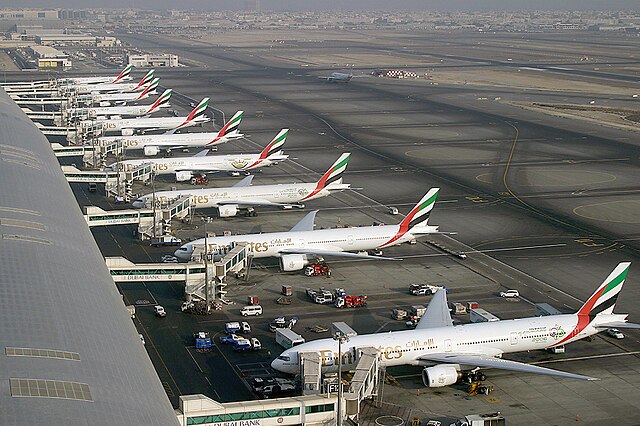
Many people who have flown or are considering a trip from the U.S. or Europe to nations across the globe likely noticed that a direct flight may not have been an option, and the connection choices often included Dubai, Doha, or Abu Dhabi. This is no mistake. Ever since development started in the mid-2000s, these Gulf cities have become international aviation hubs, connecting major nations. These cities have always had airports; Dubai’s (DXB) international airport opened in 1960 as a regional airport, but underwent massive renovations in the mid-2000s, with the transformation completed in the 2010s. Abu Dhabi International Airport opened in 1982; however, it has grown into a massive hub with the expansion of airlines like Etihad, and in 2023, it was renamed Zayed International Airport, which now rivals DXB. Finally, Doha International Airport opened in 1959, also as a small regional airport; however, it was formally replaced by Hamad International Airport in 2014 as a modern hub for passengers. Overall, these hubs serve many roles for their respective nations. Both the UAE and Qatar are major oil exporters, and their expansion into travel and aviation adds an additional facet to their economies. Also, playing the role of a “connector” paves the path for soft power and influence. Finally, the geographic location is a motivator, as these cities are reasonable hubs for many cities across the globe, making the expansion worthwhile.
Diversification from Oil
Nations like Saudi Arabia have employed strategies such as Saudi Vision 2030 to diversify their economic portfolios; however, the UAE and Qatar are generally viewed as ahead of the game in this realm. Both the UAE and Qatar are largely viewed as major oil exporters, which is true, as the UAE exports around 2.7 million barrels of crude oil per day and Qatar exports around 500,000 barrels per day. This has led to a desire for diversity for a variety of reasons, ranging from economic stability to more jobs for citizens. For example, diversification has been quite apparent in the UAE, as the non-oil share of GDP rose to 77.3%, up 3.9% from the last check as of September 2025. More specifically, the airports generate substantial revenue through large airlines such as Emirates and Qatar Airways, which are based in the Gulf cities of Dubai and Doha. These airlines charge high prices for their long-haul flights, which generate massive revenue, as well as a large-scale presence in cargo, a huge side of aviation that isn’t often recognized. In addition, Emirates is state-owned, so much of the airline’s profit goes back into the UAE economy, unlike other airlines, where profits go to shareholders who can be based anywhere. In addition, airport hubs generate mass tourism, boosting the nation’s overall revenue. The expansion of airports creates more jobs for locals, as these large airports require significantly more maintenance than older, smaller regional airports, which don’t hire nearly as many people. DXB reportedly employs around 90,000 people and indirectly supports over 400,000 jobs, which is substantial to the UAE’s employment rate and directly correlates with the economy. In addition, Zayed International employs about 20,000, and Hamad International employs about 45,000. Overall, these airport hubs have enabled the massive cash cow that is the airline industry to fully take off while also creating hundreds of thousands of jobs without touching the oil industry.
Strategic Global Positioning
In addition, there’s more to the airport hubs than purely economic interest. The global positioning of these nations makes them a quintessential part of travel, as these cities often serve as the “connector” between Europe, Asia, and Africa, as well as some U.S. routes into Asia. This role helps spread influence and shape perceptions of nations, as airlines such as Emirates, Qatar, and Etihad are often referred to as the pinnacle of flying due to their high standards of passenger treatment and overall service. This helps build the notion of an “advanced” nation, often to the Western eye, as their flagship airlines are seen in a highly positive light. Also, the airport hubs position the nation as a central hub, leading to more diplomatic and business-oriented interactions, which, in turn, gives these Gulf states greater international power and puts them on the map in a more physical sense.
Conclusion
In conclusion, the expansion of airport hubs in Gulf cities has enabled economic diversification away from oil and has enabled these nations to spread influence and shape perceptions through their key global positioning. The role of a “connector” helps push these nations into broader global conversations while simultaneously boosting their economies and employment rates. The airports that could be seen as just aviation centers are truly a key part of a highly strategic advancement in Gulf cities.
Want more articles like this? Sign up for our e-newsletter!
Check out our blog here!