Subscribe
to receive news by email
Poll
Will the Trump Administration Shift U.S. Policy in Favor of Palestine?
- No (87%)
- Yes (13%)
 Loading ...
Copyright © 2026 Arab America
Go topPalestine's Rich Coffee Culture
By: Robert Jackson / Arab America Contributing Writer
Palestine has an intense coffee culture. It is a ceremony, a community bonding experience, and a statement of identity. It has brought families and friends together for generations. From the snacks, traditions, methods of brewing, and more, Palestinian coffee culture is a truly distinct part of Arab culture. The smell of freshly roasted beans is familiar across cities, villages, and refugee camps alike. Each sip carries layers of history, hospitality, and resilience. It has served to weave Palestinians together for centuries, no matter where they live. Through the Palestinian diaspora, still deeply connected to their homeland, this drink’s unique flavors and customs have spread across the globe.
The Origins
Coffee spread to Palestine sometime in the 16th century. Originating in Yemen, it made its way north through trade routes along the Hijaz. It soon became a symbol of sociability and refinement. By the time coffeehouses appeared in cities like Jerusalem, Nablus, and Gaza, they were already spaces of lively conversation, poetry, and political discussion. These early coffeehouses became the pulse of urban life and would have been central to creating a unified Palestinian identity.
While coffeehouses in Istanbul or Cairo might have catered to the elite, in Palestine, they were strikingly communal. Farmers, traders, and scholars alike could sit at the same table. It became a democratizing beverage, cutting across class lines. By the 19th century, it had become a central part of both public and domestic life, served in homes and tents, at weddings and funerals, and in the quiet of the morning before the day’s labor began.
Coffee Brewing Traditions
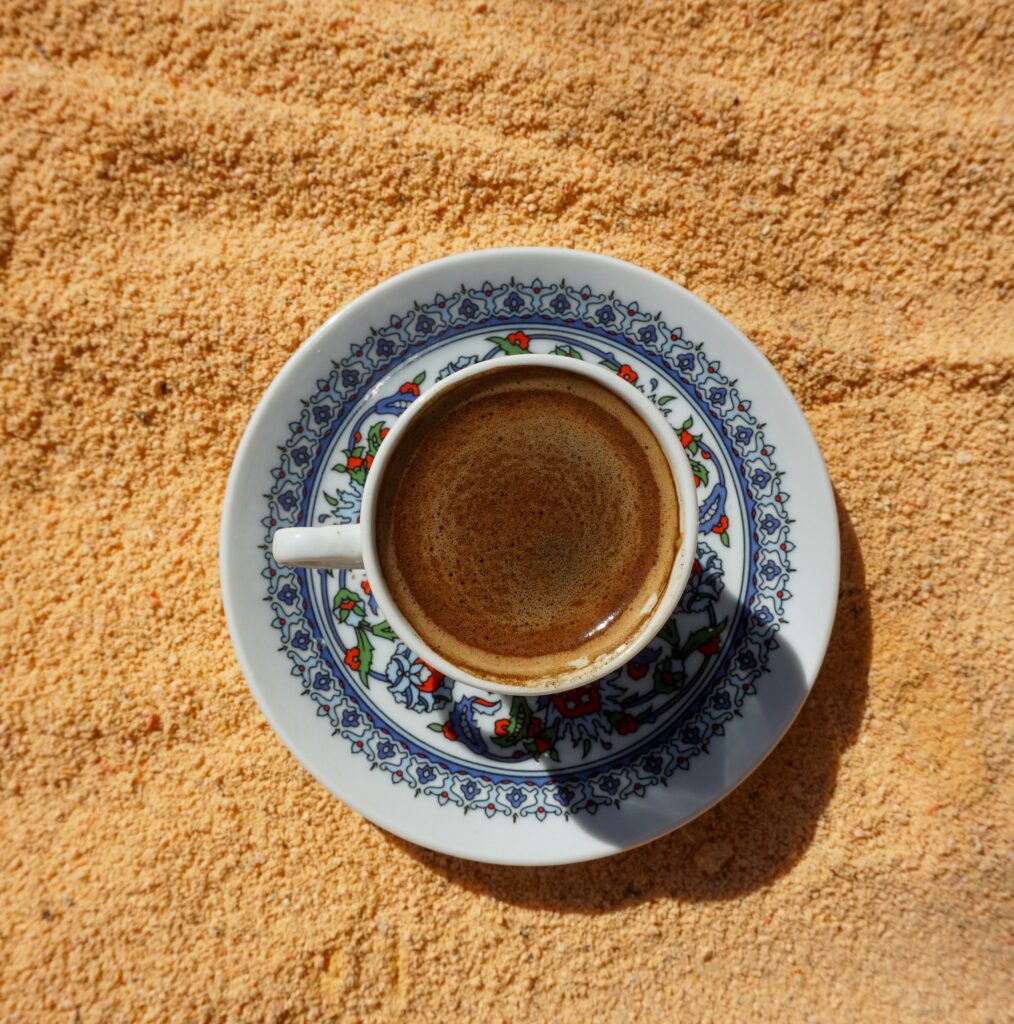
Traditional Palestinian coffee, often referred to as qahwa, is brewed differently from Western espresso or Turkish coffee. Finely ground dark coffee beans, roasted and flavored with cardamom, are simmered slowly in a long-handled pot called a dallah. The coffee is poured carefully into small handleless cups, finjan, which hold only a few sips at a time. The host always pours for the guests, beginning with the eldest or most respected person present, moving rightward as a sign of courtesy.
In its ceremonial role, each cup is an offering of peace, respect, or reconciliation, and the guest must drink in specific ways to convey gratitude or agreement. Declining a cup without explanation is considered a serious insult, while accepting and finishing it is a gesture of mutual respect. The flavor of the coffee had symbolic meaning too. Served sweet in times of celebration and bitter in times of sorrow.
Coffee as Hospitality and Social Code
To serve coffee in a Palestinian home is to enact a sacred form of hospitality, or diyafa. The host prepares the brew in front of the guests, signaling transparency and care. The act of pouring is slow and deliberate. Guests rarely pour for themselves; doing so would break the social choreography that defines respect and generosity.
Hospitality extends beyond family and friends. In Palestinian villages, travelers and strangers could always find coffee and conversation in a home or roadside tent. During the olive harvest, the drink circulates freely among workers as a source of energy and companionship. In times of hardship under occupation, in refugee camps, or during power cuts, Palestinians continue to prepare and share coffee, reaffirming dignity and the strength of their community.
Coffee and Community Building
Coffee has witnessed the turbulence of Palestinian history. As Palestinians continue to face displacement and occupation, the act of brewing and sharing coffee could be seen as a subtle form of resistance in the face of oppression. Refugees have carried with them coffee pots, small cups, and family recipes as fragments of home. Camps in Lebanon, Jordan, and the West Bank, the familiar aroma of coffee provided comfort and cultural coherence amid terrible loss.
In modern Palestinian cafes, the beverage has retained its political undertones. Coffeehouses in Ramallah, Bethlehem, and East Jerusalem often serve as informal salons for artists, students, and activists. Over coffee, people discuss politics, literature, and the future of their homeland. Even in Washington DC, you can find Palestinian coffee shops like LuLu’s Cafe preserving this important piece of cultural heritage amid the genocide.
The Modern Era
Today, this part of Palestinian culture sits at an intersection of old and new. Espresso machines hum beside traditional rakwa pots, and young Palestinians frequent trendy cafes offering iced lattes and Wi-Fi. Yet even as global coffee culture seeps in, qahwa remains. At weddings, funerals, and holiday gatherings like Eid, the same small cups still circulate among guests, linking generations through gesture and taste.
In recent years, Palestinian coffee roasting has emerged as a critical way for the Palestinian diaspora to connect with their heritage. The drink now creates cultural bridges, allowing Palestinians abroad to have a small taste of home wherever they live. The widened availability also gives others a taste of Palestinian culture to those who would never have had access to it previously.
The Significance
To understand Palestinian coffee is to understand a tradition. Each brew represents patience: the slow simmering, the deliberate pouring, the attentive hosting. It reflects resilience, the ability to find warmth and solidarity even under incredible strain. It embodies generosity, the kind that insists on sharing even when resources are scarce. Coffee is not merely consumed; it asserts Palestinians’ presence, solidarity, and dignity.
In every village courtyard and city cafe, this ethos endures. The bitter taste of coffee reminds those who drink it of endurance and belonging. Whether sipped before work or shared long into the night, coffee continues to anchor Palestinian life both in times of grief and hope.
Want more articles like this? Sign up for our e-newsletter!
Check our blog here!
Works Cited:
- Arabic Coffee in Palestine: History and Hospitality
- Palestinian Coffee: A Delicious and Historic Beverage