Subscribe
to receive news by email

Poll
Will the Trump Administration Shift U.S. Policy in Favor of Palestine?
- No (87%)
- Yes (13%)
 Loading ...
Copyright © 2026 Arab America
Go topPathbreakers of Arab America—Donna Shalala
By: John Mason / Arab America Contributing Writer
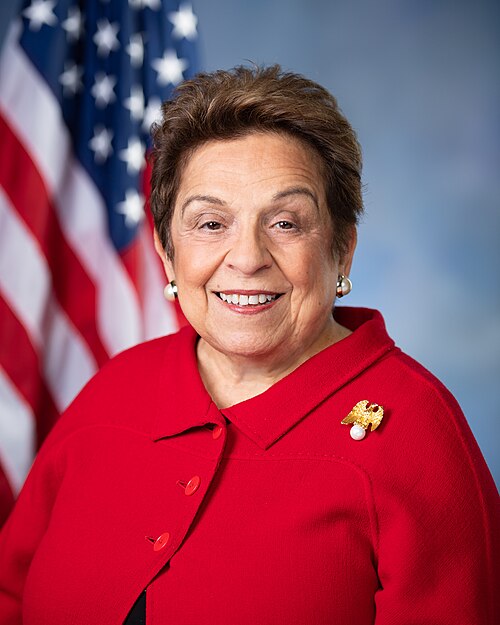
This is the ninety-eighth in Arab America’s series on American pathbreakers of Arab descent. The series features personalities from various fields, including entertainment, business, sports, science, the arts, academia, journalism, and politics. Our ninety-eighth pathbreaker is Donna Shalala, an Arab American academic and politician who served in leadership positions in several universities and in the Carter and Clinton administrations, as well as in the U.S. House of Representatives from 2019 to 2021. Shalala is a recipient of the Presidential Medal of Freedom, which she was awarded in 2008.
Donna Shalala, a superpowered master of bureaucracy–in academia, government administration, elective office, and civil society
Donna Edna Shalala was born on February 14, 1941, in Cleveland, Ohio, to parents of Maronite Catholic Lebanese descent. Her father was James Abraham Shalala, a real estate salesman, and her mother, Edna Smith Shalala, a physical education teacher and a lawyer. Her father encouraged his Lebanese friends to let their daughters be educated and instill a strong feminist attitude in their children. Shalala’s mother, one of the first Lebanese Americans to graduate from Ohio State University, was a teacher who worked two jobs and attended law school at night. According to Wikipedia’s series on Arab Americans, Shalala’s upbringing in a Maronite Catholic family “likely influenced her values and perspectives, contributing to her work in education and public service.”
Shalala earned a bachelor’s degree from Western College for Women in 1962 and served in the Peace Corps. A Peace Corps report described Shalala as spending two years during the 1960s in a “mud village” called Molasani in Southern Iran, where she and about 40 volunteers worked on building an agricultural college. She is quoted as saying, “I’m not pretending to be an expert on Iran, only a person whose affection for Iran has never left her.”
Following an M.A. degree from Western in 1970, Shalala earned a PhD from the Maxwell School of Citizenship and Public Affairs at Syracuse University. She subsequently became a professor at Baruch College and Teachers College, Columbia University, both in New York City. Then she transitioned temporarily into a more directly political career, being appointed by President Jimmy Carter as assistant secretary for policy development and research at the U.S. Department of Housing and Urban Development. Typical of her career, she then transitioned back to academia, becoming the president of Hunter College in 1980, serving until 1988, when she was appointed chancellor of the University of Wisconsin–Madison.
Then, from 1993 to 2001, Shalala advanced her political agenda, serving as the 18th United States Secretary of Health and Human Services under President Bill Clinton. She served as HHS secretary for all eight years of the Clinton administration, becoming the nation’s longest-serving HHS secretary. She distinguished herself as the first Lebanese-American to serve in a Cabinet position. Then back to academia, Shalala went, serving as president of the University of Miami (Florida) from 2001 through 2015, also continuing to teach selected courses at the university during that period. She then tried her hand at running a foundation, as president of the Clinton Foundation from 2015 to 2017.
A member of the Democratic Party, Shalala was elected to the U.S. House of Representatives from Florida’s 27th congressional district in 2018. She served one term in the House before being defeated in the 2020 election by María Elvira Salazar in an upset. Shalala was interim president of The New School in New York City from 2023 to 2024. On December 18, 2019, Shalala voted to impeach President Donald Trump. On April 17, 2020, Shalala was appointed by House Speaker Nancy Pelosi to serve on the COVID-19 Congressional Oversight Commission, which oversees the implementation of the CARES Act. Her appointment was met with some criticism over her failure to disclose more than 500 stock trades. Still, Shalala remained on the commission and paid a $1,200 fine to the United States House Committee on Ethics for violating the STOCK Act.
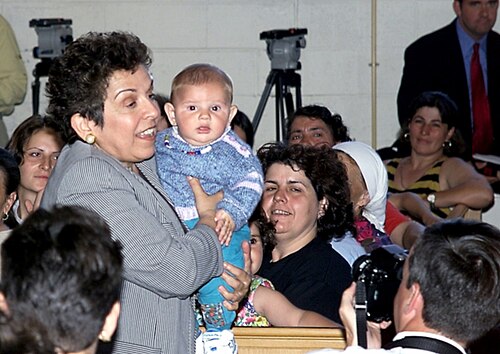
Samples of Shalala’s responsibilities as an academic leader include the earlier-mentioned University of Wisconsin–Madison chancellorship (1988–1993), during which the university enrolled 42,000 students, employed 16,500 people, and had an annual budget of $1 billion. She was the first woman to lead a Big Ten Conference school and only the second woman in the country to head a major research university.
Shalala’s assumption of the presidency of the University of Miami in 2001 was an essential part of her academic leadership portfolio. There, she created a fundraising campaign, ‘Momentum,’ designed to raise the university’s endowment from approximately $750 million to $1 billion; the goal was later increased to $1.25 billion by the end of 2007.
A great civic spirit, there is a legend that Shalala has spent her lifetime at the center of storms
A profile of Shalala featured in the Washington Post in 1993 depicts her initially as a child in her Cleveland neighborhood in heroic terms. The story is that when a tornado raced through her Cleveland neighborhood, “The household flew into chaos, with Shalala’s father yelling, gathering the children and sending the family into the basement for safety. But suddenly, Donna was gone,” her twin sister, Diane Fritel, remembers. “Nobody could find her, but she’d been in the basement with us.”
“The family searched upstairs, outside, and eventually down the tree-littered block. And there at the corner, in the middle of the street, was 10-year-old Donna. She was directing traffic. She was always the leader,” said Fritel. The story then transitions to the future, when “In each position she has, by all accounts, marched into the eye of the storm and taken charge, forcefully and decisively.”
This image of the storm involves the fact that Shalala, with her long and very public record as an administrator, is seen as,” a strong philosophical advocate of what she believes in, namely liberal and politically correct. It is that association with “political correctness” – in her case primarily a speech code at the University of Wisconsin – that has been the main point of contention raised by congressional Republicans since Shalala’s selection to the Congressional Committee.
Another view of Shalala’s record comes from the Harvard Crimson, in 2,000, which shows this longest serving Secretary of Health and Human Services (HHS) in U.S. history, as a very serious actor, and not afraid to tell anyone. This account depicts her, almost as if she were boasting, as saying, “Places are different when I leave them.” Further, it reports that she is “Known for her extensive educational background, her strong feminist ideals and her five-foot stature, Shalala stands proud of her accomplishments.” An aspect of Shalala’s energy that is not well recognized is her role in developing South Florida’s health care system.
A final note concerns a more recent case of Shalala’s statements about the New School’s Students for Justice in Palestine. In her interim role as President of the flagging New School, she sent an email addressing the ongoing Israel-Hamas war. “We are shocked and outraged by the multi-pronged and deadly attacks on Israel by Hamas that began over the weekend.” That message, referring to the October 7, 2023, attack on Israel, sparked condemnation from student groups who say she did not address the Palestinian lives lost.
The Students for Justice in Palestine averred that President Shalala’s statements expressed her insensitivity to the ongoing humanitarian crisis in Gaza. After receiving backlash for her statement, President Shalala issued another statement the following morning that included Palestinian recognition and an apology for her previous exclusion.
In her 84 years, Donna Shalala has played an enormous part in the lives of thousands of students, healthcare patients, and voters. She has operated at a very high political level in positing her social values that favor the not-so-well off in our American society, whose levels of well-being are widening every day.
Sources:
-“Donna Shalala,” Wikipedia Series on Arab Americans, 2025
-“Special Report: Iran RPCV, Cabinet Member, and University President Donna Shalala,” Peace Corps Online: Directory, 5/28/2004“
-“At Helm of Nation’s Health, Donna Shalala Thrives,” Harvard Crimson, 6/7/2000
-“A Lifetime Spent in the Center of Storms, Profile of HHS Secretary Donna Shalala,” Washington Post, 1/14/1993
-“University of Miami President Shalala announces she will retire in 2015,” Miami Herald, 9/8/2014
-“Shalala rode anti-Trump sentiment to take a congressional seat away from the GOP,” Miami Herald, 11/5/2018
-“The New School’s Students for Justice in Palestine group condemns President Shalala’s statements,” New School Free Press, 10/25/2023
John Mason, Ph.D., focuses on Arab culture, society, and history and is the author of LEFT-HANDED IN AN ISLAMIC WORLD: An Anthropologist’s Journey into the Middle East, New Academia Publishing, 2017 and of his new novel, WHISPERS FROM THE DESERT: Zaki, a Little Genie’s Tales of Good and Evil (2025), under his pen name, Yahia Al-Banna). He has taught at the University of Libya in Benghazi, Rensselaer Polytechnic Institute in New York, and the American University in Cairo. John served with the United Nations in Tripoli, Libya, and consulted extensively on socioeconomic and political development for USAID and the World Bank in 65 countries.
The views and opinions expressed in this article are those of the author and do not necessarily reflect the position of Arab America. The reproduction of this article is permissible with proper credit to Arab America and the author.
Want more articles like this? Sign up for our e-newsletter!
Check out our blog here!