
Subscribe
to receive news by email

Poll
Will the Trump Administration Shift U.S. Policy in Favor of Palestine?
- No (87%)
- Yes (13%)
 Loading ...
Copyright © 2026 Arab America
Go topPathbreakers of Arab America—Omar Mwannes Yaghi
By: John Mason / Arab America Contributing Writer
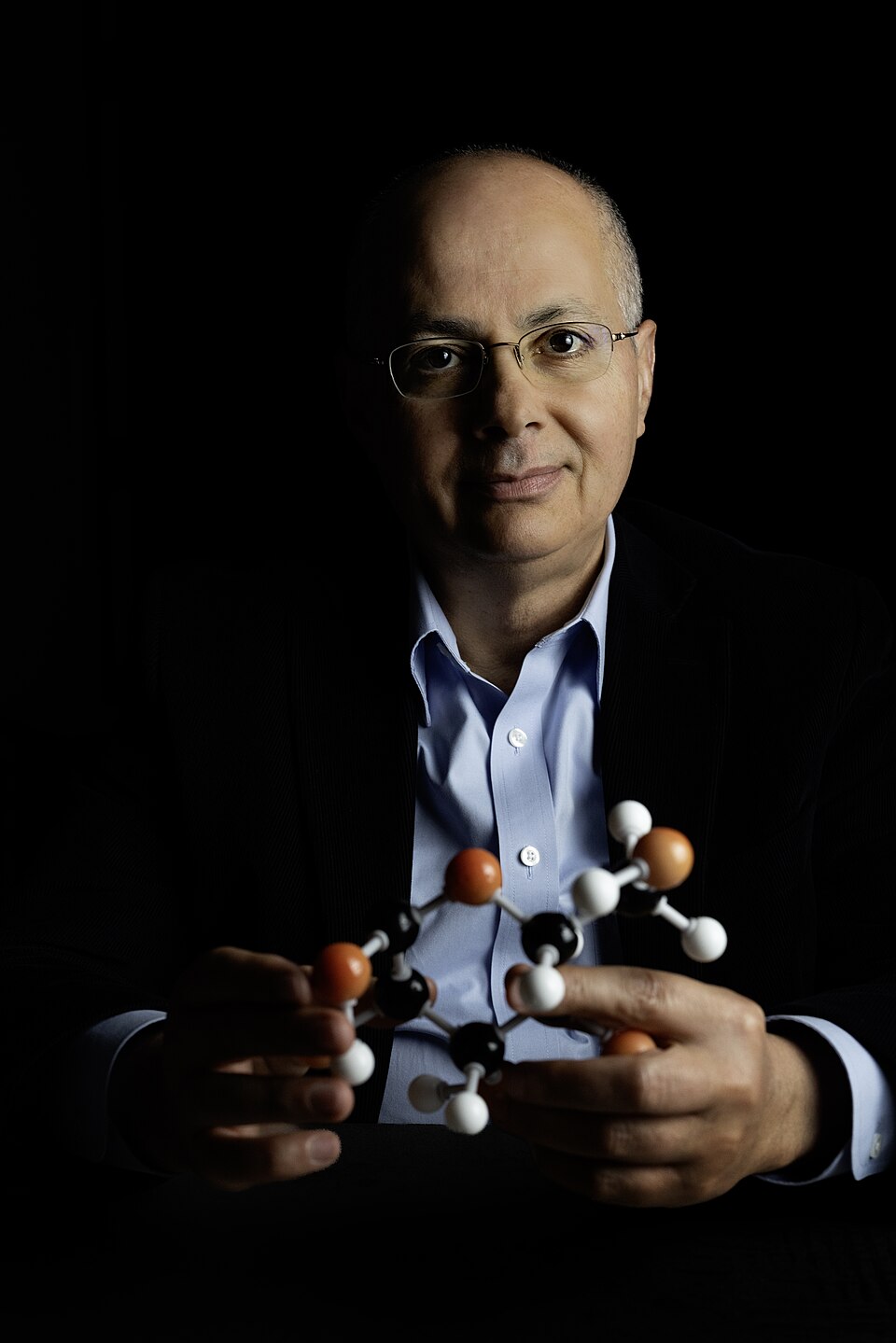
This is the ninety-seventh in Arab America’s series on American pathbreakers of Arab descent. The series features personalities from various fields, including entertainment, business, sports, science, the arts, academia, journalism, and politics. Our ninety-seventh pathbreaker is Omar Yaghi, the 2025 Nobel Prize in Chemistry winner and the first Palestinian scientist to win a Nobel Prize. He was born in Amman, Jordan, to a Palestinian refugee family that had fled from Gaza during the 1948 Palestinian expulsion and flight.
A long journey for Nobel chemistry winner, Omar Yaghi, born to Palestinian refugees, becomes the foremost applied chemist
Omar Mwannes Yaghi was born to a Palestinian refugee family in Amman, Jordan, on February 9, 1965. Yaghi grew up in Amman, where his parents moved after fleeing Gaza in 1948, when hundreds of thousands of Palestinians were forced from their homes amid the war of 1948, which led to the creation of the Jewish state. According to the Wikipedia series on Arab Americans, Omar recalled growing up “in a crowded household with many children, all living in a single room that also housed the family’s livestock.” The family had little access to clean water and no electricity. He also remembered that “his parents could barely read or write.”
In a first brush with the world of chemistry, which would later become his passion, Yaghi, then 10, recalled seeing a “stick and ball” diagram of molecules at a public library in Amman. He said he was immediately drawn to them and only later “learned that these were molecules that make up our world.”
Omar reported that at the age of 15, he was told by his father that he must go to the U.S. to study and, within the year before he graduated from high school, he had obtained a visa and settled alone, in Troy, New York, to pursue his college education.” With a poor grasp of English, per the University of California-Berkeley bulletin, Yaghi took courses in English, math, and science at Hudson Valley Community College in Troy before transferring to the State University of New York at Albany in 1983.
Recalling fondly, Omar said, “I was in love with chemistry from the very beginning…and when I moved to Albany, I immediately got into research. I was working on three projects with three professors at the same time: a physical organic project with one, a biophysical project with another, and a theory project with a third. I really loved the lab. I disliked class, but I loved the lab.”
Yaghi supported himself by bagging groceries and mopping floors, which enabled him to pursue a B.S. in chemistry, and he graduated from SUNY Albany in 1985 cum laude. From there, he pursued graduate studies at the University of Illinois at Urbana–Champaign. He earned his PhD in 1990, then served as a National Science Foundation postdoctoral fellow at Harvard University during 1990–1992. Following that, Yaghi joined the faculty at Arizona State University in 1992, then at the University of Michigan in 1999 and, after that, at UCLA in 2007.
Since 2012, Yaghi has been a professor at the University of California, Berkeley. In May 2025, the University of California Board of Regents promoted him to the rank of University Professor, the system’s highest honor reserved for scholars of the highest international distinction. Linked to that position, he was also appointed the James and Neeltje Tretter Endowed Chair in Chemistry.
Alongside his University appointment, Yaghi is an affiliate scientist at Lawrence Berkeley National Laboratory, founding director of the Berkeley Global Science Institute, and a member of the U.S. National Academy of Sciences and the German National Academy of Sciences Leopoldina. In January 2025, he became the seventh president of the World Cultural Council, an international organization promoting cultural and scientific advancement.
State-of-the-art impacts by Yaghi in clean energy technologies, carbon dioxide capture, and even harvesting water from desert air, lead to a revolution in chemical technologies
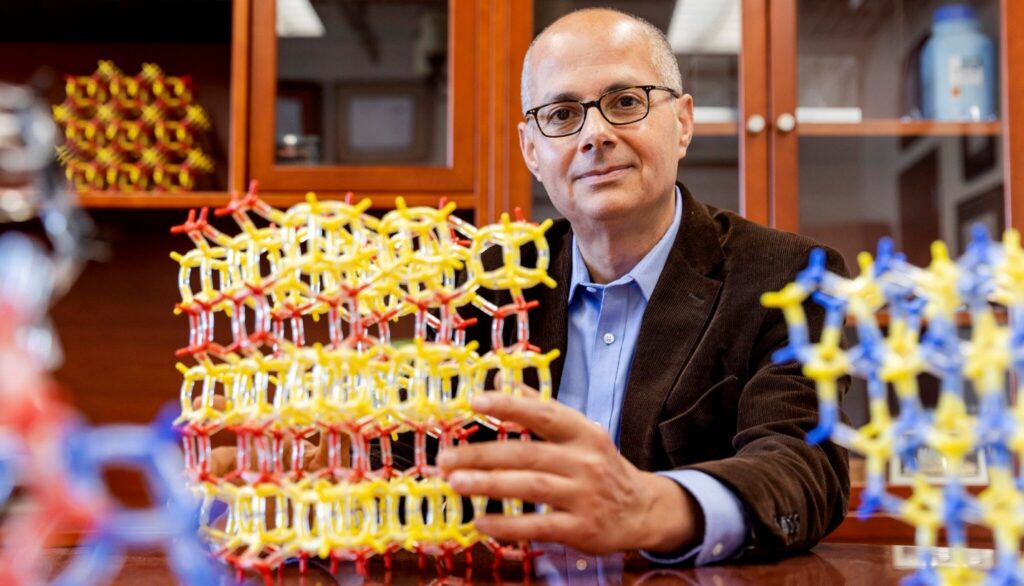
Yaghi is the pioneer of what is called reticular chemistry. This is a field “dedicated to assembling molecular building blocks into open, crystalline frameworks using strong bonds.” (A dictionary definition of reticulated is “constructed, arranged or marked like a net of a network.”) While the language is a bit technical, this is a relatively new field of applied chemistry devoted to bonding materials that were previously believed to be difficult to bond.
This technology allowed for stronger bonding of materials than previously thought possible. This breakthrough, heavily attributable to Yaghi, led to the development of a new class of materials known as ‘metal–organic frameworks’ (MOFs), marking the birth of what is known as reticular chemistry. “The strong bonds in MOFs are fundamental to their structural robustness, ultra-high porosity, and longevity in industrial applications.” Yaghi has taken advantage of these applications in the entrepreneurial arena, founding in 2020, Atoco, a California-based startup focused on commercializing his advancements in MOF and COF technologies for carbon capture and atmospheric water harvesting.
In the honors and awards arena, Yaghi has excelled. He has received numerous international awards and medals, including the already-mentioned prestigious Nobel Prize in Chemistry (2025), the Albert Einstein World Award of Science (2017), the Wolf Prize in Chemistry (2018), the Gregori Aminoff Prize (2019), the VinFuture Prize (2022), and the Science for the Future Ernest Solvay Prize (2024).
The Washington Post applauded Yaghi’s Nobel Prize, describing it as “A long ‘journey’ for Nobel chemistry winner born to Palestinian refugees.” In the same vein, Arab leaders touted Yaghi’s win as a regional success. Jordan’s King Abdullah II called the chemist’s achievement “Jordan’s pride” in a statement posted to X, and said that his win proved that Jordanians could “make a difference wherever they are.”
Again according to the Post, Mohammed bin Rashid al-Maktoum, vice president and prime minister of the United Arab Emirates, posted to X the following accolade for Yaghi: “The Arab world is full of geniuses” and “rich in minds.” Al-Makhtoum continued, “Our message is to restore confidence in ourselves, confidence in our youth, and confidence in our scientists.” Representatives from Saudi Arabia and the Palestinian mission to the United Nations also claimed Yaghi as one of their own, the Post reported.
Saudi Arabia called Yaghi, who recently accepted Saudi Arabian citizenship, the “first Saudi to receive the award.” The Palestinian mission to the U.N. reposted the Nobel committee’s award announcement with the caption, “Palestine refugees can also win Nobel Prizes.” Palestinian leader Yasser Arafat shared the 1994 Nobel Peace Prize with Israel’s then-prime minister, Yitzhak Rabin, and then-foreign minister, Shimon Peres, for their efforts on a joint peace process outlined in the Oslo accords.
Yaghi, who credited his family and his fellow Nobel Prize winners, noted to the Post just as he learned he’d been awarded the Prize, “He was born into a family of refugees, he told the Royal Swedish Academy of Sciences, which awarded him the Nobel Prize in chemistry for groundbreaking work in molecular architecture, along with collaborators Susumu Kitagawa and Richard Robson.” He ended, saying, “My parents could barely read or write.” Bravo ‘ilayka.’
Sources:
-“Omar Yeghi,” Wikipedia Series on Arab Americans, 2025
-“UC Berkeley’s Omar Yaghi shares 2025 Nobel Prize in Chemistry,” Facebook, Twitter, LinkedIn, Reddit, 10/8/2026
-“Scientist Omar Yaghi holds a news conference after winning the 2025 Nobel Prize in chemistry along with two others, in Brussels on Wednesday,” Washington Post, by Cate Brown, 10/8/2025
John Mason, Ph.D., focuses on Arab culture, society, and history and is the author of LEFT-HANDED IN AN ISLAMIC WORLD: An Anthropologist’s Journey into the Middle East, New Academia Publishing, 2017. He has taught at the University of Libya in Benghazi, Rensselaer Polytechnic Institute in New York, and the American University in Cairo. John served with the United Nations in Tripoli, Libya, and consulted extensively on socioeconomic and political development for USAID and the World Bank in 65 countries.
The views and opinions expressed in this article are those of the author and do not necessarily reflect the position of Arab America. The reproduction of this article is permissible with proper credit to Arab America and the author.
Want more articles like this? Sign up for our e-newsletter!
Check out our blog here!