Subscribe
to receive news by email

Poll
Will the Trump Administration Shift U.S. Policy in Favor of Palestine?
- No (87%)
- Yes (13%)
 Loading ...
Copyright © 2026 Arab America
Go topPathbreakers of Arab America—Walid Khalidi

By: John Mason / Arab America Contributing Writer
This is the one-hundred and thirteenth in Arab America’s series on American pathbreakers of Arab descent. The series features personalities from various fields, including entertainment, business, sports, science, the arts, academia, journalism, and politics. Our 113th pathbreaker is Walid Khalidi, a distinguished historian and a scholar of rare stature, who devoted his life to writing about Palestine and defending its cause. He passed away at age 100 in Cambridge, Massachusetts, on March 8, 2026. This article, then, is both an obituary and a celebration of Khalidi’s life.
Palestinian by birth, Khalidi observed Israel’s occupation and depopulation of large parts of Palestine and thus began his long intellectual struggle to preserve the historical record of the Palestinian people’s loss and suffering
Walid Khalidi was born in Jerusalem on July 16, 1925, one of five children. His father, Ahmad Samih Khalidi, was the dean of the Arab College of Jerusalem, who descended from a family with roots in pre-Crusader Palestine. Khalidi’s stepmother, Anbara Salam Khalidi, was a Lebanese feminist, translator, and author who made significant contributions to the emancipation of Arab women. He attended primary school at the Friends School in Ramallah, then moved to St. George’s School in Jerusalem, where he completed his secondary education. Walid then attended the University of London, graduating with a B.A. in 1945, and later studied at the University of Oxford, earning an M.Litt. in 1951.
Walid’s next stage was teaching, first at the Faculty of Oriental Studies in Oxford, until he resigned after the trilateral British, French, and Israeli assault on Egypt in 1956. His resignation was on moral and ethical grounds. He then took up teaching at the American University of Beirut as a lecturer in political studies. In 1982, Walid became a research fellow at the Harvard Center for International Affairs and a senior research associate at the Institute of Middle Eastern Studies. He also held lectureships at Princeton and Oxford Universities and was elected a Fellow of the American Academy of Arts and Sciences.
Under his guidance, Walid co-founded the Institute of Palestine Studies in Beirut in December 1963. The Institute was established as an independent research and publishing center focusing on the Palestine problem and the Arab–Israeli conflict, and was its general secretary until 2016. Some of his best-known works are ‘Before Their Diaspora,’ a photographic essay on Palestinian society prior to 1948, and ‘All That Remains,’ the encyclopedic collection of village histories which he edited. More broadly, his intellectual interests extended from modern European history to international relations, in strategic and military terms.
Khalidi was a Fellow of the American Academy of Arts and Sciences. He was influential in institutional development planning and diplomacy. His books and scholarship have contributed significantly to shaping, disseminating, and solidifying the Palestinian narrative worldwide. His scholarly legacy will remain an essential reference for any serious researcher studying the Palestinian question.
His academic work in particular, according to Rashid Khalidi, a Middle East scholar and cousin of Khalidi, has played a key role in shaping both Palestinian and broader Arab reactions to the loss of Palestine, and in outlining ways for the former to ensure that they remain visible as a presence on the Middle East map.
In recognition of his rich intellectual contributions, Khalidi received numerous awards and honors, including the prize of Distinction in Cultural Achievement in the Arab World awarded by the Arab League Educational, Cultural and Scientific Organization (ALECSO) in 2002, and the Jerusalem Order of the Star of Honor in 2015, awarded by Palestinian President Mahmoud Abbas. He was also awarded an honorary doctorate by Birzeit University in 2011. In 2025, he was honored with a Lifetime Achievement Award during the 14th Palestine Book Awards, in recognition of his long-standing contributions to documenting the history of the Palestinian cause and supporting the Institute for Palestine Studies.
One of Khalidi’s most cited arguments concerned the implementation of ‘Plan Dalet,’ a Zionist military strategy that led to the occupation and depopulation of large parts of Palestine. It was executed during the 1948 Palestine war for the conquest of territory in Mandatory Palestine in preparation for the establishment of a Jewish state. The plan was the blueprint for Israel’s military operations starting in March 1948 until the end of the war in early 1949, and so played a central role in the 1948 Palestinian expulsion and flight known as the ‘Nakba.’
‘Plan Dalet’ was a set of guidelines to take control of Mandatory Palestine, declare a Jewish state, and defend its borders and people, including the Jewish population outside of the borders, “before, and in anticipation of” the invasion by regular Arab armies. The plan’s tactics involved laying siege to Palestinian Arab villages, bombing neighborhoods of cities, forced expulsion of their inhabitants, setting fields and houses on fire, and detonating TNT in the rubble to prevent any return. Zionist military units possessed detailed lists of neighborhoods and villages to be destroyed and their Arab inhabitants expelled. This strategy is subject to controversy, with some historians characterizing it as defensive, while others assert that it was an integral part of a planned strategy for the expulsion, sometimes called an ethnic cleansing, of the area’s native inhabitants.
For Walid al-Khalidi, the writing of Palestinian history was an act of preservation against erasure. His work was rooted in the belief that Palestine had to be documented with rigor, depth, and historical discipline, especially after the Zionist destruction and depopulation of Palestinian society in 1948.
Honoring the life of Walid Khalidi–Architect of Modern Palestinian Historiography–who dedicated his life to documenting the Palestinian experience and safeguarding its historical memory
The following are composites of testimonials to Khalidi on his passing from major Palestinian organizations and news outlets, including the Institute for Palestinian Studies, the ‘Palestine Chronicle,’ and ‘Al Jazeera.’
For more than seven decades, Khalidi stood among the most influential historians of Palestine. His work fundamentally reshaped how Palestine was studied in Western academia and helped establish Palestinian historiography as a serious scholarly field. At a time when Palestinian voices were largely absent from academic discourse in Europe and the United States, Khalidi produced meticulous historical research that challenged dominant narratives surrounding the creation of Israel and the displacement of Palestinians.
Khalidi’s research helped bring international attention to these events and provided a scholarly foundation for understanding the Palestinian exodus. Much of his scholarship focused on the ‘Nakba’ not as an abstract national tragedy, but as a concrete historical process carried out through the seizure of land, the destruction of villages, and the forced exodus of Palestinians from their homes. He helped establish a documentary foundation for the study of Zionist colonization and the ethnic cleansing that accompanied the creation of Israel.
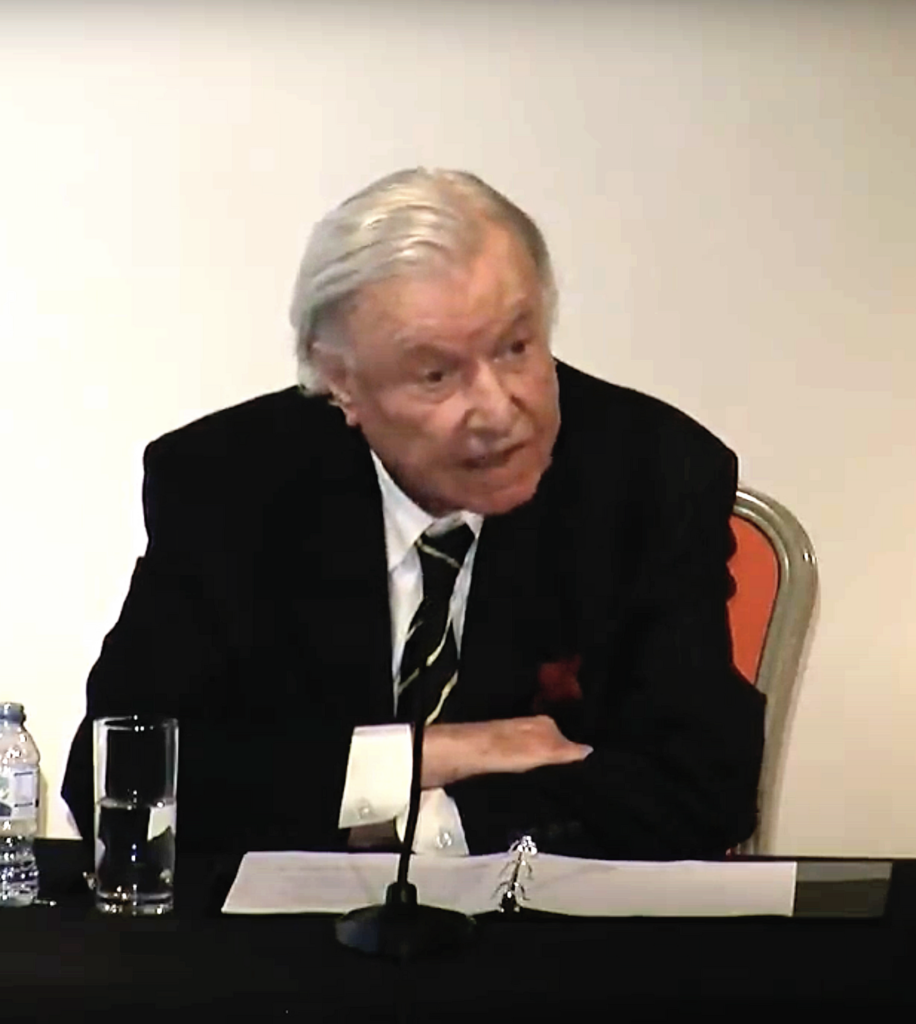
In this sense, his legacy lies not only in the books he wrote but in the historical framework he built. He helped make Palestinian history impossible to dismiss, impossible to obscure, and impossible to detach from the lived reality of dispossession. Generations of historians, journalists, and researchers now rely on the foundations he helped construct—foundations grounded in documentation, evidence, and historical clarity.
Khalidi was a proponent of a two-state solution, writing in Foreign Affairs in 1988 that a Palestinian state within the 1967 borders in “peaceful coexistence alongside Israel” was “the only conceptual candidate for a historical compromise of this century-old conflict”. How sad that he is not here to see this solution fulfilled, though some scholars say that even the two-state solution is not feasible due to the irreversible fragmentation of the West Bank by Israeli settlers.
With his passing, Palestinians and the world have lost a distinguished historian and a scholar of rare stature, who devoted his life to writing about Palestine and defending its cause. Arab America and its membership convey its sincere condolences to the family of Walid Khalidi.
Sources:
-“Walid Khalidi,” Wikipedia Series on Arab Americans, 2026
-“Obituary–The Passing of Walid Khalidi, Co-Founder and Honorary President of the Institute for Palestine Studies (1925–2026),” Institute for Palestinian Studies, 3/8/2026
-“Walid al-Khalidi, Architect of Modern Palestinian Historiography, Dies at 100,” Palestine Chronicle, 3/9/2026
-“Walid Khalidi, historian of the Palestinian cause, dies aged 100,” Al Jazeera, 3/9/2026
John Mason, Ph.D., focuses on Arab culture, society, and history and is the author of LEFT-HANDED IN AN ISLAMIC WORLD: An Anthropologist’s Journey into the Middle East, New Academia Publishing, 2017 and of his new novel, WHISPERS FROM THE DESERT: Zaki, a Little Genie’s Tales of Good and Evil (2025), under his pen name, Yahia Al-Banna. He has taught at the University of Libya in Benghazi, Rensselaer Polytechnic Institute in New York, and the American University in Cairo. John served with the United Nations in Tripoli, Libya, and consulted extensively on socioeconomic and political development for USAID and the World Bank in 65 countries.
The views and opinions expressed in this article are those of the author and do not necessarily reflect the position of Arab America. The reproduction of this article is permissible with proper credit to Arab America and the author.
Want more articles like this? Sign up for our e-newsletter!
Check out our blog here!