
Subscribe
to receive news by email
Poll
Will the Trump Administration Shift U.S. Policy in Favor of Palestine?
- No (87%)
- Yes (13%)
 Loading ...
Copyright © 2026 Arab America
Go topPope Leo XIV meets with Palestinian Authority President Mahmoud Abbas
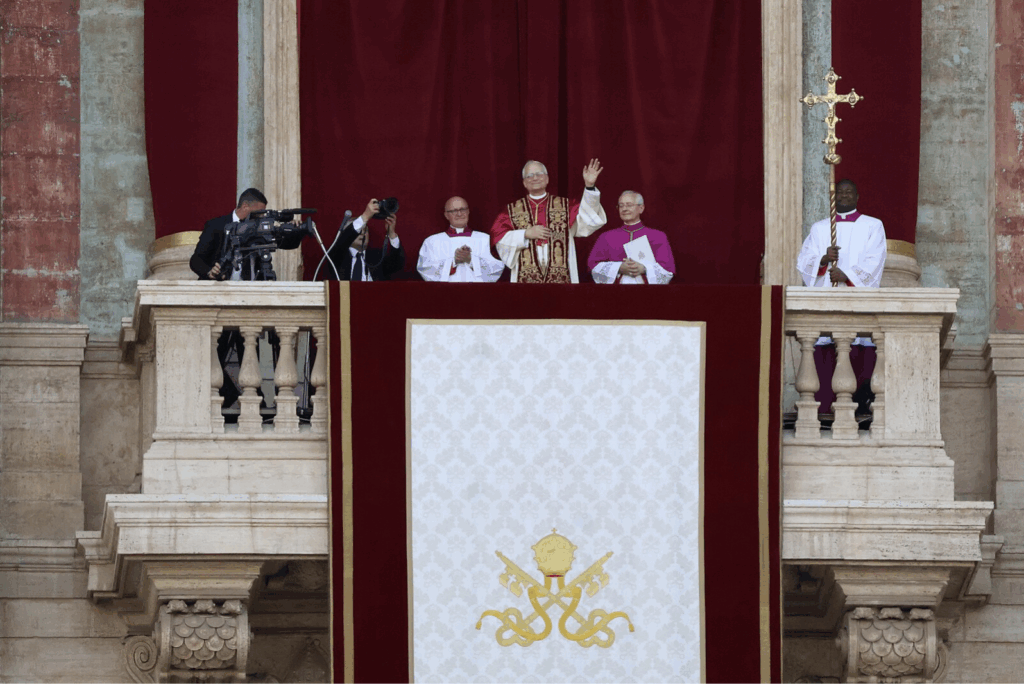
Pope Leo XIV on the Loggia after his Election. Photo by Edgar Beltrán / The Pillar, CC BY-SA 4.0, via Wikimedia Commons
By Jake Harris / Arab America Contributing Writer
The Papacy has long tried to ride the fence when it comes to their involvement in domestic affairs. It is an attempt to remain neutral in order to avoid alienating members of the church. In most scenarios it has played to their advantage. Riding the fence keeps the Vatican’s diplomatic relations straightforward. In other scenarios such as World War II, the church received criticism for not being outspoken enough against the rise of fascism in Europe. People often forget the Vatican’s sovereignty as a state, and that the Pope is a political leader as much as a religious one. Maintaining foreign relations is a factor in any papacy. This is admittedly less so in comparison to the papacies of the Middle Ages when the Catholic Church was Europe’s most powerful political institution.
Pope Francis and Gaza
Pope Leo XIV, the first American Pope succeeds a Pope in Francis who was incredibly outspoken on human rights issues, war, and political issues. Francis was notoriously outspoken on Gaza. The late Pope would call the Catholic parish in Gaza daily to check in on them. He said he would often hear how incredibly difficult it was for them and the horrors of the daily shelling.
Pope Leo XIV Meets with Abbas
Pope Leo XIV recently met with Palestinian Authority President Mahmoud Abbas. The meeting comes not too far after the Pope’s meeting with Israeli official Issac Herzog. The meeting with Abbas was described as “cordial” by the Vatican. Topics of discussion were said to be the urgent need for an uninhibited flow of humanitarian aid as well as the commitment to a two-state solution as the only viable solution.
During the visit, Abbas visited the tomb of the late Pope Francis to pay his respects. He acknowledged Francis’s outspoken recognition of Palestine without being asked or told to do so.
Palestine-Holy See Comprehensive Agreement
The visit’s timing is symbolic. The day of the visit represents the 10-year anniversary of the Palestine-Holy See Comprehensive Agreement. The document reaffirms the Vatican’s commitment to the Palestinian people having self determination. The agreement also advocates for equality of rights for Jews, Christians, and Muslims in the holy city of Jerusalem. The document also reaffirms the ultimate goal of a “just and lasting peace” in the Israeli-Palestinian conflict.
Abbas remains deeply unpopular in opinion polls conducted among Palestinians. Many feel his leadership has been totally ineffective in reaching any semblance of Sovereignty. Couple this with widespread allegations of political corruption and you get a deeply unpopular leader. Polling conducted prior to the October 7th attacks had him trailing Ismail Haniyeh, and Marwan Barghouti in opinion polls on Palestinian leadership.
Upon Pope Francis’s passing, the ascension of Leo XIV to the Papacy was expected to be a continuation of Francis in a way. Cardinal Robert Prevost was considered to be one of the more reformist/liberal candidates during the conclave. Less fundamentalist than some of the other favorites to succeed Francis. Pope Leo has remained relatively quiet when it comes to the US’s ultra polarizing political landscape but did urge people to “deeply reflect” on the treatment of migrants in the Trump administration.
Pope Leo Speaks on IDF actions
On Gaza, Leo’s stated position is that he advocates for a ceasefire. While most of his rhetoric has been vague calls for peace, there have been some instances where he called out Israel for violations of international law. He demanded that Israel stop the “collective punishment and forced displacement” of Palestinians in Gaza. This was following the IDF strike on a Gaza Hospital. A strike in which Israel initially called it a tragic accident. They claimed following their internal investigation that there was a “Hamas Camera” on the roof.
Being the first American Pope puts Leo XIV in a unique position. He is the first Pope to ever come from a nation that is a global superpower. It is one of the things that he himself believed would disqualify him during the conclave. He also has to tread carefully on his involvement in politics. He is trying to walk a tight rope between alienating the American Diocese, and appearing so aligned with US government interests that it appears as a conflict of interest.
Want more articles like this? Sign up for our e-newsletter!
Check out our blog here!