
Subscribe
to receive news by email
Poll
Will the Trump Administration Shift U.S. Policy in Favor of Palestine?
- No (87%)
- Yes (13%)
 Loading ...
Copyright © 2026 Arab America
Go topRefugee Voices Through Art
By: Fayzeh Abou Ardat / Arab America Contributing Writer
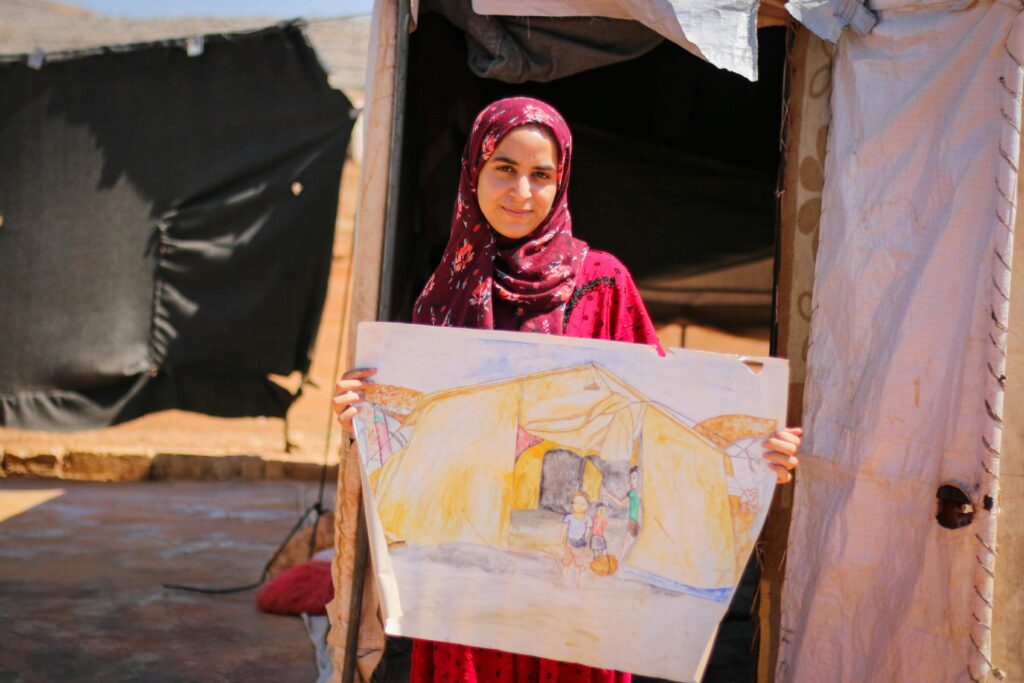
Arab refugees have survived wars, occupations, and forced migrations that have displaced millions of people. Beyond the numbers and the headlines, refugees have experiences that are frequently disregarded or silenced. Art has emerged as one of the most effective means for displaced Arabs to convey their tales. Art, whether in the form of murals, poetry, theatre, or music, provides a language of survival and resilience, allowing refugees to preserve memories, confront loss, and imagine the future.
Arab refugee art, from camp walls painted with country symbols to internationally famous gallery pieces, communicates trauma. It also asserts dignity. It demonstrates the humanity of those who refuse to be defined merely by displacement.
Visual and Literary Arts: Memory and Resistance
Visual art has become an important medium for Arab refugees, particularly in areas where other forms of self-expression are prohibited. Palestinian camps in Lebanon, Gaza, and the West Bank are adorned with paintings honouring devastated villages, martyrs, and dreams of return. These works turn concrete walls into archives of collective memory and resistance.
Prominent artists have also taken similar ideas to a worldwide scale. Mona Hatoum, who was born to Palestinian refugee parents, has achieved international acclaim for her installations about exile and displacement, which frequently use everyday things to depict fragility and alienation. Tammam Azzam, a Syrian refugee, gained worldwide recognition for his “Freedom Graffiti,” in which Gustav Klimt’s The Kiss was digitally placed over a wrecked Damascus building. The sculpture demonstrated the enduring power of love and beauty in the face of destruction.
Literature and poetry remain equally important. Arab exiles frequently use writing to preserve memories and narrate their experiences in exile. Palestinian poetry, particularly the works of Mahmoud Darwish, has long served as a voice for displacement. Other refugee writers continue to publish memoirs and novels that weave personal experiences into larger histories of conflict and movement.
Performing Arts: Healing and Expression
Performance provides another important opportunity for Arab immigrants to express themselves and maintain their identity. Syrian children in Jordan’s Za’atari refugee camp have taken part in theatre and music classes, which have turned trauma into creativity and provided a sense of normalcy in the midst of relocation.
Another example is Cairo’s theatre collectives created by Sudanese and Syrian refugees. These organizations provide plays about migration, identity, and loss, allowing both actors and spectators to tackle difficult situations via art. Such performances highlight the fact that refugees are active narrators of their own tales, rather than quiet victims.
Music is also an important way for refugees to express themselves. Palestinian hip-hop groups in the diaspora employ rhythm and lyrics to defy preconceptions and preserve cultural identity, whereas Iraqi oud players carry on centuries-old musical traditions in exile. Wafaa Bilal, an Iraqi refugee artist, combines performance and multimedia installation in work like “Domestic Tension,” in which he spent a month living in a gallery while people fired paintballs at him remotely. His work pushes viewers to confront the detached manner in which distant wars are frequently consumed.
The Impact and Challenges of Refugee Art
Arab refugee art has both local and global relevance. Syrian artists’ exhibitions in Europe, Palestinian art shows in the United States, and refugee-led theatre performances in host nations have raised awareness of displaced communities and challenged limiting stereotypes of refugees. Art preserves tradition, fosters solidarity, and ensures that voices from exile are heard in cultural and political discussions.
Despite its influence, refugee art confronts significant hurdles. Many artists have limited access to materials, funding, and formal platforms. There is also tokenization, in which refugee works are utilized exclusively to create compassion rather than being valued as art in and of itself. Political censorship creates additional barriers, particularly for individuals who criticize regimes, occupations, or current hostilities.
Refugee art continues to evolve. Social media technologies have created new avenues for visibility. Arab refugee artists share their work online and immediately reach foreign audiences. Cultural festivals, such as Refugee Week in the United Kingdom, give new forums for Arab refugee voices to be heard while also commemorating their contributions to world art and culture.
Arab refugee art proves that creativity can persist in the most terrible situations. Tammam Azzam’s digital collages, murals in Palestinian camps, and refugee theatre collectives in Cairo all speak to resistance and the unwillingness to be erased. Art allows refugees to digest their own experiences. It challenges worldwide audiences to listen to and interact with their stories.
Refugee art is more than just a representation of sorrow; it is also a statement of identity, a method of resistance, and a vision of hope. By boosting their perspectives, the world is reminded that refugees are more than just displaced people. They are active producers whose cultural contributions extend well beyond the borders of exile
Want more articles like this? Sign up for our e-newsletter!
Check our blog here!