
Subscribe
to receive news by email

Poll
Will the Trump Administration Shift U.S. Policy in Favor of Palestine?
- No (87%)
- Yes (13%)
 Loading ...
Copyright © 2026 Arab America
Go topRoot of Patience: The Politics of the Sabr Plant
By: Mitzi Tapang / Arab America Contributing Writer
In 1863, the American missionary-botanist George Edward Post walked into what he would later call a botanical microcosm. Particularly, a replication of Palestine so compressed and floristically dense, confined to such a narrow strip of land, that one could pass from the Mediterranean littoral to mountain valley to the margins of the desert. He insists that even the “useless” deserts were thick with specialized life, and their deeply channeled wadis eminently favorable to the flourishing of a great variety of species.
Still, Post was underpinning a flora already incorporated into the grids of European conquest and, henceforth, Western science. This is so due to the discovery of the Indies and the ramifications of the Columbian exchange. As the allure for The Cabinet of Curiosities multiplied across Europe, travellers went out in search of the unusual. Or, plants and animals that further signified the scope of sovereign reach. An array of “exotic” artifacts inevitably summarized the marvels and propertied nourishment of the private elite.
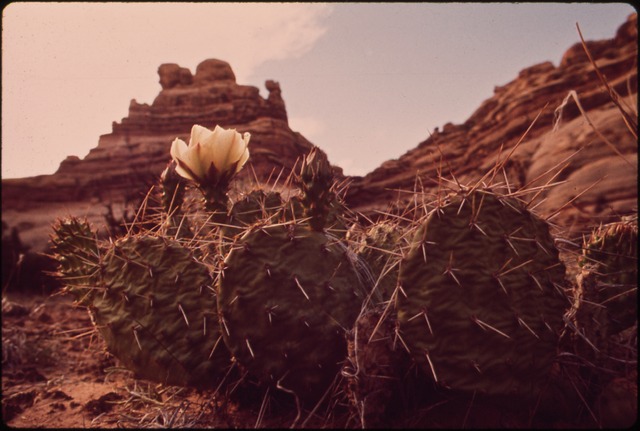
The prickly pear cactus, locally called sabr, fits the bill perfectly for this reason. It is spectacular in form, thorny and fleshy at once, and unmistakably different to European eyes. Considered as the first European account of the plant, Spanish officer Gonzalo Fernández de Oviedo y Valdés notes:
“I cannot make up my mind whether it is a tree or one of the most frightful monsters among trees.”
Within notional borders of ecological (trans)formation, the sabr was ferried from Latin America to Europe in the 1500s. Primarily used for cochineal production, it naturalized around the Mediterranean before being enfolded into Palestinian agro-ecologies.
The Numerous Faces of the Sabr Plant
Sabr (Arabic: صبر—), names both a drought-resistant hedge plant and a food source. Using the crassulacean acid metabolism (CAM) photosynthesis, it opens its stomata at night to take in carbon dioxide. The plant then converts the carbon dioxide into organic acids and stores them until daylight. At its most biological level, it employs a form of patience as a means of survival.
Indeed, French explorer Victor Guérin’s 1868 account of Bureij (Bureir) in Gaza’s coastal plain includes inscriptions on herds of cattle, goats, and camels grazing adjacent pastures, with prickly pear hedges tracing the edge of tobacco plots. So much so that the only stone structure was that of a sheikh’s house amid otherwise earthen architecture. Such living boundaries were practical as sabr was cheaper than barbed wire or stone and was easily propagated by cutting and planting pads.
The plant, which also means ‘patience’ in Arabic, played a huge role in creating durable perimeter markers needed for labor-intensive cash crops like tobacco under Ottoman land codes. While this may seem like the inception of a burgeoning ecological preservation, it ends exactly by the utterance — one that Palestinian visual artist Jumana Manna frames as the domain where “nature ends and settlements begin.”
The Ecology of the “New Jew”
In the Palestinian Jewish community of Yishuv, tzabar (Hebrew: צבר) was initially a derogatory term used by European immigrants to mock locally born Jewish children as rough or “uncivilized.” It was, however, reclaimed in the 1930s as a badge of the tough-yet-tender “new Jew.”: the sabra.
In literature and film, the sabra is the sunburnt, Hebrew-speaking youth who served in the Haganah and the Palmach; fought in the British army during World War I; and later took part in IDF combat units in both the Arab-Israeli War and the Sinai campaign.
The sabra, both an identity and ideology, punctuated the Zionist achievement through labor brigades pushed forth by temporal boundaries. They were the actors “concerned with the formative years of people for whom those years coincided with the formative years of the new Israeli society.” This is done so primarily through the kibbutz movement, an Israeli community based on socialist and Zionist ideals of agricultural labor and environmental settlement.
The Kibbutz Movement
Zionist bodies like the Histadrut (founded 1920) and the Haganah funneled resources to kibbutzim (e.g., Jezreel Valley marshes) for road-building and defense. The ideological apparatus that is the creation of new settlements is made all the more clear once we understand that most, if not the entire, Zionist settlement activity rests on mythmaking processes.
In what was largely considered one of the greatest historiographic debates in Israeli thought, scholars Yoram Bar-Gal and Shmuel Shamai challenged the Zionist master narrative of the valley as a malarial wasteland redeemed by heroic Jewish drainage efforts. Still, the myth proved to be productive as the kibbutzim population grew by 312 per cent by 1923.
Following Manna’s deep-rooted lamentation on settlerism, the Jewish National Fund (JNF) had excavated the agricultural land grazing the Negev desert, which is home to the Bedioun village community as-Sa’wa al-Atrash. Now, as before, the act was born out of the formalization of green advocacies (i.e., the effort to protect the “natural” world). That the plan to grow a forest in the area should weigh in on the fact that by radically disrupting ecological affairs under the guise of transformation, they are working with lethal stocks of violence: genocide, ecocide, and imperialism.
As with past land-grabbing and terraforming rhetorics, it simply is not a matter of separating the human entities from its ecological, in this case agro-ecological, dimensions. The Zionist project requires that the destruction of one be followed through by the destruction of the other. It bolstered a social economy founded on production and consumption, “so that the idea of struggling with nature was combined with that of establishing a new society.” The problem arises precisely from the lack of “natural”-ity in interventions such as the one in Negev.
Meditating on the Sabr
The dichotomy between human and non-human species is laid bare when looked through the biopolitical lens. Specifically, when an area’s flora and fauna are reduced to “killable” biological matter under settler inventories.
Ontologically, there can truly be no telling how the hedge-plant domineered through the imperial logic of eco-expansion. Nevertheless, we can deduce this from the overwhelming repertoire of historiographic prototypes.
What we know for sure is this: that the structure of ecological imperialism is more than a completed historical episode. These cactus shrubs had seen and felt every barrage of military force, every weight on their thorny hedges. They would grow again and “continue [to] stubbornly mark the old boundaries of the towns and villages that have been demolished since 1948.”
Want more articles like this? Sign up for our e-newsletter!
Check out our blog here!