
Subscribe
to receive news by email

Poll
Will the Trump Administration Shift U.S. Policy in Favor of Palestine?
- No (87%)
- Yes (13%)
 Loading ...
Copyright © 2026 Arab America
Go topSound, Space, and Time: A Walk Through Manshiyya
By: Mitzi Tapang / Arab America Contributing Writer
Places are ordered in a system of opposition. It can be sacred and profane, protected and exposed, destroyed and preserved. All the same, each domain lurks within the etymology and practice of politics (polis; city-state) and ethics (ethos; habitats), disciplines that largely behold themselves to be rooted in some form of communal emplacement.
At the most fundamental level, society, too, holds the presupposition of a shared place. Experiences such as initiations and festivals provide threshold experiences that are always enacted somewhere. It is in this bounded ritual arena that collective memory is furnished from the very ethers that make gathering and assembly possible. Place, then, while bearing rituals of everyday life, often carries historical sediment and narratives of transformation.
Who Clears and What Remains
At the same time, the idea of place entails the utilitarian calculation of security and territoriality. Owing to the particular textures and sensitivities of neighborhoods and cities, this spatial exchange yields an assertion that some people or group must be ejected into the chaos so that the sanctity of the interior remains inviolate.
Place, here, moves between the recognition of an interchangeable site and one destined for clearance. Indelibly so, the terms are strict and absolute: there are those who dwell within the protection of the threshold, and those whose bodies constitute the threshold itself. In one relational sweep, only then can a new, pure order be built upon the unmoored flesh from its placial inscriptions.
Now, as along many other attempts, the question inevitably reverts to place-structures that remain after deposition. Yet now, as before, we have only ever been met with acts of enmity and forced kinship. Once these structures’ repertoire of rituals and relations are inflected by architectural and commercial homogenization, remains take on a very specific, phantom-like sensation. Perhaps a ghost. Perhaps a twitch in a limb. A faint rustle, if you will. But we know there is silence, and not only does it remain, it echoes.
The Sound Project
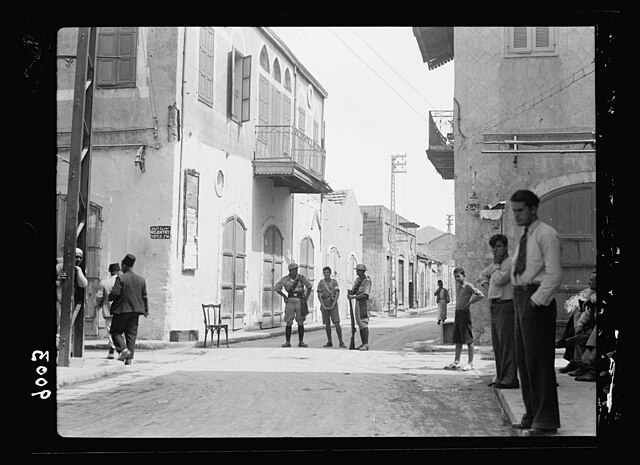
Echoing Yafa is a site-specific audio walk produced by Miriam Schickler that uses sound to reactivate the erased Palestinian neighborhood of Manshiyya and the Tel Aviv-Yafa border as a contested, layered memory landscape. It is a story, she described, designed for visitors who otherwise would not easily access knowledge about the Nakba in the city.
The walk leads participants through present-day Tel Aviv-Yafa while playing a mix of narration, archival fragments, field recordings, and sound design. As such, the path runs along the erased quarter’s former extent. From the northern border with Tel Aviv (near today’s Carmel Market area), west towards the sea by Hassan Bek mosque, and then south through what is now Charles Clore Park, ending near Etzel House.
At each station the narration ties the listener’s current GPS-less position to layers of historical mapping. The car parks and bus station now encroaching the market were, for one, marked as former border spaces. The junction by the mosque was Manshiyya’s northern gate. The lawns of the park were identified as covering the rubble to demolished houses. Simply by creating counter-routes of movement in the former Arab neighbourhood, the work already unearths the sinews of political zoning and dispossession: that present-day Tel Aviv-Yafa overlays an absent Palestinian street map.
Tel Aviv-Yafa under the British Mandate
Under the British Mandate, authorities had no prior interest in carving out a Jewish urban enclave from Arab Yafa. Unlike classic colonial urbanism (e.g., European concession in Shanghai or native quarters in Delhi), they did not classify Zionist Jews as “European settlers” requiring spatial separation from “native” Arabs.
In 1921, however, mandate authorities recognized Tel Aviv as an independent township after negotiations led by Zionist leader Meir Dizengoff and local committees. Negotiations that leveraged post-WWI political flux, as he positioned himself as the singular voice for all Yafa’s Jews via the wartime General Jewish Committee. Immediately after Herbert Samuel’s arrival as High Commissioner for Palestine, Dizengoff petitioned to declare Tel Aviv and other Jewish neighborhoods (i.e., Yishuv bodies) an autonomous borough within Yafa’s municipal framework.
Leading to the decision, Yafa’s Arab-led council was chronically mismanaged with tax collection failures and corruption claims, while Tel Aviv collected its own taxes and provided services. Dizengoff’s framing of the separation was opposed heavily and considered by Yafa’s municipality as a challenge to its sovereignty. Jewish neighborhoods accounted for roughly 20-30% of Yafa’s tax base but received disproportionate services. Detachment only meant forfeiting those taxes as Tel Aviv already ran parallel systems.
The separation took a decisive turn after the May 1921 riots that erupted along the Tel Aviv-Manshiya seam. From then, Zionist urban secession portrayed Arab governance as dysfunctional, and that Jews needed independent jurisdiction for self-defense and rapid reconstruction. Such was the template of the political capital and the ultimatum had birthed the ‘Palestine problem.’
The Unified City of Tel Aviv-Yafo
Under the 1947 UN Partition Plan, Yafa was slated as an Arab-controlled enclave within the proposed Jewish state, while Tel Aviv would be part of the Jewish State itself. Within the single Zionist spatial project, Tel Aviv emerged as the “first Hebrew city” founded to escape the “chaos” of Arab Yafa. Still, by 1950, the victorious garden suburb had swallowed its “mother city” and taken its name: Tel Aviv-Yafo. Bolstered by Mandate opportunity, Tel Aviv was primed for expansion by the very separation that now makes the unified Tel-Aviv-Yafo so ironically seamless.
In the starting point of the audio walk, the narrator stands at the threshold of Kalisher Street, dating it to the legitimization of the boundary line and expresses disdain over the “damned barbed wire” over the two cities — that, once removed, “would be the same.”
Same, before the Zionist petition, before riots turned policing into borders, and before Irgun blasted the seam in 1948, which led to the eventual depopulation of Palestinians. The municipal unification that erased the borderline was only possible because that line existed long enough, and violently so, to let Tel Aviv grow strong enough to consume the city it once needed to separate from.
The “Third Place”
In Echoing Yafa, as the listener pauses on that wide, emptied pavement of the Charles Clore Park edge, the female narrator marks the exact spot, the former Hassan Beq Street, as “where they decided to draw the border line between Yafa and Tel Aviv.”
Yet, as spatial points of the map toppled over known borders and those imaginary, and as the Manshiyya straddled what became the seam, the juridical distinction also paved the way for the rupture to happen. The walk shifts understanding towards the neighbourhood from simply being a peripheral strip to an active, volatile hinge that haunts Jewish suburbs.
In this creation of the midst, the evil midst is where collective memory lies. The border, the rupture, acts as a third space of recognition which does not assume an identity so fixed it declares who belongs where. Here, “regulations do not apply,” and the listeners, as well as those who once lived in Manshiyya, are bound by the simple fact of experiencing. The supposition of an act is necessary for the project, primarily because a large part of the Zionist propaganda relied on images, and of eradicating vantage points from those images. Here, too, in this space, the listeners are implicated to full immersion of its history and its demise.
In an interview, Schickler situates Echoing Yafa as an intervention in memory politics that “recreat[es] a history that had been actively erased, that of a destroyed Palestinian neighbourhood.”
From the sighs, groans, screams, whispers, to the loading and unloading of guns, to the explosion of party walls between adjacent houses, and systematically dynamited street-fronts — no noise is left out from Manshiyya’s purported silence.
Want more articles like this? Sign up for our e-newsletter!
Check out our blog here!