Subscribe
to receive news by email

Poll
Will the Trump Administration Shift U.S. Policy in Favor of Palestine?
- No (87%)
- Yes (13%)
 Loading ...
Copyright © 2026 Arab America
Go topThe Question of Olympic Neutrality
By: Emma Campbell / Arab America Contributing Writer
As the 2026 Winter Olympics in Milan-Cortina come to an end, debates surrounding participation and political neutrality continue. Prior to the Games, the Palestinian Olympic Committee called for the International Olympic Committee (IOC) to impose restrictions on Israel. Spanish Prime Minister Pedro Sánchez also supported this initiative. These proposed restrictions would be similar to those placed on Russia and Belarus following the 2023 invasion of Ukraine. However, the IOC has rejected these appeals, allowing Israel to compete without limitations. In the aftermath of the games, these decisions have caused scrutiny. Critics question whether Olympic neutrality is truly neutral – or varies depending on the conflict.
What Does “Neutrality” Mean in the Olympics?
According to the Olympic Charter, political neutrality is central to the Olympic Games. The International Olympic Committee is charged with organizing the games and overseeing each country’s Olympic Committee. In addition, the IOC is tasked with overseeing the Olympic Truce: an Ancient Greek tradition known as Ekecheiria. This truce calls for a halting of all conflict and hostilities seven days before the Olympics begin, until seven days after the Paralympics conclude.
The Use of Neutral Status in the Ukraine War
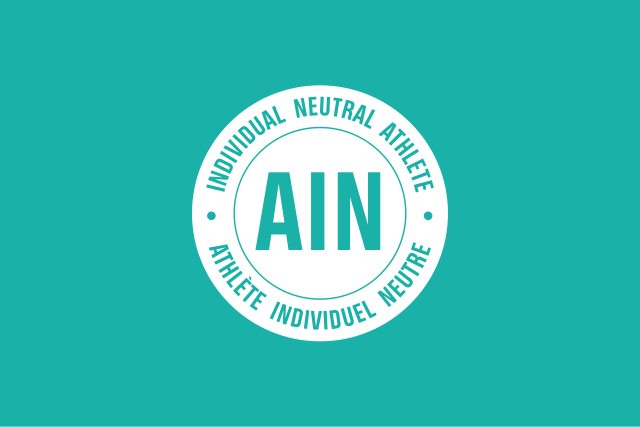
The discussion surrounding Israel’s competition in the Olympics can better be understood by looking at the IOC’s handling of Russia and Belarus, which set the precedent for enforcing political neutrality in the Olympics. Viewers of the global sporting competition are familiar with neutral teams. The most notable prior to the 2024 Summer Olympics in Paris was the Refugee Olympic Team (EOR). Now, following Russia’s invasion of Ukraine in October 2023, another neutral team has been introduced – the Individual Neutral Athletes (AIN). Both teams fly under a distinct flag, with the EOR flying the Olympic flag and the AIN flying its own turquoise flag.
However, AIN athletes must compete independently and are banned from using their own nation’s symbols. This includes flags and national anthems. Additionally, each member of the team must have no military affiliation or support the ongoing conflict their country is engaged in. Currently, only Russia and Belarus have been members of this team. In the Winter Games, 13 Russian athletes and 7 Belarusian athletes competed. Therefore, these members must not support the ongoing war in Ukraine to compete.
Israel’s Continued Participation: Neutrality Under Scrutiny
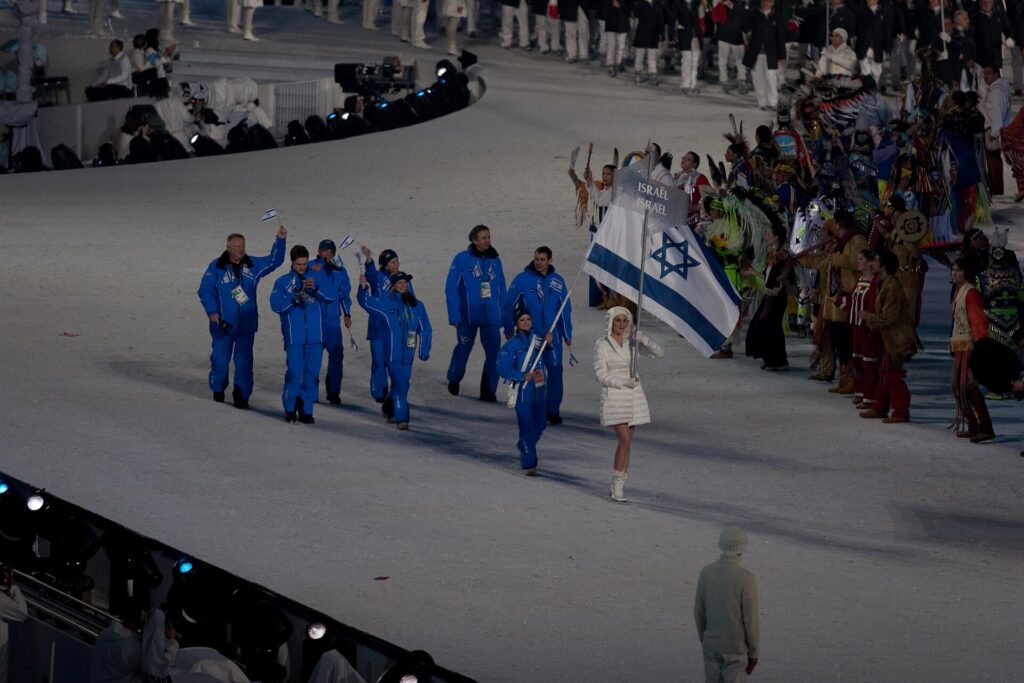
While Russian and Belarusian athletes competed under neutral status, Israel was allowed to participate fully with 10 athletes, highlighting a contrasting application of Olympic rules. Despite global calls for restrictions from the winter games in 2025, the IOC stated that Israel would not be banned. When comparing the genocide in Gaza to the War in Ukraine, the IOC has stated that both conflicts are “not comparable”.
This highlights perpetuated Western narratives across the globe, as a large number of organizations and nations condemn Russia’s war crimes, yet not Israel’s. The common narrative, “Israel has a right to defend itself”, shows both double standards in terms of competition, as well as violating the IOC’s clause of “political neutrality”. According to the Palestine Football Organization, Israel has killed over 800 athletes and sports officials in Gaza and the West Bank since October 2023, including 100 children. In addition, the Lancet Global Health Medical Journal estimates that between October 7, 20243 and January 5, 2025, over 75,000 individuals have been killed in Gaza.
With reports indicating that roughly 90% of Gaza’s population has been displaced, and the Gaza ceasefire currently being violated, analysts question the IOC’s position that the conflicts involving Israel and Ukraine are “not comparable”. According to September 2025 correspondence, the IOC released a statement, stating: “The IOC deeply believes that differences between nations must be resolved through dialogue, not violence”.
Media Coverage and Controversies: Consistency or Context?
In addition to official statements, media coverage during the 2026 Winter Olympics emphasized issues around Israel’s participation. One notable example came from Swiss RTS broadcaster Stefan Renna. During the Israeli two-man bobsleigh competition, Renna discussed competitor Adam Edelman. On air, he described him as someone who “defines himself as a Zionist to the core”. Renna also told viewers that Edelman has posted on social media “in favor of genocide”. In the end, Renna stated, “One can therefore question his presence in Cortina during these Games”.
Following this broadcast, RTS removed Renna’s commentary. They stated that while the information presented about Edelman was factual, it was not appropriate in terms of sports commentary. This incident underlines how debates concerning Olympic neutrality stem beyond official IOC decisions. Instead, it has extended into media and public discourse. While the Olympics appear to highlight neutrality, it appears that neutrality is defined differently globally.
As the war in Ukraine is ongoing, so is the genocide in Gaza. In this context, the world is opening its eyes to the potential double standards in international neutrality. Ultimately, this raises an important question: should Israel be allowed to participate under the current Olympic framework?
Want more articles like this? Sign up for our e-newsletter!
Check out our blog here!