

Subscribe
to receive news by email

Poll
Will the Trump Administration Shift U.S. Policy in Favor of Palestine?
- No (87%)
- Yes (13%)
 Loading ...
Copyright © 2026 Arab America
Go topThe Rise of Ethnic Enclaves: Little Arabia
By Rena Elhessen/Arab America Contributing Writer
Beginning in the early 1900s, immigrants would settle in communities with a shared demographic. People arriving from the same global region or country found themselves in a singular community. This trend became recognizable by scholars, who coined these communities as ‘ethnic enclaves’.
The term ‘ethnic enclave’ emerged from the need to describe areas where immigrants of shared origin concentrate geographically. The earliest enclaves were first recognized in Chicago in immigrant neighborhoods such as ‘Little Italy’ or ‘Chinatown’. To the Western world, a community where members share a similar origin can be described, but to every immigrant, it’s a piece of home.
Ethnic enclaves emerge as an adaptive strategy within immigrant life. These communities form in response to both external pressures, such as discrimination or economic barriers, and an internal desire to preserve culture and tradition. Enclaves have become cultural havens for immigrants and their future generations to experience a piece of their motherland without leaving the United States.
Prominent Ethnic Enclaves
One of the most well-known Arab American enclaves is Dearborn, Michigan, often referred to as the cultural capital of Arab America. Beginning with Lebanese and Syrian Christians int he early 20th century and later expanding to include large numbers of Yemenis and Palestinians. Today, Dearborn represents the demographic and institutional strength of Arab communities in the United States.
Another prominent enclave is found in Paterson, New Jersey, sometimes called ‘Little Ramallah’. Initially shaped by Lebanese and Syrian immigrants who worked in Paterson’s silk mills, the area later became home to Palestinian newcomers. Each built thriving businesses, religious centers, and cultural associations, making it one of the largest Palestinian communities in the country.
In Brooklyn, New York, the neighborhoods of Bay Ridge and Atlantic Avenue are well-known Arab enclaves. Since the mid-20th century, waves of Yemeni, Palestinian, Lebanese, and Egyptian immigrants have created a vibrant community there.
An Emerging Communal Hub
The most recent ethnic enclave to get recognition is on the opposite coast. Little Arabia, located in Anaheim, California, has quickly become a center for Arab Americans and their thriving businesses.
Little Arabia District is an ethnic enclave in Orange County, California, a few miles from Disneyland. Sometimes referred to as “Little Gaza”, which was a play on the original designation of this area as “Garza Island”.
This little district in Anaheim grew with a diverse Arab population in the 1980s. In the 1990s, Arab American immigrants from Egypt, Syria, Lebanon, and Palestine arrived in the city of Anaheim. Local Arab American business leaders began buying distressed homes and selling them to Arab immigrants. They also bought plazas, office buildings, and recruited merchants to start up new businesses in West Anaheim.
On Tuesday, August 23rd, 2022, the Council voted in favor of designating a portion of the Brookhurst Corridor, from Broadway to Ball, as Little Arabia. Council members also voted to conduct a Brookhurst Corridor Study to guide the Little Arabia designation. The study searched for possible district options to be assigned to Little Arabia. This would provide recommendations for funding and resources to enhance Little Arabia.
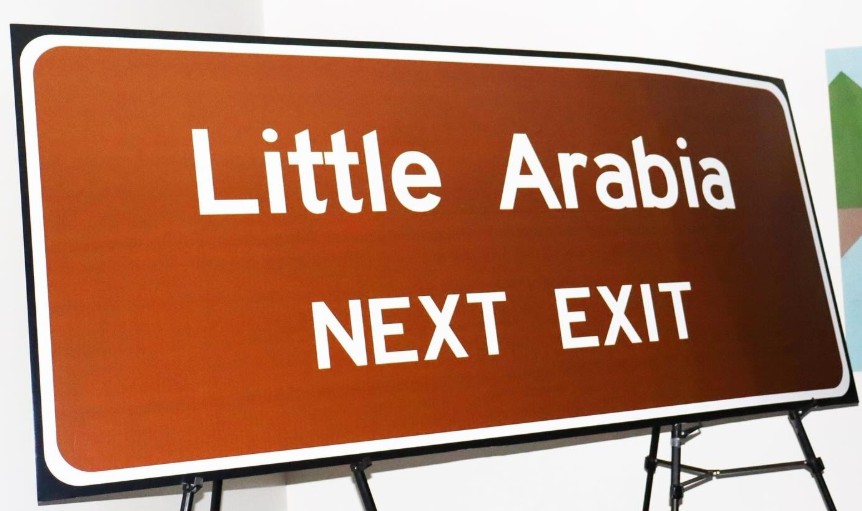
On December 12th, 2023, the City of Anaheim unveiled the results of an extensive study on the Brookhurst Corridor. A month later, Anaheim City Council members voted 5-1 on a resolution with CalTrans to get four freeway signs up.
The Little Arabia Celebration
Over the weekend, Little Arabia celebrated their third anniversary. The celebration was held on Saturday, August 23rd, and included musical performances, vendors, and activities. It was an extraordinary showing of community, filled with life and love for the Arab identity.
It was a day filled with good food, good company, and good coffee. From Dubai to Gaza, you could taste flavors from across the Arab world. This is just a glimpse of the magic Little Arabia holds.
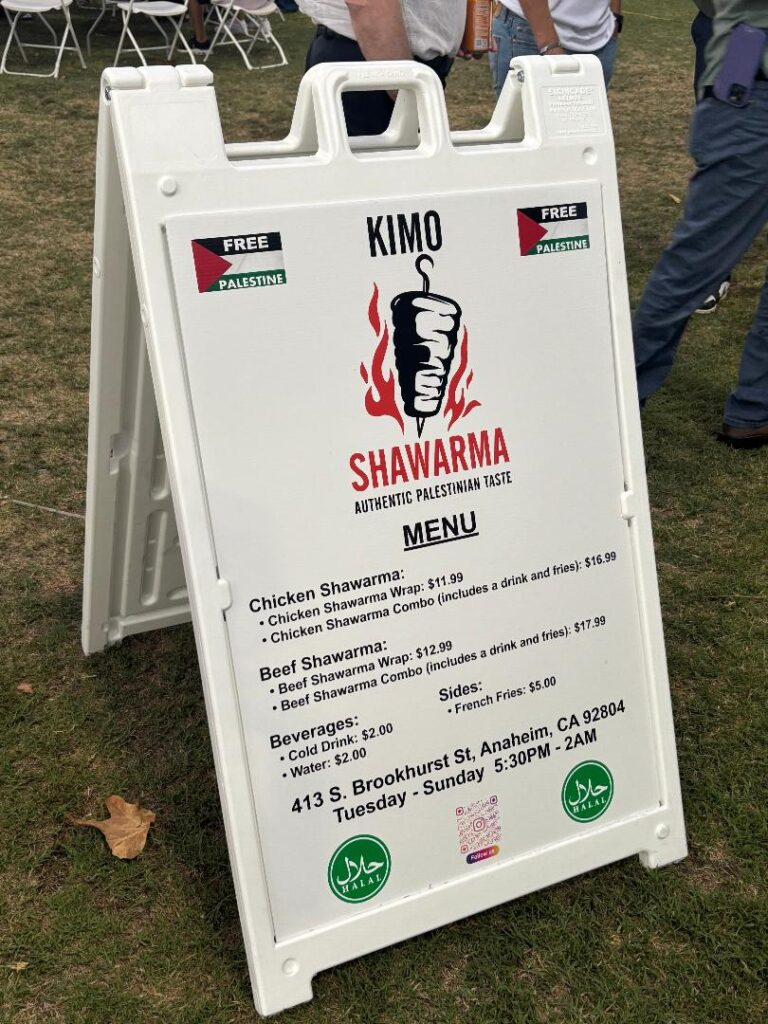
Even as an Arab attending, I was able to experience new customs from different parts of the Arab world. Notable businesses baking and cooking food from various countries, such as Kimo Shawarma. Kimo Shawarma offers authentic Palestinian shawarma, giving me, a Lebanese Arab, an experience from another country.
Another notable business was Knafeh Cafe, which has long been a staple of Little Arabia. Known for its coffee and knafeh, this cafe is a staple of Levant cuisine and the Dubai chocolate bar.
However, the best part of the event was the dabke. Where every Arab from different regions got to showcase their own country’s unique dabke steps. The diversity present at this event really reflected the diversity of the Arab world, and offered a place to celebrate my heritage while also learning more about others.
An ethnic enclave serves to preserve the traditions and culture of a community’s country of origin, but it can also serve as a place to discover more about the countries of the Arab world.
Want more articles like this? Sign up for our e-newsletter!
Check out our blog here!