Subscribe
to receive news by email

Poll
Will the Trump Administration Shift U.S. Policy in Favor of Palestine?
- No (87%)
- Yes (13%)
 Loading ...
Copyright © 2026 Arab America
Go topUN Resolution 194 - The Right to Return
Disclaimer: In this article, Zionism refers to the nationalist movement supporting the establishment of a Jewish homeland in what followers of this movement consider the Land of Israel, which they consider the ancestral territory of the Jewish people. Zionist refers to the people who follow Zionism, thereby supporting the development of a Jewish nation as it is defined as ‘ancestral territory’.
It’s important to distinguish between Jewish and Zionist in the context of this article, as figures such as Ben-Gurion (who are quoted within the text) do not. Zionist hostility towards Arabs was not a collective Jewish effort, only a Zionist one, consisting of some Jews and some non-Jews alike. Zionism disregards ethnic and religious ties, despite how it might try to paint itself, and is purely political.
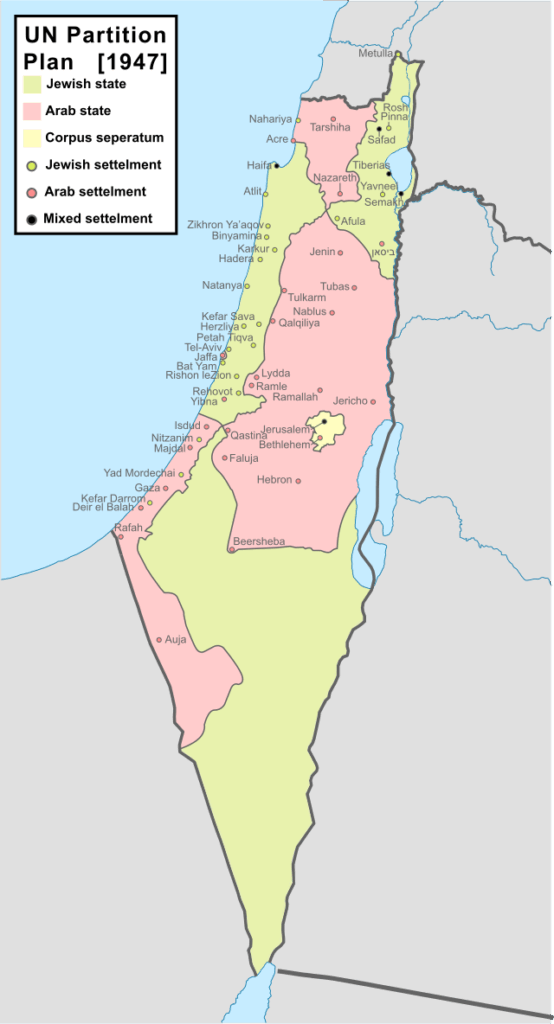
A year prior to the first Arab-Israeli War in 1948, the UN passed UN Resolution 181, partitioning Mandatory Palestine, or then British Palestine, into a Jewish state and an Arab state. Zionist Jews and Arabs in Palestine were experiencing animosity at the time, and officials had already proposed earlier partition plans, however, the UN’s had the largest impact. Multiple reasons caused the Arabs to reject this Resolution. These include their skepticism of the UN’s ability to enforce such a mandate between two sides who didn’t agree on much politically, and the Zionist hostility towards co-existence with the Arab side, based on their reaction to the 1939 White Paper.
In hindsight, neither of these would be the most important reasons in the context of the Arab-Israeli Wars. The prevailing reason in this context was the Arabs’ knowledge of the Zionist intention to continue their armed theft of Arab land regardless of whether a proposal of this sort was passed. The Arabs knew the land granted to the Zionists by Resolution 181 wouldn’t be the end of Zionist expansion- the basis for this evidence is further detailed in this article.
Zionist Statements and Action in the Context of Expansion prior to 1948
The Zionists had made it clear that their intentions with Mandatory Palestine didn’t end at a certain line within its borders. Multiple signs made this clear.
An example of intended Zionist expansion not ending with Palestine or a state within Mandatory Palestine lay in statements made by David Ben-Gurion. Ben-Gurion was the Chairman of the World Zionist Executive, the Jewish Agency Executive, and an affiliate of the Haganah- a Zionist paramilitary group. Although he attempted to appear more diplomatic on the surface and to the international community, secret letters and statements he made showed his true intentions and beliefs.

In 1937, after the Peel Commission– a British Royal Committee of Inquiry- first proposed partition, he wrote a letter to his son that included one of these statements. In it, he said, “A Jewish state in part [of Palestine] is not the end, but the beginning… it will serve as a lever for the restoration of our national possessions. This state will only be a stage in the realization of Zionism, and its task is to prepare the ground for our expansion into the whole Land of Israel.” Self-explanatory would be an understatement. In this account, he directly points towards the fact that the task of a Zionist state within Palestine would be the tipping point for full expansion into all territories he considers Israel.
Another statement by Ben-Gurion, to the Jewish Agency Executive, confirmed that the partition was seen as a necessary and temporary first step to a larger Zionist state: “After we become a strong force, as a result of the creation of a state, we shall abolish partition and expand into the whole of Palestine.”
However, one last statement made by Ben-Gurion ties them all together. The previous two were made ten years before the UN Partition Plan, allowing for the argument to be made that he changed his mind and would have been open to the two-state form of co-existence by 1947. However, the statement, “The boundaries fixed now (1947) are not eternal. If the Jewish state is established, it will possess an ever-growing force; and it will not be content with the status quo. It will liquidate the Diaspora. And it will expand,” says otherwise. This shows beyond doubt that Ben-Gurion and the Zionists of the time were keen on the expansion of Zionist territory beyond what the 1947 Partition Plan provided them. As the leader of Zionist ideologies, his writing reveals it is indisputable to recognize the Zionist goal expanded beyond Mandate Palestine.
Other Proofs for Zionism’s Intended Expansion
Another proof of Zionism’s end goal lies in the symbol of the Zionist paramilitary group named “Irgun.” One didn’t have to search deep to find their intentions with Mandatory Palestine, as their logo made it quite clear (shown below).

It consists of two states, Mandatory Palestine and Transjordan (modern-day Jordan), split by a hand holding a gun. The Hebrew text under the map, reading “רק כך,” roughly translates to “only this way” in English, meaning the only way for Zionists to achieve their goals in Palestine was through war. The Irgun rejected diplomacy, compromise, and acceptance of partition. They intended to steal Palestinian land, no matter the moral cost, and eventually, the land of Transjordan, hence the organization’s logo.
Effects of the First Arab-Israeli War
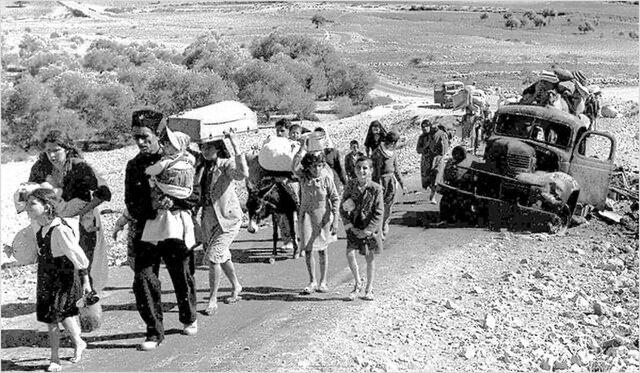
After the First Arab-Israeli War in 1948, approximately 750,000 innocent Palestinians were displaced from their homes, and 78% of what was Mandatory Palestine, based on the region of historic Palestine, was conquered and immediately sieged and annexed by the new government of the State of Israel, consisting of all the paramilitary groups such as the Haganah, Irgun, and others who made up its new government and IDF. The first Arab-Israeli war was carried out in blatant disregard of an international civil agreement. The UN Resolution aimed to resolve this conflict through a land distribution of 55% for the Zionist-Jewish paramilitary groups and 45% for the Palestinian nationalist paramilitary groups. To avoid probable economic instability, which would be caused by a sudden land grab, this Resolution included an economic agreement. Unfortunately, this was all disregarded despite the Arab-Palestinian inclination towards agreement when the first Arab-Israeli war began.
The percentage of land grabbed by the Zionist militias in the war is an important figure, and a key to looking at the history of the two states. A main reason is that during the time of British-controlled Mandatory Palestine, particularly in 1945, Palestinian land-workers owned and/or operated around 93% of land and made up 2/3 of the population. The displacement caused by the war meant that an overwhelming majority of Palestinians would have to leave their businesses and farmland, leaving it up for grabs for any group that wanted to come in and take it, whether that be the new Zionist state or anyone who would move into it. This land would end up being considered land “promised” to its settlers, disregarding thousands of years of Palestinian Canaanite and Arab history, as a means to reinstate the Israel that was once apart of the Bible.
UN Resolution 194
All this leads to one main UN Resolution, also the title of the article, UN Resolution 194. This Resolution details: “refugees wishing to return to their homes and live at peace with their neighbors should be permitted to do so at the earliest practicable date, and that compensation should be paid for the property of those choosing not to return and for loss of or damage to property which, under principles of international law or equity, should be made good by the Governments or authorities responsible.” Furthermore, the UN has confirmed Resolution 76 times since it was adopted, thereby affirming its legitimacy in international law.
In fact, Israel’s admittance to the UN was based on the agreement that it would “unreservedly [accept] the obligations of the UN Charter and [undertake] to honour them from the day when it becomes a member of the UN.” Unfortunately, several International Human Rights Organizations, including BDS, Human Rights Watch, and even Jewish Voices for Peace, have concluded that Israel has continued breaking Resolution 194. It’s time that Israel complies with the UN charter, or it will continue facing repercussions from the international community, such as ICC arrest warrants for Israeli leaders, suspension of arms exports, diplomatic isolation, calls for boycotts, and the threat of sanctions.
Want more articles like this? Sign up for our e-newsletter!
Check our blog here!