

Subscribe
to receive news by email

Poll
Will the Trump Administration Shift U.S. Policy in Favor of Palestine?
- No (87%)
- Yes (13%)
 Loading ...
Copyright © 2026 Arab America
Go topWho Inspired the Greeks and Romans? The Ancient Libyan Origins of the Jard

By: Nourelhoda Alashlem / Contributing Writer
The Libyan “Jard“ is often seen as a simple traditional garment worn by men and women across Libya. Yet its story may reach far deeper into the ancient Mediterranean world. While classical dress is usually associated with Greece and Rome, historical evidence suggests similar draped garments existed in the region long before.
This raises an intriguing question: could the ancient Greeks have borrowed inspiration from Libyan dress traditions?

The Jard Costume
The Jard, sometimes called the “Houli,” is one of the most famous garments in Libyan traditional dress. The garment consists of a single rectangular piece of cloth measuring roughly four to six meters long and about one and a half meters wide. Instead of being sewn, the fabric is wrapped and draped around the body, covering the shoulders and often the head.
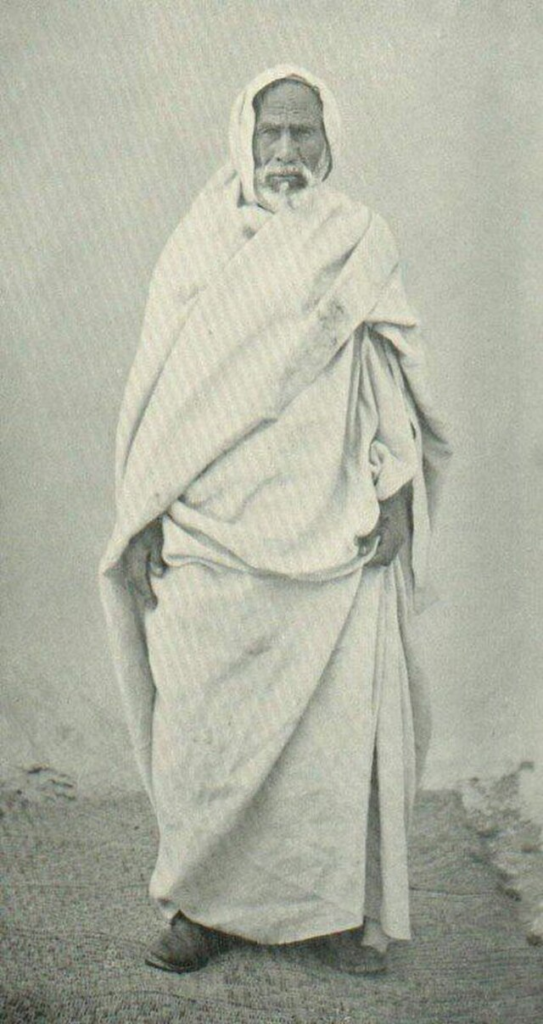
The ability to wrap clothing correctly is a necessary skill for Libyans. A tiny knot known as a “Tukumia“ was used to secure the cloth, leaving one arm free while the remainder of the fabric flowed around the body
Traditionally white, the Jard symbolized dignity and modesty. Brown versions appeared in colder months, but the white Jard remained the most recognizable form. For centuries, the garment served practical and symbolic purposes. In Libya’s desert climate, people used it as bedding during travel, protection from wind and sun, and even to draw water from wells.
In the past, the Jard represented all societal levels in Libya, despite its simplicity. Farmers, traders, tribal leaders, and rulers all wore it.
The significance of the Jard only increased over time, particularly during Libya’s struggle against Italian colonial rule in the early twentieth century. The garment became closely associated with Omar al-Mukhtar, leader of the Libyan resistance. Photographs of al-Mukhtar wearing the white Jard transformed it into a symbol of Libyan perseverance and national identity.

King Idris I, the country’s first monarch after independence, was frequently photographed wearing the traditional garment, while Muammar Gaddafi was seen in a darker brown version of the Jard.
Ancient Libya in the Eyes of Early Historians
The idea that elements of Greek dress draw influence from Libyan clothing is not a modern claim. One of the earliest references appears in the writings of the Greek historian Herodotus in the fifth century BCE. InThe Histories, Herodotus wrote:
“It would seem that the robe and aegis of Athene were copied by the Greeks from the Libyan women; for save that the dress of Libyan women is leathern.” — Herodotus, Book IV, Chapter 189

Herodotus described the clothing associated with the goddess Athena and suggested that aspects of Greek attire had origins in Libyan dress traditions. While historians continue to debate the precise interpretation of this passage, the observation is significant. It shows that even in antiquity, Greek writers recognized cultural influences coming from North Africa.
Evidence appears not only in classical Greek sources but also in later historical analysis. Some historians, such as Birket-Smith in his book, The Paths of Culture (1965), and references Herodotus, note that the draped garments commonly associated with Greek and Roman elites resemble earlier Amazigh Libyan civilization, the “Libu,” clothing traditions.

In one account describing a Roman statue, a teacher explains that the cloak wrapped around the figure’s body and fastened at the shoulder resembles the ancient Libyan Jard or Houli. According to this interpretation, the Romans inherited the style from the Greeks, while the Greeks themselves had adopted the draped garment from the Libyans.
Within this Mediterranean network of exchange, Greek clothing traditions drew inspiration from the Libyan garment. Draped garments such as the Greek Himation and later the Roman Toga took inspiration from the Libyan Jard in structure and style.
Preserving the Jard: A Call to Recognize Libya’s Cultural Heritage
Today, the Jard continues to appear during cultural celebrations such as Libya’s National Day of Traditional Dress on March 13th, where Libyans gather in public spaces like Martyrs’ Square in Tripoli. Witnessing multiple generations dressed in the same draped cloth worn by Libyan ancestors shows that the garment is not a piece of the past but still a living cultural tradition today.
The garment also marks important moments in Libyan social life. At weddings, a bride passes beneath her father’s Jard as she leaves her family home, symbolizing protection and blessing. The garment also appears in funerary traditions, where families place it over a coffin as a sign of respect and honor.
The history of the Jard also pushes for a reconsideration of Mediterranean history and its truth. Greece and Rome are often regarded as the centers of classical civilization, yet ancient sources suggest otherwise, as older generations, such as the Libu civilization, existed and considered them to be older than the Greeks.
Today, the Jard remains a visible symbol of that heritage. As Libya continues documenting and preserving its traditions, the garment stands as a reminder that the country’s cultural history extends far deeper than many realize. Recognizing the jard as part of UNESCO’s Intangible Cultural Heritage is necessary, as it would help protect this enduring symbol of Libyan identity for future generations.
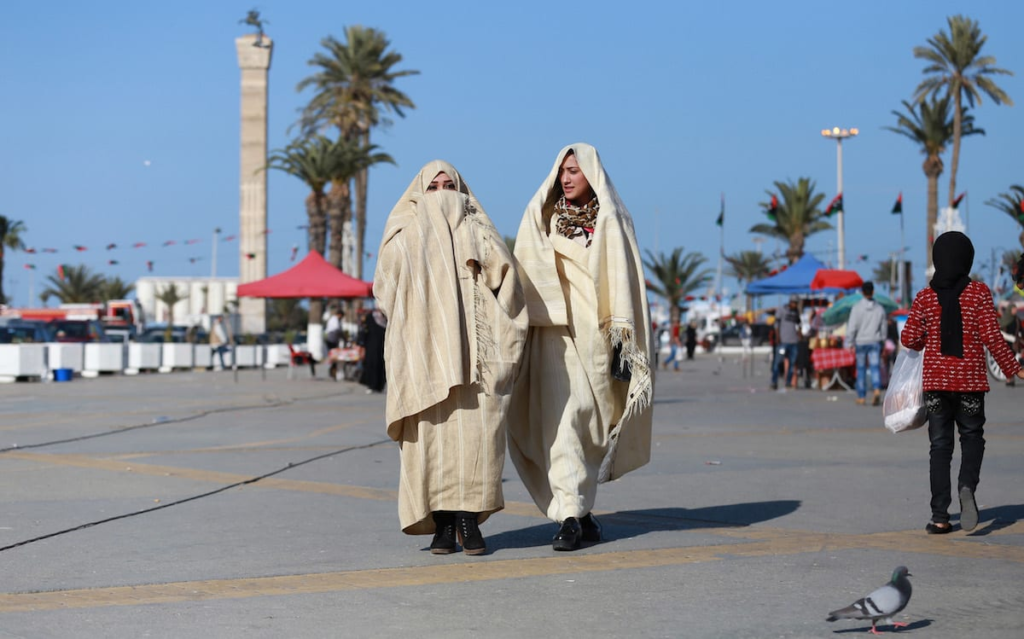
Watch how to wrap the Jard below:
A post shared by Maher Alawami (@maher_alawami)
Want more articles like this? Sign up for our e-newsletter!
Check out our blog here!





_(8289807480).jpg)

