

Subscribe
to receive news by email

Poll
Will the Trump Administration Shift U.S. Policy in Favor of Palestine?
- No (87%)
- Yes (13%)
 Loading ...
Copyright © 2026 Arab America
Go topAll That's Left of You: Love After Loss
By Rena Elhessen/Arab America Contributing Writer
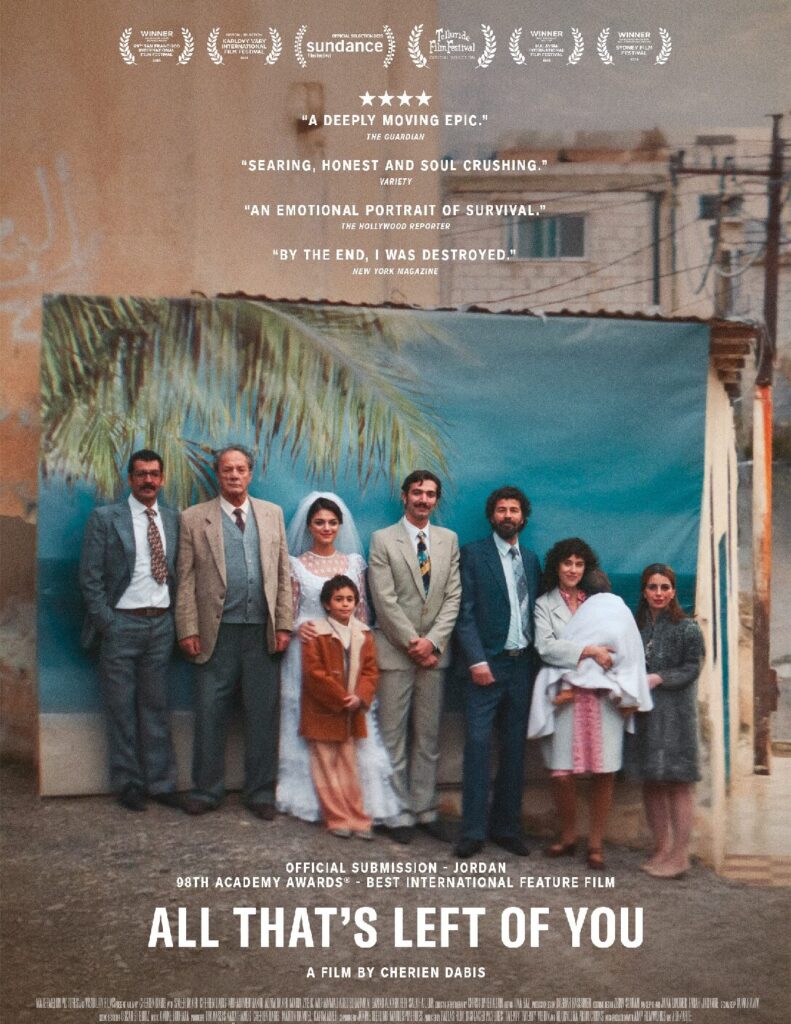
The most recent project from Watermelon Pictures, debuting in theatres nationwide, All That’s Left of You, encapsulates the array of emotions experienced as a displaced person and leaves an Arab audience feeling seen. Palestinian-American director Cherien Dabis bares her soul in this Arab epic, spotlighting the silent, continued grief of an Arab family through an inter-generational lens. Spanning seven decades, this film explores grief, love, and perseverance despite displacement. Having won more than 24 awards and an Oscar nomination, All That’s Left of You is a must-watch.
All That’s Left of You
The film has a run time of just under two and a half hours, yet each minute captivates you in a well-woven story that spans three generations. All That’s Left of You follows a Palestinian teenager who gets swept into a protest in the Occupied West Bank and experiences a moment of violence that uproots his family. The film unfolds as his mother recounts the historical, political, and emotional events that led to that unfortunate moment.
Following the violence of the opening event, the film transitions to the mother of the teenager (Hanan), speaking to the audience. In this conversation, she wants the audience to understand “why we are here”. Yet, a full scope of understanding can not be built without the historical context.
Why We Are Here
The perspective of this film is from a lesser-seen point of view. The Palestinian mother, Hanan, recounts three generations of trauma, heartache, and survival. The root of this history begins in 1948 and carries to the present, allowing the audience to visualize the thread of trauma as it weaves itself through generation after generation.
1948
In 1948, the British mandate of Palestine ended, and the Zionist leaders in the state declared the territory the state of Israel. In the following days, the surrounding Arab countries invaded the land, fighting against the occupation. The war that followed is known to Israel as the War of Independence, but for Arabs, this year is known as the Nakba. This film offers the Palestinian perspective on the events of 1948, capturing the heartbreak amid the tragedy.
Almost every Arab American has heard the story a million times. The story of their family’s escape, exile, or fleeing, but to witness its recreation on screen evokes a different feeling. To witness such tragedy on screen allows the Arab expat to feel their history, though rooted in tragedy. Yet, if this history is so tragic, why is it continuously told by Arab parents and grandparents?
That is an answer delivered from the beginning of this film. This history is constantly told and retold to understand “why we are here”. To understand why a family still carries the anger and burden of generations, and how it has shaped each family member’s identity.
1978
The timeline of the family progresses 30 years to 1978. The joy of this opening scene contrasts with the tragedy of the Nakba, as we witness a traditional Palestinian wedding. Sadly, there are reminders of the effects of displacement throughout this scene. Particularly, an occurrence many Arab Americans identify with, the departure from one’s homeland.
Despite this departure, the joy of this scene introduces the theme of love in the face of grief. A form of resistance in the midst of occupation. The family has suffered immense loss, having a wedding in a refugee camp, yet remembers to embrace joy where it is found. A fundamental form of protest.
However, the grief and trauma from the Nakba are still present. Though the wound has scabbed over, it remains.
Three generations of family members reside in a single home in the Occupied West Bank. The familial patriarch, who was witness to the Nakba, has carried the anger for years. Yet we are able to see how each generation is responding to this tragedy. His son (Salim), the second generation, wishes to forget and move on. The third generation, Noor, wishes to carry on the resistance.
During this time, we also witness an emotionally heartbreaking scene, as Israeli soldiers harass Salim and his son on their way home. From this scene, a central emotion appears, pivoting the direction of the film. The shame and embarrassment that comes with occupation is now a rancid emotion felt by this family.
1988 (حرب الحجارة)
The timeline then moves ten years forward, to the First Intifada. In 1988, the Palestine Liberation Organization (PLO) declared an independent state of Palestine. This time period is known for protests, civil disobedience, and the beginning of rock throwing by Palestinian youths. The Western world knows this time as the First Intifada, but the Arab World calls it the “War of the Stones“. (حرب الحجارة)
When the youngest son of the family, Noor, gets caught up in one of these protests, he is the victim of a great tragedy. This tragedy uproots the lives of the family and examines their resistance as it takes on a new form. Instead of choosing anger, they find love persevering.
Choosing tolerance and acceptance to remedy their loss, their humanity becomes their resistance.
An Exploration of Language
Arab films are rarely shown in theatres, and it is even less frequent that the dialogue is entirely in Arabic. However, being able to understand this film in Arabic amplifies the emotional experience. The use of language in this film should not be overlooked.
In the opening scene, we hear the lines of Hafez Ibrahim, “I am the sea, in my depths all treasures dwell”. A poem written nearly a century ago, describing the beauty of the Arabic language. This purity of the Arabic language is then mutilated throughout the story. When Sharif is taken from his home, it is by Israeli soldiers speaking broken Arabic. When Salim faces a violent altercation at the hands of Israeli soldiers, Arabic is used as a tool to further his embarrassment.
The Arabic language, known for its beauty, is mutilated and used as a tool for further colonization. An effect that is further felt by an Arab American audience, who understands the gravity each word carries.
Final Remarks
All That’s Left of You has earned a Film Independent Spirit Award nomination and an Oscar nomination, but that is not the only reason to watch the film. For an Arab American, watching the film is a journey in feeling seen. A story heard for generations among Arabs has found its way to the big screen, and you do not want to miss it. Director Cherien Dabis creates a powerful statement of resistance and love amidst the tragedy. A defining trait of all Arab refugees, asylees, and immigrants is refreshing to see on screen.