
Subscribe
to receive news by email

Poll
Will the Trump Administration Shift U.S. Policy in Favor of Palestine?
- No (87%)
- Yes (13%)
 Loading ...
Copyright © 2026 Arab America
Go topArab League Observer States: Diaspora, Language, and the Global Reach of the Arab World
By: Emma Campbell / Arab America Contributing Writer
Arab Influence Beyond Membership
The Arab League is often understood as a regional body limited to its 22 member states. However, its reach extends far beyond the Arab world via observer nations. These observer states reflect the enduring impact of Arab diaspora communities, linguistic ties, and long-standing cultural and political connections.
The Arab League (also known as the League of Arab States) was established in March 1945. According to the Council on Foreign Relations, the League has a primary purpose of improving coordination of member states based on common interests. In addition to the 22 member states, the League has developed broader diplomatic outreach through observer states. These 7 countries have been invited to participate in meetings and deliberations without the right to vote. Each holds observer status for distinct engagement reasons, ranging from linguistic ties and geography to Arab diaspora influence and strategic partnerships. Observer states currently include Brazil (2003), Eritrea (2003), Armenia (2004), Chad (2005), Venezuela (2006), India (2007), and Greece (2021). Despite these nations appearing abstract, deeper examination reveals patterns that reflect both diplomatic pragmatism and the cultural footprint of Arabic language and heritage.

Arab Diaspora and Latin American Observers: Brazil and Venezuela
Brazil
Brazil hosts the largest Arab diaspora outside of the Middle East. According to Georgetown’s Center for Contemporary Arab Studies, migration from the Eastern Mediterranean to Brazil started around the late 1870s. During this period, around 150,000 people migrated from contemporary Lebanon and Syria. In 2020, the Arab-Brazil Chamber of Commerce released its first-ever census, claiming there are around 12 million people of Arab descent living in Brazil. This equates to 6% of Brazil’s population.
Venezuela
In addition to Brazil, Venezuela also hosts a large Arab diaspora community. The Arab Venezuelan community amounts to around 2 million Venezuelans, primarily from the Levant region. Venezuela joined the Arab League as an observer state in 2006. This occurred under the presidency of Hugo Chávez. The decision to make Venezuela an observer state followed strengthened diplomatic ties between Venezuela and Arab states in the early 2000s.
Language and Geography: Eritrea and Chad

Eritrea
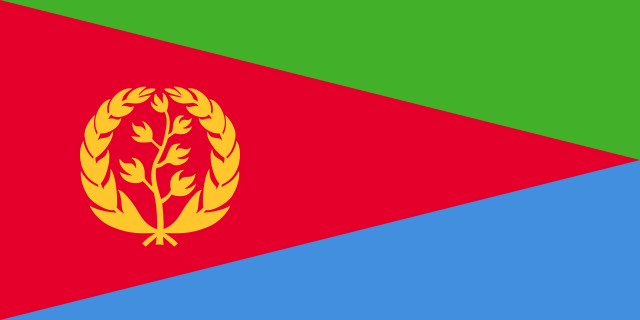
Eritrea has been an observer state in the Arab League since 2003. This followed internal debates after the country’s independence in 1993, specifically focusing on whether Eritrea should fully join the Arab League. Those in favor of full membership argued about Eritrea’s proximity to the Red Sea and the country’s historical ties to Arab states. Those opposed to fully joining highlighted the importance of a neutral regional position. Arabic is one of three significant languages for business, alongside Tigrinya and Tigre.
Chad
Chad has been an observer state in the Arab League since 2005. Arabic is one of the two official languages in Chad, alongside French. According to Abiri Kenya, the national lingua franca and language of business in Chadian Arabic. This is spoken by 40-60% of the population. However, Modern Standard Arabic and French still have slightly higher native speakers than Chadian Arabic. French is concentrated in the capital, N’Djamena. On the other hand, Arabic is found all over the north. In terms of geography, Chad borders both Libya and Sudan – both Arab League member states.
Economic and Labor Ties: India
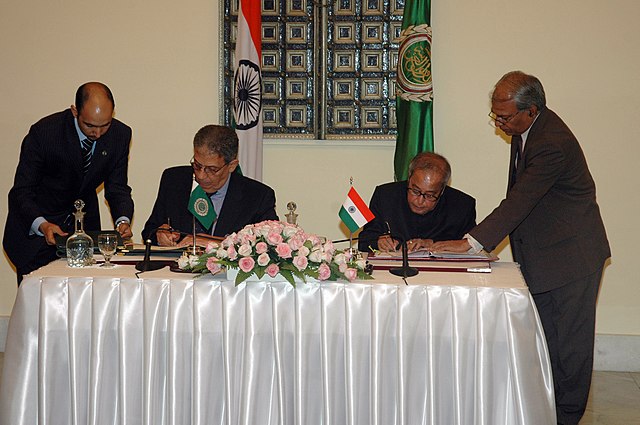
India became an Arab League observer state in 2007 as a result of growing diplomatic and economic engagement with the Arab world. According to the Embassy of India in Cairo, India and the Arab League established formal diplomatic ties that enabled closer cooperation across political, economic, and cultural fields. In addition, over 9 million Indian diaspora have made Arab League nations their home. Beyond migration, Arab News highlights the importance of trade between India and Arab States. Particularly, energy cooperation has become a central pillar of India-Arab relations. India’s engagement with the Arab League has continued to increase over recent years. Now, India is preparing to host Arab League foreign ministers in New Delhi later this month.
Historical and Mediterranean Connections: Armenia and Greece


Armenia
Armenia became an Arab League observer in 2004 following a Syrian invitation. According to Azad‑Hye, about 300,000 Armenians live in Arab countries such as Syria, Lebanon, Egypt, Iraq, and Jordan. This forms some of the oldest Armenian diaspora communities in the region. These communities helped strengthen historical, cultural, and economic ties between Armenia and Arab states. The Armenian communities in Syria and Lebanon played a key role in maintaining Armenia’s diplomatic and humanitarian engagement with the Arab world.
Greece
Greece is the newest observer state, and was admitted in 2021. The country signed a cooperation agreement with the League in Cairo. According to Greek City Times, the decision followed expanding ties between Greece and Arab states such as Egypt, the United Arab Emirates, and Saudi Arabia. This particularly related to issues in diplomacy and regional security. This modern cooperation builds on centuries of Greek-Arab interaction across the Mediterranean. According to Arab News, Greek traders have been present in the Red Sea and Middle Eastern ports since antiquity, illustrating centuries of economic and cultural exchange across the Mediterranean between Greek and Arab societies.
A Global Arab Presence
The Arab League’s observer states demonstrate that Arab identity is not confined to borders or passports. Through migration, language, labor, and historical ties, Arab communities have shaped global relations that continue to influence diplomacy today. Observer status recognizes these enduring connections, affirming that Arab history and culture remain deeply intertwined with societies far beyond the Arab world.
Want more articles like this? Sign up for our e-newsletter!
Check out our blog here!