
Subscribe
to receive news by email

Poll
Will the Trump Administration Shift U.S. Policy in Favor of Palestine?
- No (87%)
- Yes (13%)
 Loading ...
Copyright © 2026 Arab America
Go topArabic Thought’s Mark on Modern Philosophy
By: Diksha Tyagi/Arab America Contributing Writer
When we think about modern philosophy today, our minds usually turn to Enlightenment-era European thinkers such as Descartes and Kant. However, the medieval Islamic world laid the foundations for many of the central tenets of their works, a fact often overlooked. Due to Arabic philosophers such as Ibn Sīnā, Al-Ghazali, and Ibn Rushd, scholars across the world inherited a vast philosophical legacy that later influenced the rationalism and empiricism of the Enlightenment.
The Islamic Golden Age
After the fall of the Western Roman Empire, the western half of Europe, mostly speaking Latin, lost access to much of Greek philosophical knowledge. Translated philosophical texts were few and inadequate, while there was little contact with Greek-speaking Europe.
However, the expansion of the Islamic Empire into this fallen territory allowed Arabic access to Greek texts. This was mainly due to the absorption of certain Greek-speaking regions like Egypt and Syria. Between the 7th and 13th centuries, scholars in the Islamic world translated and expanded on many Greek works, particularly those of Aristotle and Plato.
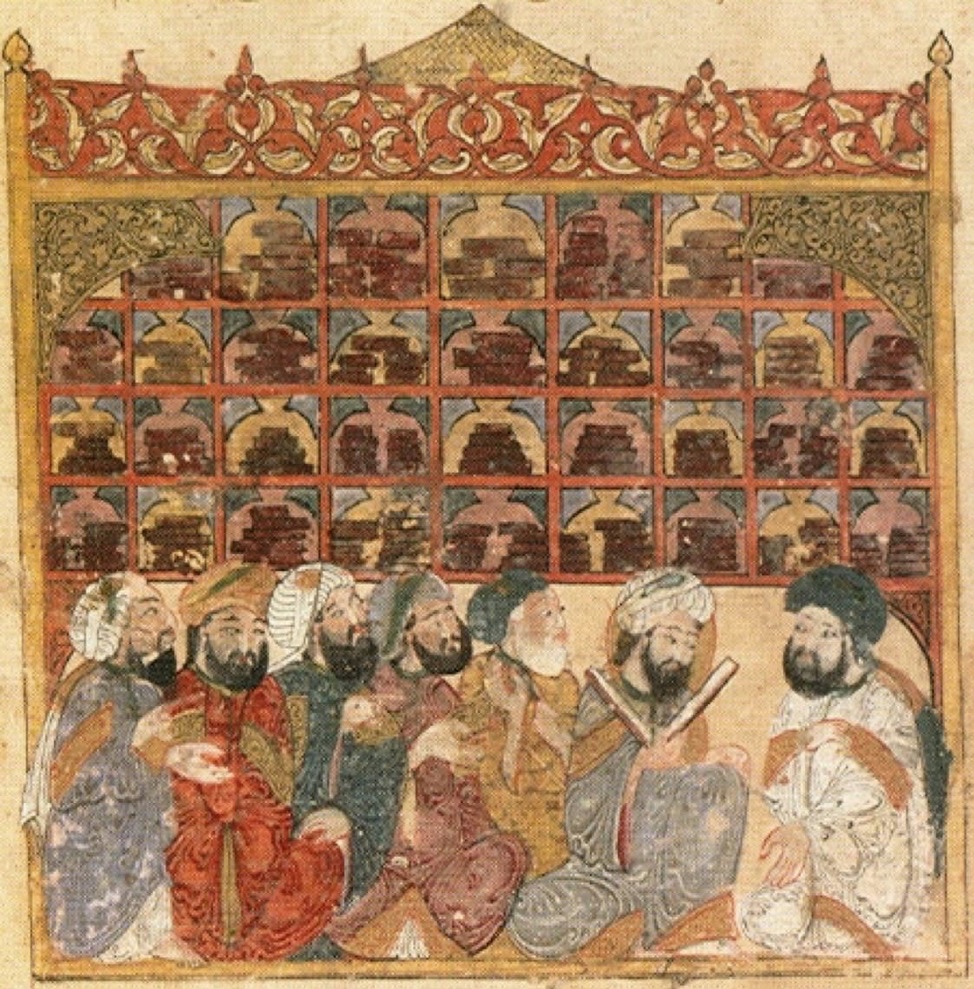
A major hub of this intellectual transformation was The House of Wisdom in Baghdad. Founded under the Abbasid caliphs, it operated as both a major library and translation center where scholars translated Greek works into Arabic. Philosophers built further on these texts, adding Islamic theology to Greek dialogue and producing a vibrant culture of inquiry.
Ibn Sīnā and Rationality
One of these influential thinkers was Ibn Sīnā, also known as Avicenna. Writing in the 11th century, his philosophical writings, accompanying many others on medicine, science, and mathematics, drew on the works of Aristotle but also managed to incorporate Islamic theology. He intended to create a system that sought to explain both the natural and metaphysical worlds.
Avicenna introduced a groundbreaking and now well-known distinction between essence and existence. This would become foundational to later European metaphysics, influencing Scholastic philosophers like Thomas Aquinas and becoming a key element of rationalist thought. Another influential idea was his concept of the ‘Necessary Existent’. This is a being whose existence is necessary due to the existence of contingent things. With this, he offered one of the, if not the first, logical proofs for God’s existence. Finally, his most well-known “Flying Man” thought experiment, which imagined a man created in midair who, even deprived of sensory experience, is still aware of his own existence, anticipated Descartes’ idea of the cogito.
Al-Ghazālī and Skepticism
While Avicenna emphasized and furthered reason and rationality, Al-Ghazālī brought its limits into discussion. In his Incoherence of the Philosophers, he argued that sole rationalism could not fully explain divine creation or causation, emphasizing the importance of God’s will. The apparent link between cause and effect was not necessary but instead a habit of human observation. This was a crucial rift in Islamic philosophy that was mirrored by European philosophical conflicts centuries later: in particular, pertaining to human reason and its relation to God’s absolute power.
These critiques of causality and reason, meant to defend faith, also laid the philosophical foundation for skepticism. This is the view that questions the possibility of certain knowledge. During the Enlightenment, David Hume would echo Al-Ghazālī’s argument, stating that our belief in cause and effect comes from custom. In this way, Al-Ghazālī anticipated modern empiricism and skepticism.
Ibn Rushd and Humanism
In Córdoba, Ibn Rushd, also known as Averroes, defended reason as the highest form of human inquiry. While Avicenna synthesized Aristotelian thought with Islamic theology, Averroes pursued a much stricter Aristotelian agenda. His extensive commentaries on Aristotle reintroduced him to the Latin West in his true form, uncovering Aristotle’s original teachings as opposed to earlier interpretations that, according to him, had distorted his message.
Averroes focused on how philosophy and religion, instead of contradicting each other, in fact both point toward truth through different methods. Asserting that “truth does not contradict truth” became central to later Scholastic thought, as it defended the harmony between philosophy and religion. Through his work, Averroes helped restore Aristotle’s philosophy and solidified reason as vital to human understanding, laying a foundation for humanism by emphasizing the power of human reason to achieve truth.
Philosophical Legacy
Though modern philosophy is usually examined by reading European philosophers who popularized its ideas during the Enlightenment, its full understanding requires the knowledge of a foundation built by Arabic scholars. Their efforts preserved the nature of Greek inquiry, expanded it, and allowed it to be read in Europe, where it would eventually become modern rationalism and empiricism. The total legacy of Arabic philosophy is not only in what it preserved, but in what it created and facilitated. By translating, commenting on, and reinterpreting Greek philosophy, Arabic thinkers created the bridge between the ancient and modern worlds.
Want more articles like this? Sign up for our e-newsletter!
Check out our blog here!