Subscribe
to receive news by email

Poll
Will the Trump Administration Shift U.S. Policy in Favor of Palestine?
- No (87%)
- Yes (13%)
 Loading ...
Copyright © 2026 Arab America
Go topBuffer Zones and QR Codes: The Psychological Warfare on Lebanon
By Mitzi Tapang / Arab America Contributing Writer
On Sunday, March 29, Israeli Prime Minister Benjamin Netanyahu insisted on a multi-arena campaign to strike Iran and “its proxies” with military forces that could thereby reveal the cracks within the terrorist regime.
“Determined… to remove the danger from our borders…we are the ones attacking,” said Netanyahu in a video statement from the Israeli Northern Command. “We are the ones taking the initiative, and we are deep within their territory.”
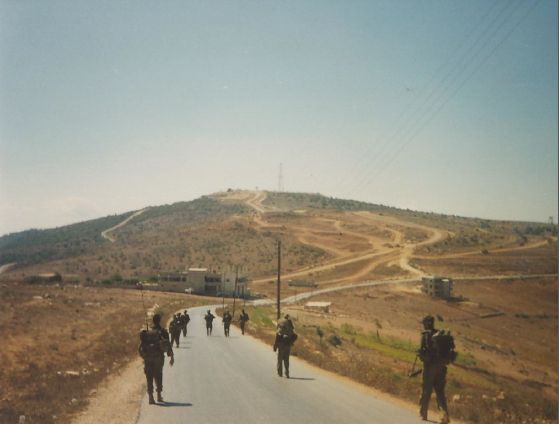
At the core of his campaign was the expansion of a security zone in southern Lebanon to drive out Hezbollah given “its residual capability to launch rockets at us [Israel].” Netanyahu claimed that the operations were detrimental to thwart existing threats following the creation of buffer zones in the Hermon ridge in Syria and in almost the entirety of Gaza Strip’s territory.
In what is potentially believed to be the largest ground escalation in Lebanon since 2006, the concerted military push by the Israel Defense Forces (IDF) foremost included advances to the Litani river. In its most strategic placement, the river runs through a large agricultural region and serves as Lebanon’s primary water source. Expanding a security buffer zone ultimately meant dislodging Hezbollah supply routes.
The situation also presents a clause to, once again, return to the grand scale of the Zionist project and wonder whether the decision to further militia-operated invasions is rooted firmly in an attempt to “neutralize” the area or a “seizure of an additional territory.”
The Buffer Zone Question
What actually constitutes a buffer zone? For a long time, framing an area as a “security zone” or “buffer zone” instantaneously conjured images of destroyed bridges and forward military positions. Now, as before, the entire traction of Israel’s “big strategic change” follows the logic of moving the threat farther from the border, even if that creates a new occupation-like zone.
Israel’s current move toward a zone up to the Litani River mirrors that of their first major intervention in 1978, in 1982, and later in the 2006 war. Notably so, it settled into a southern occupation belt rather than full control of the country. It was only by 1985 was Israel had created a security zone in southern Lebanon.
In the establishment of a wider occupation zone, typically described as a strip of about 15 km deep, the belt was meant to keep Palestinian militants, and later Hezbollah, away from Israel’s border. At full tilt, however, it became a prolonged guerilla war and a source of mounting Israeli casualties.
Following the 2006 war, UN Security Council Resolution 1701 envisioned the area between the Blue Line and the Litani River to be free of “armed personnel, assets and weapons” other than those of the Lebanese government and UN Interim Force in Lebanon (UNIFIL). When the Israel-Hamas war intensified in 2023, Israel pressed Hezbollah to abide by said provision. In late 2024, a new ceasefire framework was put forth, while still encasing the idea that Hezbollah would pull out north of the Litani River and Israeli forces would withdraw from southern Lebanon.
On Propaganda and Campaign
A year before that, Netanyahu warned against Hezbollah’s “all out-war,” lest Israel “single-handedly turn Beirut and South Lebanon into Gaza and Khan Yunis.” Beyond the destruction waged upon the land and its people, Lebanon’s residents were also forced to confront warfare through means of psychological control and targeting. Precisely, broadsheets, leaflets, and websites that continue to place civilians in constant negotiation with their conditions.
Putting Israel’s psychological warfare against Lebanon into the purview of the current state of affairs makes prominent the consequent mapping of Netanyahu’s campaign and the question of what the future of geopolitical tensions entail. Particularly, the event on March 13th laid out the rationale of Israel’s seventh invasion of Lebanon. Similar to what happened in December of 2023, Israeli occupation forces dropped leaflets over Beirut and Barbour neighborhoods to report Hezbollah affairs.
The leaflet followed the classic format of propagandist, fear-inducing notice: responsibility (“Lebanon is your decision, not someone else’s); recognition (“Stability isn’t just a word, it’s the right of every Lebanese/”Your land is yours, don’t leave it in a state of chaos); and restaging of actors (“Unit 504 is working to ensure the future of Lebanon and its people”/”We are here to listen to you”).
Central to the paradigm is the Israeli promise of salvation and of messianic redemption. Unit 504, the tree that bears the cherry, is the same intelligence unit that has been subject to recurring accusations of torturing prisoners of war.
At the bottom of the leaflet are two scannable QR codes, which Beirut’s Social Media Exchange (SMEX) executive director Mohamad Najem purports to append exposure to tracking tools— parallel to the interception of the 2006 war by Israel through the All4Lebanon website, enfolded also in leaflets dropped by the Israeli military.
The Promise of the “Gaza Model”
In the same statement released by Netanyahu at the IDF Northern Command, the application of the “resounding success” of the “Gaza model” finds its way in his plan to “fundamentally change the situation in the north of Israel.” Most importantly, he reveals the veneer of establishing a buffer zone against the large backdrop of surveillance and manipulation.
Such a zone, at the end of the day, rests in contested ways of radically modeled occupational projects. Not bound by coincidental means whatsoever, on the back of the newly-released leaflet was a mock newsletter—The New Reality—with the headline, “Where is our country heading?”
Want more articles like this? Sign up for our e-newsletter!
Check out our blog here!