Advertisement Close

Business

Bucking Gaza’s desperate situation through social media

Sarah Algherbawi

The Electronic Intifada 

Sabreen al-Sununu, 38, Walaa al-Ifranji, 26, and Asmaa Nassar, aged 21, are exceptions to a depressing Gaza rule. In spite of the world’s highest unemployment rate, including a youth unemployment rate at over 60 percent, these three have all, with some success, turned to online platforms to earn money.

Sabreen, a mother of four, started what is in effect her own online restaurant, the name of which loosely translates to A Unique Flavor, in order to help supplement the income of her husband Mustafa, 49, a public servant, and help pay university fees for their sons.

The family lost their home in the 2014 Israeli military assault on Gaza, when the al-Nada Towers in which their northern Beit Hanoun apartment was located was bombed.

“I don’t have a university certificate,” Sabreen told The Electronic Intifada, explaining how she got started. “Cooking is what I can do to help my family.”

Among her relatives, Sabreen always had a reputation, not only for the tastiest food, but the most attractive presentation. So when she started out, family and neighbors were her first customers.

With their encouragement, said Sabreen, and the online savviness of her sons Mahmoud, 20, and Ahmad, 18, who shared pictures of her food among their friends, who in turn shared with theirs, the number of Sabreen’s Instagram followers rose to 3,500 in the first four months.

Looking to expand
Her boys also helped her set up a Facebook page, which now has more than 10,000 likes. The only thing holding her back now is the lack of space and capacity. She receives an average of eight orders a day, she said, so her food — prices range from $3 to $12 — is selling, but she cooks everything in the kitchen of the apartment the family now rents.

“I spend from six to 11 hours cooking, based on the number of orders. Sometimes, I make announcements for a specific type of food and I receive almost 40 orders on such days.”

She said she hopes to expand her operations — ideally to open a kitchen outside the family home with the financial support of an institution that helps startups — and then ask relatives to work with her, like she does now on busy days.

Walaa al-Ifranji also turned to Instagram to help her start her business. Walaa graduated in English and taught around Gaza for two years. But the work wasn’t regular and she decided to branch out.

“It’s very challenging and difficult to find a job in Gaza, I got frustrated with working on temporary contracts, and I needed a stable source of income.”

According to the Palestinian Central Bureau of Statistics, unemployment for women in Gaza is just under 63 percent. So Walaa turned to social media.

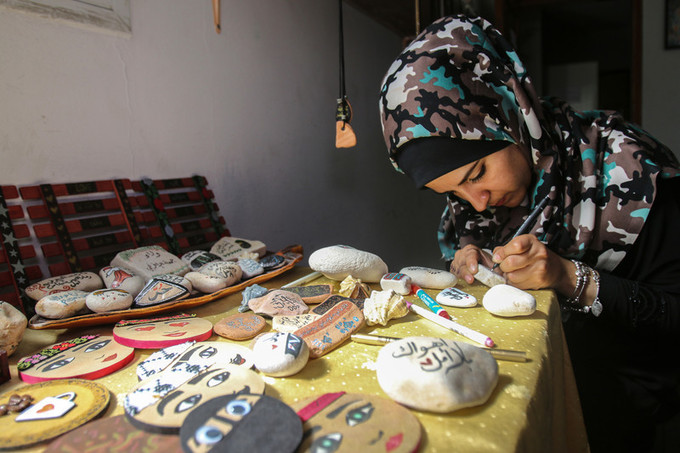
The young artist has written and drawn on wood since she was eight. And by coincidence, just a few months before starting to market her work online, she also started doing so on stone.

“I go to the sea with my friends almost every day. I love to collect seashells and stones on the beach,” she told The Electronic Intifada. “Once, I drew on three stones and posted a photo on Instagram.”

Online encouragement
The response stunned her. People encouraged her to do more and soon the number of her Instagram followers topped 11,000. She began receiving orders for specific work, and Walaa posts a picture of every finished piece.

And one thing led to another.

“On Land Day [when Palestinians commemorate the deadly repression of protests inside Israel in 1976] I got my first opportunity to participate in an exhibition organized by the Gaza Municipality and the results were fantastic,” she said.

Like everyone else in Gaza, Walaa’s work is completely circumscribed by the restrictions that have followed the Israeli-imposed siege on the Gaza Strip, now nearly a decade old.

“Electricity cuts force me to work by my phone’s flashlight. I can work until my battery dies. I often don’t have internet access. And not all the types of pens I need are available locally. It’s also difficult to deliver products around Gaza, which I need to do since I exhibit online and don’t have a showroom.”

She sells her products for between $2 to $4 and displays some of her work at the Surprise Company, a gift and decorations outlet established by the Arab Women’s Association of Jerusalem for young women entrepreneurs.

None of it would have happened without social media, said Walaa. “It has been a great tool. It has helped me develop and expand my ideas and enabled me to reach many people. It we use it in the right way, it can be very effective.”

Picturing success

Asmaa Nassar Rola Harazen
Asmaa Nassar, the youngest among the three entrepreneurs, couldn’t agree more. A budding photographer still in her last year as a media studies student at the Islamic University of Gaza, Asmaa bought a camera in her first year and discovered a talent in herself.

“I started thinking how to turn this talent into an income to help my family pay my tuition fees.”

She turned to social media platforms where she began posting her pictures. That led to requests for her to do specific work, and from there she began a now two-year-old photography career that she has managed alongside her studies.

The bulk of her work — from wedding parties, engagements, graduation ceremonies and other special occassions — is published on her Facebook and Instagram pages, and the exposure they have brought have in turn allowed her to practice photography in a way she said she couldn’t have working with media institutions in Gaza.

“Over 6,500 people like my Facebook page, and over 3,300 are following me on Instagram. Social media can be a very fruitful business tool if used in the right way.”

Asmaa now aspires to establish her own studio to provide unique photography services.

Together, the three are fighting an uphill battle. Gaza, which the UN has warned could become “uninhabitable” by 2020, is teetering on the brink. It will take all the ingenuity of people like these three women to, in some small way, engender hope that life can improve.

Source: electronicintifada.net

Palestinians move into new city of Rawabi, part of statehood dream

Salon.com


After years of setbacks, Palestinians are proudly starting to move into their first planned city being built in the West Bank — a move that isn’t just about real estate but also a symbol of their quest for statehood after nearly 50 years of Israeli military occupation.

Though Rawabi is still unfinished, its glistening high-rises and shopping centers bring a rare sense of pride and excitement to the territory at a time of growing malaise over a standstill in Mideast peace efforts.

Palestinian-American developer Bashar Masri dreamed up Rawabi, which means “hills” in Arabic, back in 2007. But the construction of the city, located about 40 kilometers (25 miles) north of Jerusalem, has repeatedly stalled due to political obstacles. Work only began in 2012.

Perched on a once desolate hilltop, it’s the first Palestinian city being built according to a modern urban design plan. The organized layout and modern facilities are in jarring contrast to chaotic Palestinian towns and villages in the area.

Since January, the first residents have been slowly moving in.

Mahmoud Khatib came here with his wife and three children from a nearby village because they wanted to live in a modern city. First, “it was an idea,” the 41-year-old banker told The Associated Press. Then “it became a reality.”

His wife Sanaa, 40, is thrilled about her new home.

“Here everything is organized. There is a safe playing area for the kids where you don’t feel worried when they go out. The services are central and available around the clock,” she said. “That’s the place I dreamed to live in.”

Palestinians see the West Bank, which Israel captured in the 1967 Mideast, as part of their independent state, along with east Jerusalem and the Gaza Strip. Under interim accords reached two decades ago, the Palestinian government now rules about a third of the territory. The rest remains under Israeli control, and home to some 370,000 Jewish settlers. The last round of peace talks broke down two years ago, and prospects for resuming negotiations — much less reaching an agreement — are dim.

Masri said one of the major hurdles in starting Rawabi was getting approval from Israel for an access road and water supply to the city, which took years.

“Dealing with occupation is not dealing with a proper nation,” he said. “It’s dealing with an ugly system.”

Rawabi now has a yearly renewable permit to use a narrow road that passes through an adjacent 1-kilometer (0.6-mile) stretch under Israeli control. A pipeline, which passes through the same area, brings in 300 cubic meters of water a day — insufficient for the residents as well as the construction that’s underway.

Additional water is currently being brought in on tankers, and some people supplement their supply from a nearby village. Masri said his next battle is to triple both the width of the seven-meter (yard) road and the water supply.

He said Israelis from a nearby settlement have gone to court to curb Rawabi’s expansion.

“I’m a strong believer that a Palestinian state is in the making and part of the pillars of building a proper state is to have a strong economy and higher standard of living,” Masri said.

Israel’s defense body, COGAT, blamed the delays on the “unwillingness” by the Palestinian officials to convene a necessary Joint Water Committee but said that despite this, water connection to the city was approved and work is underway to increase supplies. In addition, COGAT said it’s working with the Palestinian developer to find solutions to the access road.

Currently 250 families live in the city. That population is expected to swell to 60,000 when construction ends in about five years.

For Masri, Rawabi has become part of history — “the first Palestinian city to be established in thousands of years” — and he is sure more cities like this will follow. The Palestinian government has envisaged a new city near Jericho, though it’s still in the planning stages.

Rawabi building costs have reached $1.2 billion so far. Funding has come from a Palestinian company run by Masri as well as the Qatari holding company Diar. A three-bedroom apartment averages about $100,000, about 25 percent less than in the main Palestinian West Bank city of Ramallah nearby.

Along with a large amphitheater that can hold 12,000 people, Rawabi now boasts also an industrial zone, schools, and the first big Western-style open-air shopping center in the West Bank. Such attractions lumped together in one city are unheard of in Palestinian areas.

There is a mosque under construction and also a church, which will serve the Palestinian Christian minority. About 10 percent of Rawabi residents are expected to be Christian.

Masri can see it all so vividly.

“I would love to sit at a café in Rawabi and watch the people going around, enjoying themselves, living in a nice clean environment and being happy,” he muses.

“We deserve some relaxation and happiness … we have been dealt a terrible deal, dozens and dozens of years. We deserve better.”

Source: www.salon.com

Lebanese Designer Brings Traditional Materials Into Modern Age

By NAZANIN LANKARANI

THE NEW YORK TIMES


The designer Karen Chekerdjian is known in her native Lebanon for modernist objects made with traditional materials and techniques. Now, two exhibitions in Paris — at the Institut du Monde Arabe and at the private Dutko Gallery — offer a close look at an artist who addresses the divide between art and function, and the wider gap between Western and Arab cultures.

The show at the Institut du Monde Arabe, “Respiration,” opened on May 30 and runs until Aug. 28. The exhibition at the Dutko with the same title closed on Sunday, with pieces offered for sale through August.

“The idea was to show the positive elements of the Arab world,” said Philippe Castro, the chief adviser to Jack Lang, the president of the institute and a former French culture minister. “Today, that can only be shown through Arab art. There is real creativity coming out of the Arab world, especially Lebanon. Given the geopolitical context, we felt it was important to give a voice to this narrative.”

Ms. Chekerdjian, 45, who is of Armenian descent, was raised in Lebanon, the region’s most diverse society, a land unsettled by decades of conflict and turmoil, most recently by fallout from the Syrian war. She began her artistic career in film, then moved on to graphic design before earning a master’s degree in industrial design from the Domus Academy in Milan, where, she said in an interview in Paris, she learned to “think rather than design.”

“My objects do not have a traditional ‘Arab’ feel, in that they are not folkloric or ornamental,” she said. “They have emotion, ambiguity and search for meaning beyond their function. Mine is not a structured, rigid approach to objects.”

“I guess this ambiguity is typically Lebanese,” Ms. Chekerdjian said. “Beirut is a place that is both fragile and violent. My objects represent Beirut.”

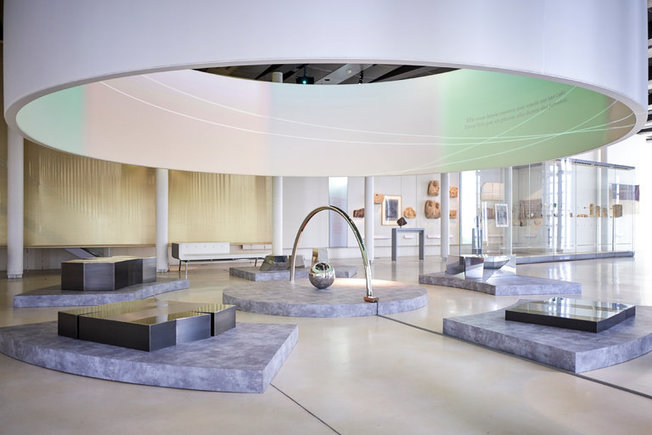
At the institute show, Ms. Chekerdjian’s pieces are interspersed among objects from the permanent collection, an effort to “confirm her place within Arab heritage,” said Mr. Castro, whose visit to her studio in Beirut three years ago led to an invitation to exhibit her work.

Her “Spaceship” stools and tables are organic shapes with geometric angles threatening to take flight; arched light fixtures bisect the space they occupy; and plates carved with Arabic calligraphy are displayed alongside pieces representing the birth of Arabic writing.

Her use of traditional materials, namely gold and copper, fabricated with local smithing techniques, places her work within its regional provenance.

“There is always a Lebanese element, but I push further,” she said. “I do not reinterpret.”

Scott Longfellow, the director of D’Days, an annual design festival in Paris, said, “What is interesting is Karen’s relationship to Lebanese savoir-faire.”

“Her pieces are exceptionally well-made,” he added, noting that her designs reference a wide range of eras, including midcentury Italian and 1960s Brazil.

Ms. Chekerdjian’s show at the Institut du Monde Arabe is the first solo exhibition for a designer there, Mr. Castro said. In a low-key way, he said, her work embodies a modern, progressive edge within Arab tradition.

“Despite her orientalism, Karen is a universal artist,” Mr. Castro said. “Arab artists like her are the fresh breath that will shape the future of the region.”

Source: www.nytimes.com

“Shame on Cuomo”: New Yorkers protest “McCarthyite” blacklist

Ben Norton

Salon.com

Hundreds of New Yorkers gathered outside the office of New York Gov. Andrew Cuomo on Thursday, protesting a new pro-Israel policy that legal groups warn is “McCarthyite” and unconstitutional.

Cuomo signed an executive order this weekend that punishes institutions and companies that support a boycott of Israel on behalf of Palestinian human rights.

The New York Civil Liberties Union said the executive order establishes a discriminatory “blacklist” that “raises serious First Amendment concerns.”

Baher Azmy, legal director at the Center for Constitutional Rights, called the new policy “plainly unconstitutional in its McCarthyist vision.”

More than 300 protesters joined the demonstration on Thursday, calling on Gov. Cuomo to rescind the executive order.

Jewish Voice for Peace, a social justice group that co-organized the protest, blasted Cuomo’s executive order as an unconstitutional “attempt to repress the growing movement for Palestinian rights.”

“The overwhelming turnout for this protest speaks to the fact that our political leadership is increasingly out of touch with its constituents,” Beth Miller, an activist with the New York City chapter of Jewish Voice for Peace, or JVP, told Salon.

“The sidewalks and streets were packed with hundreds of people, standing literally toe-to-toe, to send the clear message that we refuse to be silenced,” she added.

“Gov. Cuomo’s executive order does not change the fact that it is our constitutional right to boycott, and it does not change the fact that it is right to boycott Israel until it respects and upholds Palestinian rights,” Miller stressed.

A dense crowd of protesters lined downtown Manhattan’s 3rd Ave. on Thursday evening.

(Credit: Jewish Voice for Peace/Jake Ratner)

They carried an array of signs and banners. Many expressed solidarity with past struggles.

One man held a sign that read, “Boycott worked in Montgomery and South Africa, and it will work in occupied Palestine.” Montgomery refers to a city in Alabama where a 1955 bus boycott helped kick off the civil rights movement.

(Credit: Jewish Voice for Peace/Jake Ratner)

JVP stresses that the “Palestinian-led civil society BDS movement is modeled on the global campaign that helped bring an end to apartheid in South Africa.”

BDS refers to the Boycott, Divestment and Sanctions, an international grassroots movement that promotes nonviolent economic means to pressure Israel to comply with international law and cease its violations of Palestinian human rights. The global campaign was called for by Palestinian civil society in 2005.

Many veteran leaders in the struggle against U.S.- and Israel-backed apartheid in South Africa have endorsed BDS.

“The signs we held and messages we wanted to convey — such as ‘We will continue to boycott for justice until Palestinian refugees can return to their homes and land’ — reflect the many ways Israel is violating basic principles of human rights and international law,” said Donna Nevel, an activist with Jews Say No!, another group that helped organize the demonstration.

These are “the reasons that the BDS movement is so critical,” Nevel told Salon, stressing that BDS can help pressure Israel to change its illegal policies.

Gov. Cuomo’s Executive Order No. 157 declares that “the State of New York will not permit its own investment activity to further the BDS campaign in any way, shape or form, whether directly or indirectly.”

The new order, in its own language, establishes “a list of institutions and companies that… participate in boycott, divestment, or sanctions activity targeting Israel, either directly or through a parent or subsidiary.”

Cuomo summarized the new policy: “If you boycott Israel, New York will boycott you.”

JVP Executive Director Rebecca Vilkomerson published an op-ed in The New York Daily News on Thursday warning that Cuomo’s executive order will “set a dangerous and likely unconstitutional precedent for governments to deny groups financial opportunities and benefits because of their exercise of First Amendment-protected political speech.”

“When a chief executive unilaterally signs an executive order declaring that the state blacklist and divest from companies and organizations with a particular political view, we usually call that state repression,” she said.

At the protest outside Gov. Cuomo’s office, activists articulated many of the important reasons that a boycott is necessary. They carried a large banner that read “We will continue to boycott for justice until…”, which was accompanied by smaller signs that listed reasons for boycotting Israel.

Some of these reasons included: “until Israel respects Palestinian human rights,” “until the brutal occupation of Palestine ends,” “until Israel stops demolishing Palestinian homes,” “until Israel absolishes segregated schools,” “until Palestinian refugees can return home,” “until the siege of Gaza ends” and “until Palestinians have freedom.”

(Credit: Jewish Voice for Peace/Jake Ratner)

“Despite being planned at a very short notice, the protest had a robust turnout and a powerful presence by hundreds of outraged human rights advocates,” said Hani Ghazi, a member of Adalah-NY, the New York Campaign for the Boycott of Israel, the third group that co-organized the demonstration.

Ghazi, a Palestinian American activist, told Salon, “We expect the governor to be democratic and to protect our right to free speech and to practice honorable and nonviolent activism.”

“We expect him to side with his constituents, the people of New York, and not with wealthy corporations that profit from, and institutions that comply with, Israel’s human rights abuses, international law violations and other apartheid policies,” he added.

One protester even donned an enormous papier-mache head that looked like Cuomo’s.

For months, the New York legislature unsuccessfully tried to pass anti-boycott legislation. Cuomo circumvented this legal process completely on Sunday, June 5, signing the surprise executive order.

Dima Khalidi, the founder and director of nonprofit legal advocacy organization Palestine Legal and a cooperating counsel with the Center for Constitutional Rights, blasted Cuomo’s executive action.

“Gov. Cuomo can’t wish away the First Amendment with an executive order,” she told Salon on Monday. “It’s clear that Cuomo is bypassing the legislative process in order to muzzle morally-driven positions protesting systemically discriminatory state policies and a military occupation that is 49 years old this week.”

“As with the constitutionally faulty legislation that was pending in Albany, this Executive Order may not infringe — directly or indirectly — on the rights of New Yorkers to engage in constitutionally protected boycotts to effect economic, political or social change,” she added.

Palestine Legal issued a statement calling the executive order “a blatantly unconstitutional attack on freedom of speech [that] establishes a dangerous precedent reminiscent of McCarthyism.”

Riham Barghouti, another activist with Adalah-NY, accused Cuomo of acting undemocratically in order to implement an unpopular pro-Israel policy.

“Like other politicians, Gov. Cuomo is finding that blind support of the Israeli apartheid state requires repressive, undemocratic measures,” Barghouti said. “He is attempting to silence the growing number of morally conscientious individuals and organizations that support freedom, justice and equality for Palestinians.”

“We, along with our allies, demand that Gov. Cuomo rescind this order punishing supporters of Palestinian rights and BDS,” she added.

(Credit: Jewish Voice for Peace/Jake Ratner)

Anti-boycott legislation has been introduced in more than 20 states throughout the U.S. Bills that are likely unconstitutional have been passed in nine states.

Sen. Chuck Schumer heaped praise on Cuomo for his executive order. The New York senator said he is “looking at introducing a federal law to do the same thing” across the country.

Activists say Thursday’s protest was the first action in a new campaign to pressure the governor to repeal the order.

“This is a new low for the state-sanctioned backlash against the movement for Palestinian human rights,” Nic Abramson, an activist with Jews Say No!, said in a statement.

Abramson emphasized that the Palestinian solidarity movement “is growing and strengthening daily.”

JVP stands by the BDS movement. Vilkomerson, the executive director, defended BDS in Salon in February, warning that she and her organization were on the verge of being blacklisted.

“We act in solidarity with the Palestinian call for international grassroots pressure on Israel until it complies with international law and ends its ongoing repression of Palestinian rights,” explained JVP activist Gabrielle Spears in a statement.

She emphasized, “We will continue to boycott Israel until Palestinian children can live without fear of imprisonment and torture, until there are no longer separate roadways for Israeli Jews and Palestinians, until Israel stops bombing and killing Palestinians, and until the checkpoints and apartheid wall are dismantled.”

Source: www.salon.com

American Delivery Service Supports Local Palestinian Businesses

BY:  Kristina Perry/Contributing Writer Growing from the recent boom in subscription goods services, PalBox is a fair trade and 501(c)(3) organization that sends organic and cultural Palestinian goods in a quarterly box. Half of all proceeds from purchases of PalBox benefit the International Solidarity Movement, a nonviolent means of resisting Israeli occupation and oppression. Inside the … Continued

Elaph 15th Anniversary Reception Hosted by Arab America and NUSACC

On June 2, Arab America and NUSACC hosted a reception at the National Press Club in Washington, DC to honor the 15th Anniversary of Arabic newspaper, Elaph, and its founder Othman al-Omeir. Elaph was founded under the principles of free speech and freedom of the press. Both Elaph and Arab America were established to produce accurate … Continued

From Cairo to California: Meet the Arab world’s super-agent

By establishing talent agency CAT, Egyptian producer and film director Amr Koura hopes to bridge the cultural gap between the Arab world and the West.


By Shahira Amin

Al-Monitor


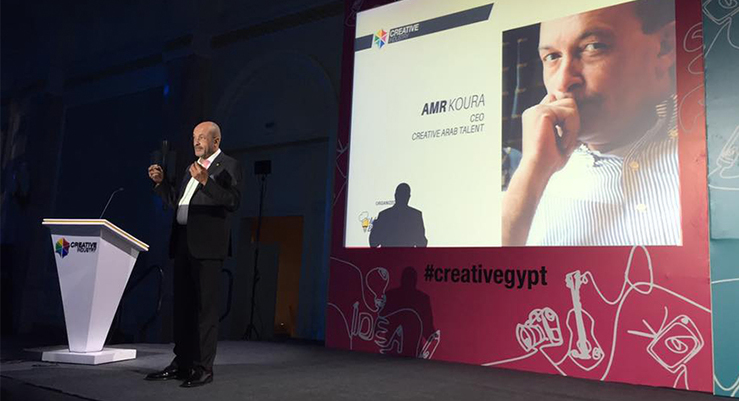
Egyptian producer and director Amr Koura is a social entrepreneur in every sense of the word. Seizing opportunities missed by others, he has used media to deliver inspiring, educational content that promotes positive social change.

Success seems to come naturally for Koura, who in the summer of 2000 made “Sesame Street” accessible to millions of Arabic-speaking preschoolers in the Middle East through an Arabic-language adaptation of the popular US children’s educational TV series. Just months after it premiered in Egypt, the local “Sesame Street” co-production named “Alam Simsim,” which literally translates into “Simsim’s World,” was already among the top five most-watched children’s TV shows in the country, reaching some 12 million children. The Egyptian cast of “Alam Simsim” muppets provides much-needed role models for the young children, encouraging them to take pride in their culture while inspiring them to pursue their academic interests and fulfill their aspirations.

Following the success of “Alam Simsim,” Koura produced the Arab World’s first TV teen drama serial titled “Al Jamaa” (“The University”) targeting teenagers. Seeking to promote diversity and tolerance, the TV drama also tackled many of the problems faced by young people in the Middle East and North Africa. 

More recently, Koura has broken new ground, setting up the Middle East’s first and thus far only Creative Arab Talent agency (CAT) in Cairo. The concept of creative talent agents is little known in the Middle East, and initially there was a great deal of skepticism toward the work of the new agency.

“The biggest challenge we faced when we launched in April 2015 was convincing talent to sign up with the agency and to trust us with their talent. It took a while for the artists to warm up to the idea of a ‘middleman’ as they had previously only dealt directly with producers,” Koura told Al-Monitor. “We also had to convince producers that we were not there to push prices higher but rather were there to help them by suggesting the best talent for the roles and intervening when there are problems on location.”

Pitching talent to producers and the market as a whole, CAT agency negotiates the terms of the artists’ contracts on their behalf. It also advises them on the best choices to make, helping them plan and develop their careers.

The agency’s clientele made up mostly of Egyptian actors and actresses has steadily grown in the first year with the company currently boasting a 30-strong roster; dozens more are on the waiting list. Koura said that he is picky and handles only “top and promising talent.” Among those who have entrusted the agency with administering their business affairs are Egyptian superstar Yousra, Jordanian producer and actress Saba Mubarak, and budding actress Amina Khalil. The agency is not limited to solely handling acting talent but caters to a variety of artistic talent including writers, satirists, stand-up comedians and film directors. Koura announced in a Facebook post on April 23, “Very proud to have the Master Illusionist Ahmed El Bayed to our select group of talents ‪#‎CAT‬.”

CAT has also recently signed a marketing and promotional agreement with Egyptian comedian Ahmed Amin, which will take him on an international tour that includes the United States, the United Kingdom and the Gulf states. 

“We have signed more than 25 contracts for our various clients ahead of the month of Ramadan, which is a great success for year one,” Koura said. The fasting month is traditionally a peak time for TV viewing in the Middle East and the Gulf states with the screening of new soap operas, some of which are produced especially for broadcast during the month of fasting.

A little over a year after establishing the agency in Cairo, Koura is opening CAT’s new office in Los Angeles. He hopes it will help Arab talent penetrate the Hollywood scene and vice versa, acting as a “cultural bridge between East and West.”

While Koura acknowledges it may be difficult to introduce Arab talent to Hollywood, he said, ”This is not impossible.” He added that the late Egyptian superstar Omar Sharif made his English-language film debut with “Lawrence of Arabia” in 1962 before starring in “Doctor Zhivago” three years later and then featuring in other American and British productions.

In recent years, a handful of actors from the Middle East have also managed to make a name for themselves in Hollywood, including Egyptian actor Amr Waked, who played the policeman in Luc Besson’s American-French science fiction film “Lucy” and also starred in Netflix’s historical epic “Marco Polo.” Palestinian actor Ali Suliman has made appearances in several American movies, including “Lone Survivor” and “Body of Lies.” Furthermore, a number of Arabs have worked or are currently working off camera in big international productions, including as videographers and lighting and sound technicians.

When the demand for Arab talent arises in international markets, Koura hopes that he would be “the point of contact in the Middle East.” He believes there is also a growing demand for foreign talent in the Arab film industry, and he wants his agency to recruit that talent when and if it is needed. He also hopes to help in the creation of Arab-international co-productions and other joint venture projects that involve collaboration from both sides. It is to this end that Koura is currently meeting with heads of some of the main Hollywood agencies such as UTA “to knock on doors” and “probe prospects of cooperation with them” during his two-week visit to Los Angeles that ends on June 12. On the agenda is a meeting with Netflix’s Ted Sarandos to discuss the latter’s proposal to create “a really well-scripted series about contemporary life in the Middle East.”

“We have a distinct advantage as we are located in the Middle East and have access to the top writers and directors whom we can recommend, so that this project can see the light,” Koura said.

Koura believes that there are a number of advantages to cross-cultural collaboration, not least among which is clearing misconceptions and doing away with the stereotypes.

“The world is becoming one big village. Cross-cultural content is being aired all around the world, and we need to put our talent and our stories to the world to remove the stereotyping of Arabs and Muslims as terrorists. When you see a good piece of drama or film from a certain country, it reflects positively,” he said.

At this time of political turmoil and violence in the Middle East, CAT’s work takes on added significance and can go a long way in fostering tolerance and mutual understanding and bridging the cultural gap between the Arab world and the West.

Source: www.al-monitor.com

ACC to Host 14th Annual Golf Outing And Scholarship Awards Dinner, June 7

The Arab American and Chaldean Council (ACC), a premier nonprofit human service organization serving Southeast Michigan, will host its 14th Annual Golf Outing and Scholarship Awards Dinner, Tuesday, June 7 at Shenandoah Country Club in West Bloomfield (5600 Walnut Lake Road).

Registration and continental breakfast will begin at 10 a.m., when the driving range opens, followed by an 11:15 a.m. shotgun start for an 18-hole game of golf. The dinner program, which includes the scholarship ceremony, tournament award distribution and raffle, will commence at 5 p.m. Scholarships, whose funds are generated from the event, will be awarded to local high school seniors of Arab American and Chaldean descent.

This year, the ACC is welcoming three honorary co-chairs to the event: Bridget Hurd, Senior Director, Diversity and Inclusion, Blue Cross Blue Shield of Michigan (BCBSM); Monty Fakhouri, Corporate Business Manager, Beaumont Hospital; and Brian Santee, Senior Sales Director , Frito-Lay North America.

In her role at BCBSM, Hurd is responsible for leading and executing the organization’s diversity and inclusion strategy. With 24 years of progressive experience in communications, community relations, corporate giving and diversity and inclusion, she has worked tirelessly to help facilitate stronger linkages among the community and health care institutions. Prior to joining BCBSM, Hurd spent eight years at the Greater Detroit Area Health Council.

The Southfield, Mich. resident received a bachelor’s degree in communications from the University of Michigan and an MBA from Wayne State University.

Santee, of Bloomfield Hills, Mich., has worked with PepsiCo for more than a decade, serving the metropolitan Detroit and Cleveland regions. Last year, he chaired the company’s Feeding Detroit volunteer event where they partnered with Feed the Children to distribute non-perishable food and daily essentials to 1,600 Detroit families for the sixth year in a row. Santee holds a bachelor’s degree from the University of Minnesota, where he played on the varsity golf team, and an MBA from New York University.

Part of the Beaumont Health System for 10 years, Fakhouri has served in his current role since October 2015, having previously worked as the organization’s Business Manager and as an adjunct professor with Oakland University’s William Beaumont School of Medicine. In 1999, he began a decade-long career as the ACC’s Director of Public Health and Youth Development. Fakhouri graduated from Wayne State University’s medical school with a specialization in community medicine.

“I am looking forward to making our 14th annual golf outing our most successful yet. It is always such a pleasure to spend the day with ACC’s friends and supporters having fun on the course while also helping students reach higher education opportunities,” said Dr. Haifa Fakhouri, President, ACC. “With Bridget, Monty and Bryan joining us this year, I know we will make 2016 one for the record books.”

Tickets range from $100 per person for dinner to $200 per person and $750 for a foursome for the golf and dinner package. Information on sponsorship and participation opportunities can be found on at www.myacc.org.

About the Arab American and Chaldean Council (ACC) The Arab American and Chaldean Council (ACC) is the premier nonprofit human service organization providing services to the Middle Eastern and mainstream communities in Southeast Michigan. Founded in 1979, the ACC provides counseling, health care, social services, employment training, job placement, translation, interpretation and youth services to more than 70,000 clients in metro Detroit. The ACC operates 40 outreach offices in the tri-county area, staffed with bilingual and trilingual professionals to serve the Arab American and Chaldean American populations and offer assistance to the Middle East refugee population. For more information, visit www.myacc.org or call (248) 559-1990.

Arab American and Chaldean Council (ACC)
ACC is the premier non-profit human service organization providing services to the Middle Eastern and mainstream communities in Southeast Michigan. Furthermore, ACC provides better opportunities to enable newcomers to adjust to their new environment. As a bridge of understanding, ACC maximizes the skills, resources and expertise of the community to:
Build cooperation and understanding
Raise the level of individuals’ well-being
Increase cross-cultural understanding through education
Deliver human services, counseling and opportunities
Gear community members towards achievement
Empower through employment training and placement

Source: campaign.r20.constantcontact.com

Trump says he made ‘a lot of money’ in deal with Gadhafi

Jill Colvin

San Diego Tribune


Donald Trump says he made “a lot of money” in a deal years ago with Moammar Gadhafi, despite suggesting at the time he had no idea the former Libyan dictator was involved in renting his suburban New York estate.

“Don’t forget, I’m the only one. I made a lot of money with Gaddafi, if you remember,” Trump said in an interview with CBS’ “Face the Nation” that aired Sunday. “He came to the country, and he had to make a deal with me because he needed a place to stay.”

“He paid me a fortune. Never got to stay there,” Trump said. “And it became sort of a big joke.”

The presumptive Republican nominee was talking about a bizarre incident in 2009, when Gadhafi was in desperate search of a place to pitch his Bedouin-style tent during a visit to New York for a meeting of the U.N. General Assembly.

After trying and failing to secure space in Manhattan’s Central Park, on the Upper East Side and in Englewood, New Jersey, the Libyan government turned to Trump’s 213-acre Seven Springs estate in suburban Bedford, New York.

Gadhafi never stayed at the property, but it was nevertheless a spectacle. Reporters flocked to the town to watch construction crews erect a white-topped tent that was lined with a tapestry of camels and palm trees and outfitted with leather couches and coffee tables.

At one point the tent was torn down after the Town of Bedford threatened to sue Trump personally — and was then re-erected, to the town’s chagrin.

At the time, Trump distanced himself from the matter, hinting that he’d been tricked into renting his land. Representatives of Gadhafi — loathed in the U.S. due to his ties to terrorism — had falsified the identity of their client in other instances to make renting property easier.

Before the tent was re-pitched, Trump said he had “no idea” that Gadhafi might be involved in the deal to rent a section of the estate, a town official said. Bedford Town Supervisor Lee Roberts told The Associated Press at the time that Trump told her that, as far as he knew, his arrangement was with partners in the United Arab Emirates.


“We have business partners and associates all over the world.

The property was leased on a short-term basis to Middle Eastern partners who may or may not have a relationship to Mr. Gadhafi. We are looking into the matter now,” Trump Organization spokeswoman Rhona Graff said in a statement at the time.


But Trump had changed his tune two years later, when he boasted of having “screwed” the Libyan leader on the deal.

“I dealt with Gadhafi. Excuse me. I rented him a piece of land. He paid me more for one night than the land was worth for the whole year or for two years. And then I didn’t let him use the land. That’s what we should be doing,” Trump said in a 2011 interview with Fox News.


He reiterated the claim on CNN that same year. Trump said he had leased Gaddafi “a piece of land for his tent. He paid me more than I get in a whole year. And then, eh, he wasn’t able to use the piece of land. … So I got in one night more money than I would have gotten all year for this piece of land up in Westchester. And then didn’t let him use it? That’s called being intelligent,” Trump said.


Trump campaign spokeswoman Hope Hicks did not respond to questions Sunday about whether Trump was aware at the time that he was dealing with Gadhafi and how much he made from the deal.


Bedford Town Attorney Joel Sachs, who dealt with Trump directly on the issue, said that Trump insisted to town officials that he didn’t know about the Gadhafi connection — and that officials suspected he was lying.

“We believe that Trump knew that he had leased his property to Gadhafi,” Sachs said. “He definitely denied that he knew, but we had gotten a lot of evidence.”

Roberts, the former Bedford town supervisor, said Sunday she didn’t remember much about the back-and-forth, but agreed it was a mess. “It was a very emotional time. People got very upset at the thought of him coming here,” she said.

But there was also an element of the absurd. “There was a goat involved. They were going to kill a goat and have it for dinner,” she said. When Gadhafi didn’t show, “it got a reprieve.”

Roberts said she was offered the goat as a souvenir of sorts, but had to turn it down.

“No, we can’t have a goat in my town house!” she recalled with a laugh.

Source: www.sandiegouniontribune.com

Interview with Lebanese American entrepreneur Tony Fabell

Ya Libnan


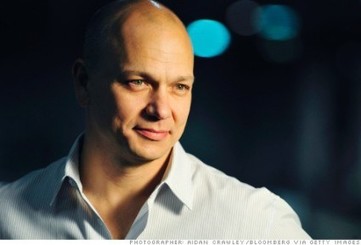
Tony Fadell brought the iPod to life at Apple Inc., ushered in the iPhone, started Nest Labs in 2010 to modernize home gadgets and sold to Google for $3.2 billion in 2014. Then he spent the last two years shaping Google’s vision of the connected future and pushing its wares deeper into consumers’ lives.

After such a meteoric rise, Fadell’s exit from the internet giant was unceremonious. Google parent Alphabet Inc. released a short statement Friday afternoon saying he will step down immediately as head of its Nest division. Both Alphabet and Fadell tried to play things amicably, but the optics aren’t great for either.

Over the past couple of months, Nest employees grumbled openly about what they see as severe problems inside the company. One engineer hopped on Reddit with a screed full of personal attacks directed toward Fadell and claims that Nest had missed sales targets, botched product upgrades and delayed future launches. Greg Duffy, founder of Dropcam, chimed in, saying he made a mistake selling the camera startup to Nest in 2014. Duffy blamed Nest’s divisive culture for an exodus of employees and claimed Dropcam’s products were much hotter than Nest’s gear.

“There is a lot that I could say about my extreme differences on management style with the current leadership at Nest, who seem to be fetishizing only the most superfluous and negative traits of their mentors,” Duffy wrote on Medium. “For the sake of the customers and for the talented employees that remain there, I hope they find a way through these struggles.”

To all the world, it looks then like Fadell left — or was pushed out — on the heels of this discord. It’s a blow for someone with a spectacular track record of producing consumer hits over the last 15 years.

As Fadell tells it, however, he began thinking about leaving Nest late last year before the public turmoil. He’s been quietly investing in about 100 companies and has felt the need to coach these startups and perhaps chase another new venture. Fadell rejects claims that Nest has hit a rough patch, saying the company’s performance remains strong. During a lengthy interview, he was cool-headed describing his tumultuous time at Google, while discussing other topics, including where Silicon Valley is headed and what excites him most. What follows is edited for clarity and brevity.

Bloomberg: The last couple of months have been unusual, with people airing very public complaints about Nest. What has been the response inside Nest?

 
Fadell: Our team was upset. It’s been a shock, like, “What? This doesn’t reflect our culture. This isn’t about us.” And then, you know what happens? It galvanized our team. It made them stronger.

I get so many incredible notes from the team and from people who used to work at Nest as well as people who used to work with me, going, “Look, this is just the new world. You know, you can argue all you want on the blogs, but that’s not going to get the job done.” What gets the job done is a great, strong business and great, strong customers. All that other stuff is sophomoric chatter.

Bloomberg: Did any of the critiques resonate with you? The knocks on the product delays and high turnover?

Fadell: I was at Apple. I’ve been at various other companies. This is just normal course of business, you know? Different priorities come up, different things change. So, look, everyone has their opinion. I just know that when I look at the numbers and I say we shipped four new products, when we have millions of customers, happy customers, when you look at the star ratings that’s the reality of the situation.

Do I wish I could ship more products? Sure, I wish I could. So no, I’m happy with where we’re at. It’s taken a lot of work and time to get there, but we have multiple teams up, running, highly experienced people. People can have their opinions, and I know the facts.

Bloomberg: A lot of people will look at your departure from Nest as you admitting defeat. It’s a sign that your critics were right.

Fadell: People will have their own opinions. The facts show that we shipped lots of product. We had really strong growth, revenue growth. Our customers love our products.

We have a road map. You know, people don’t see that, but we have a road map that’s really well-established and understood and teams are working on those products. We have lots of products coming and services coming.

People will say, “Oh, oh, oh, they didn’t ship enough product.” Well, guess what? We have shipped product. We shipped a lot of product. We shipped a lot of software. Oh, they’re going to say, “This business isn’t healthy.” Well, guess what? We have great revenues and great growth on the business. So, okay, what potshots do you want to take? “The products aren’t well regarded.” Well, we have more than four stars on all our products.

Bloomberg: Have you had sleepless nights over all of this?

Fadell: Of course. I’m a natural worrywart. Because I want to care. I care the design gets right. I care that our employees are doing great work and enjoying it. So I worry constantly. I worry about our family.

If you don’t have a shred of doubt in you about what you’re doing, you’re not trying hard enough. Right? You always should be checking — going, “Wait a second, I’m right on the edge. I’m really pushing really hard. Am I doing this right? Do I have some self-doubt in it?” You’ve got to have self-doubt, because if you don’t, you’re not pushing hard enough. You’re too complacent. You’re going mainstream.

Bloomberg: The internet says you might be a tyrant. Are you a tyrant?

Fadell: You can’t make an omelet without breaking eggs. That style may not be for everyone. But, you know, there are people that worked with me years ago at General Magic, and they have their kids working for me now. If it was true, it would get around like crazy. The Valley’s a small place. I’ve been here 25 years, right?

To me, it’s truly, what’s your mindset? Are you coming to work? Are you truly respecting the mission we’re on? Yes, things are going to go up and down. But because we have a true respect for the people, because they respect what we’re trying to do, we’ll get through anything together. And that’s what counts, right?

Bloomberg: What do you wish you had done differently at Nest?

Fadell: I don’t know of any regrets that I have. You can take something as a challenge or take it as a learning experience. And so for me, it’s always growth. We all make mistakes. We have to make mistakes when we learn to speak or we learn to walk or crawl. So to do what we do at the level we do it, no one’s done it before. So you’re bound to make mistakes.

Bloomberg: What was your relationship like with (Google co-Founder and Alphabet Chief Executive Officer) Larry Page over the years? What did you learn from him?

Fadell: I respect what he’s built. I respect what Larry and Sergey (Brin) have built. I’ve learned a lot from Larry, and a lot of the people that they’ve hired are just top-notch.

For me, it’s really contrasting this with Steve (Jobs), because I learned a lot from Steve about experience and marketing and product design.

With Larry in particular it was about looking out well beyond the horizon and trying to pull out that horizon you can’t see. They can jump up really high and see it well before anyone else does and try to pull it in. That is unheard of in Cupertino (Apple’s Silicon Valley headquarters) from my experience there.

To me that was an eye-opener. Every time I open up another (Google research) lab or somebody introduced me to something, I’m like, “What? You’re doing that? Oh, my God.” And it just — you know, it’s candy for my brain.

Bloomberg: What’s next for you?

Fadell: Well, I think it’s continuing what I have been doing, which is seeing things just coming out of the lab and turning them into products.

Over the past eight to 10 years I’ve been investing in companies very secretively. It’s all been confidential, and it’s been over 100 companies like that who have technologies, have incredibly just disruptive ideas that can change the world in a positive way, whether it’s in medical or it’s in consumer products or energy. In some cases I’ve been on the board. In some cases I helped them raise more funds or work on the marketing angles for them, the messaging, the product designs. And so I’m just going to continue to do that while I advise Larry and Alphabet.

Bloomberg: What types of companies are you involved with?

Fadell: Let’s talk about Phononic. They have an innovative solid-state cooling and heating solution. It’s almost like a chip. And it replaces compressors in commercial fridges, your residential fridges, also freezers. So you can get rid of those big, ugly compressors that make a lot of noise. Those are the number-one things that wear out that you have to replace. And they have chemicals in them. It’s hard to recycle.

Well, this has a solid-state thing that gives you more capacity, quiet and better temperature regulation and uses a lot less energy, too. So that company’s been going on for about four years now. I’m on the board. And now they have real shipping products, and they’re starting to take off like crazy.

There are others like Flexport, Airware, Mousera, Bump (acquired by Google) and ZEP Solar (bought by SolarCity).

Bloomberg: You see yourself becoming something of a venture capitalist then?

Fadell: No. I do it all confidentially. So I don’t want the companies to rely on my name to raise funding. I want them to rely on their skills and their wits and their great ideas to get their funding. What I’ll do is I’ll help them make connections, I’ll look at their financing pitches, look at their product pitches and help them shape them, help look at their organization.

And so I’ve been doing that all under the covers as a confidential adviser. They keep me sharp. They teach me about new technologies. They give me a way to peer over that horizon.

Bloomberg: How do you feel about the state of Silicon Valley right now?

Fadell: I think we’re getting back to normalcy on the funding. The really hot companies that have great revenues and a great story, they’re getting out-sized valuations, as they should. I think, just like what happened in ’99 and 2000, which was everyone got well ahead of themselves, and we didn’t have Sarb-Ox (Sarbanes-Oxley, stricter public-company rules) back then, so we could float them on the Street fast. Well, they can’t do that anymore, so what they’re doing is they’re using private capital to then create this kind of hype cycle.

We’ve got to return to making sure we don’t get too far ahead of ourselves and have fiscal responsibility along the route, because you never know what the funding environment’s going to be or whether you can go IPO or you have to just tough it out, and you’re going to have to take a down round or a flat round. So normalcy’s coming.

Bloomberg: How do you see yourself these days? What’s your legacy?

Fadell: I try to follow my passions, not follow the money. I’m curious, and I’ve kind of lived by my wits. So I don’t know what you’d call it. I’m part engineer, part tinkerer, part designer, part business person, part investor. I’ve learned each of these skills by doing, and it’s just worked out for me. I can’t tell you the rhyme or reason, but I’ve always trusted my gut and my intuition, and it’s usually ended up in the right area.

I don’t know why I feel this way, but between working closely with Bill Campbell, working closely with Steve Jobs and watching a lot of my mentors pass on, unfortunately, I feel like I bear this responsibility now. There’s a few of us who are keepers of that knowledge.

It’s almost our responsibility to be able to continue that way of thinking, that way of working. Expect excellence, respect excellence, drive hard, change things, don’t accept the status quo, push yourself, push the people on your team harder than they could ever imagine, and they will do more than they could have ever imagined.

That’s kind of that same thing that we have to continue to understand — that this stuff is hard. It’s not easy, and we all have to learn to do it, because it isn’t second nature, because it goes against the way your body wants to be and your mind wants to be.

Source: yalibnan.com

323 Results (Page 10 of 27)