Advertisement Close

Community

“Shame on Cuomo”: New Yorkers protest “McCarthyite” blacklist
Ben Norton

Salon.com

Hundreds of New Yorkers gathered outside the office of New York Gov. Andrew Cuomo on Thursday, protesting a new pro-Israel policy that legal groups warn is “McCarthyite” and unconstitutional.

Cuomo signed an executive order this weekend that punishes institutions and companies that support a boycott of Israel on behalf of Palestinian human rights.

The New York Civil Liberties Union said the executive order establishes a discriminatory “blacklist” that “raises serious First Amendment concerns.”

Baher Azmy, legal director at the Center for Constitutional Rights, called the new policy “plainly unconstitutional in its McCarthyist vision.”

More than 300 protesters joined the demonstration on Thursday, calling on Gov. Cuomo to rescind the executive order.

Jewish Voice for Peace, a social justice group that co-organized the protest, blasted Cuomo’s executive order as an unconstitutional “attempt to repress the growing movement for Palestinian rights.”

“The overwhelming turnout for this protest speaks to the fact that our political leadership is increasingly out of touch with its constituents,” Beth Miller, an activist with the New York City chapter of Jewish Voice for Peace, or JVP, told Salon.

“The sidewalks and streets were packed with hundreds of people, standing literally toe-to-toe, to send the clear message that we refuse to be silenced,” she added.

“Gov. Cuomo’s executive order does not change the fact that it is our constitutional right to boycott, and it does not change the fact that it is right to boycott Israel until it respects and upholds Palestinian rights,” Miller stressed.

A dense crowd of protesters lined downtown Manhattan’s 3rd Ave. on Thursday evening.

(Credit: Jewish Voice for Peace/Jake Ratner)

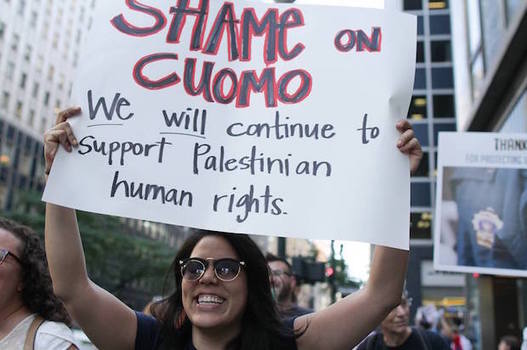
They carried an array of signs and banners. Many expressed solidarity with past struggles.

One man held a sign that read, “Boycott worked in Montgomery and South Africa, and it will work in occupied Palestine.” Montgomery refers to a city in Alabama where a 1955 bus boycott helped kick off the civil rights movement.

(Credit: Jewish Voice for Peace/Jake Ratner)

JVP stresses that the “Palestinian-led civil society BDS movement is modeled on the global campaign that helped bring an end to apartheid in South Africa.”

BDS refers to the Boycott, Divestment and Sanctions, an international grassroots movement that promotes nonviolent economic means to pressure Israel to comply with international law and cease its violations of Palestinian human rights. The global campaign was called for by Palestinian civil society in 2005.

Many veteran leaders in the struggle against U.S.- and Israel-backed apartheid in South Africa have endorsed BDS.

“The signs we held and messages we wanted to convey — such as ‘We will continue to boycott for justice until Palestinian refugees can return to their homes and land’ — reflect the many ways Israel is violating basic principles of human rights and international law,” said Donna Nevel, an activist with Jews Say No!, another group that helped organize the demonstration.

These are “the reasons that the BDS movement is so critical,” Nevel told Salon, stressing that BDS can help pressure Israel to change its illegal policies.

Gov. Cuomo’s Executive Order No. 157 declares that “the State of New York will not permit its own investment activity to further the BDS campaign in any way, shape or form, whether directly or indirectly.”

The new order, in its own language, establishes “a list of institutions and companies that… participate in boycott, divestment, or sanctions activity targeting Israel, either directly or through a parent or subsidiary.”

Cuomo summarized the new policy: “If you boycott Israel, New York will boycott you.”

JVP Executive Director Rebecca Vilkomerson published an op-ed in The New York Daily News on Thursday warning that Cuomo’s executive order will “set a dangerous and likely unconstitutional precedent for governments to deny groups financial opportunities and benefits because of their exercise of First Amendment-protected political speech.”

“When a chief executive unilaterally signs an executive order declaring that the state blacklist and divest from companies and organizations with a particular political view, we usually call that state repression,” she said.

At the protest outside Gov. Cuomo’s office, activists articulated many of the important reasons that a boycott is necessary. They carried a large banner that read “We will continue to boycott for justice until…”, which was accompanied by smaller signs that listed reasons for boycotting Israel.

Some of these reasons included: “until Israel respects Palestinian human rights,” “until the brutal occupation of Palestine ends,” “until Israel stops demolishing Palestinian homes,” “until Israel absolishes segregated schools,” “until Palestinian refugees can return home,” “until the siege of Gaza ends” and “until Palestinians have freedom.”

(Credit: Jewish Voice for Peace/Jake Ratner)

“Despite being planned at a very short notice, the protest had a robust turnout and a powerful presence by hundreds of outraged human rights advocates,” said Hani Ghazi, a member of Adalah-NY, the New York Campaign for the Boycott of Israel, the third group that co-organized the demonstration.

Ghazi, a Palestinian American activist, told Salon, “We expect the governor to be democratic and to protect our right to free speech and to practice honorable and nonviolent activism.”

“We expect him to side with his constituents, the people of New York, and not with wealthy corporations that profit from, and institutions that comply with, Israel’s human rights abuses, international law violations and other apartheid policies,” he added.

One protester even donned an enormous papier-mache head that looked like Cuomo’s.

For months, the New York legislature unsuccessfully tried to pass anti-boycott legislation. Cuomo circumvented this legal process completely on Sunday, June 5, signing the surprise executive order.

Dima Khalidi, the founder and director of nonprofit legal advocacy organization Palestine Legal and a cooperating counsel with the Center for Constitutional Rights, blasted Cuomo’s executive action.

“Gov. Cuomo can’t wish away the First Amendment with an executive order,” she told Salon on Monday. “It’s clear that Cuomo is bypassing the legislative process in order to muzzle morally-driven positions protesting systemically discriminatory state policies and a military occupation that is 49 years old this week.”

“As with the constitutionally faulty legislation that was pending in Albany, this Executive Order may not infringe — directly or indirectly — on the rights of New Yorkers to engage in constitutionally protected boycotts to effect economic, political or social change,” she added.

Palestine Legal issued a statement calling the executive order “a blatantly unconstitutional attack on freedom of speech [that] establishes a dangerous precedent reminiscent of McCarthyism.”

Riham Barghouti, another activist with Adalah-NY, accused Cuomo of acting undemocratically in order to implement an unpopular pro-Israel policy.

“Like other politicians, Gov. Cuomo is finding that blind support of the Israeli apartheid state requires repressive, undemocratic measures,” Barghouti said. “He is attempting to silence the growing number of morally conscientious individuals and organizations that support freedom, justice and equality for Palestinians.”

“We, along with our allies, demand that Gov. Cuomo rescind this order punishing supporters of Palestinian rights and BDS,” she added.

(Credit: Jewish Voice for Peace/Jake Ratner)

Anti-boycott legislation has been introduced in more than 20 states throughout the U.S. Bills that are likely unconstitutional have been passed in nine states.

Sen. Chuck Schumer heaped praise on Cuomo for his executive order. The New York senator said he is “looking at introducing a federal law to do the same thing” across the country.

Activists say Thursday’s protest was the first action in a new campaign to pressure the governor to repeal the order.

“This is a new low for the state-sanctioned backlash against the movement for Palestinian human rights,” Nic Abramson, an activist with Jews Say No!, said in a statement.

Abramson emphasized that the Palestinian solidarity movement “is growing and strengthening daily.”

JVP stands by the BDS movement. Vilkomerson, the executive director, defended BDS in Salon in February, warning that she and her organization were on the verge of being blacklisted.

“We act in solidarity with the Palestinian call for international grassroots pressure on Israel until it complies with international law and ends its ongoing repression of Palestinian rights,” explained JVP activist Gabrielle Spears in a statement.

She emphasized, “We will continue to boycott Israel until Palestinian children can live without fear of imprisonment and torture, until there are no longer separate roadways for Israeli Jews and Palestinians, until Israel stops bombing and killing Palestinians, and until the checkpoints and apartheid wall are dismantled.”

Source: www.salon.com

Arab America Helps to Feed Washington, DC

On Monday, June 5, Arab America announced its 2016 Ramadan campaign, “Hummus for the Homeless.” It partnered with Catholic Charities to achieve its modest help during the holy month of Ramadan.  Every Friday during Ramadan, we are serving the homeless of Washington, DC. Thanks to the generous women of the National Arab American Women’s Association, United Muslim Relief, … Continued

The Beauty Of An Arab American Ramadan

Nesreen Issa
The Huffington Post

In Arab countries, you count the days in anticipation of Ramadan. In the United States, we also count the days as we wait for Ramadan. We close our eyes and day-dream about its spiritual details, which, in a way, we miss out on. We fantasize about listening to the morning call to prayer that signals the beginning of our fast — we imagine it as if it were coming straight from the mosque’s minaret. Our hearts beat as we imagine the maghreb (sunset) call to prayer.

Ramadan in the United States is not as dreary as some people may think. The Muslim diaspora here is large, and the ties between them grow stronger during Ramadan. Mosques and homes become decorated with religious symbols, such as lanterns and crescents.

If you walk into Arab grocery stores, you would definitely get a taste of Ramadan. You’d run into people asking about the price of dates, or buying Vimto — a Ramadan favorite — or looking for a crescent-shaped ornament to place on their doors. At the end of the day, you’ll have an iftar table, large or small, with a special Ramadan flair.

We eat katayef (a Ramadan pastry) like everyone else does, but the difference is that we bake it at home. We go through the hassle so that we’d be able to hold the piece of katayef in our hands, take in its scent, and say that we are truly observing Ramadan.

In the United States, unlike in Arab countries, Muslims exert extra effort to create a Ramadan atmosphere.

If you’ve lived in the United States your whole life, you wouldn’t find it difficult to enjoy Ramadan. You would be able to get together with your family and relatives, and have an experience similar to that of any other Muslim in the Arab world.

If you were a visitor to the United States, and your trip happened to coincide with Ramadan — don’t worry or despair. If you want to retain that spiritual experience this Ramadan, you should try to go to cities where there is an abundance of Arab restaurants, such as Chicago, and you’ll find Ramadan in one of them. You will see other Muslims waiting for the call to prayer so that they could start eating. Everyone there will be fasting like you, and will say a prayer before they break their fast with a glass of water and dates. You won’t feel like you’re missing out just because you’re in the United States.

You’ll feel as if you’re experiencing all the Ramadans of the world, combined in one Ramadan in America.
The night prayers during the last 10 days of Ramadan are particularly beautiful here. If you go to the mosque at midnight, you would find young and old worshippers, parents and students, united in worship until sunrise. Many Muslims here — those who speak Arabic and those who don’t — make an effort to read the Quran in full throughout the month.

The diaspora here works really hard, and they work even harder during Ramadan. They organize events, group iftars and charity banquets at mosques and schools. They also organize Quran competitions, in which young and old Muslims from Turkey, Ethiopia, and Arab countries participate. We do all this with love, and we try to breathe that love into our children, so that Ramadan may become a shining light, even away from home.

The taraweeh prayers (special night prayers) make up a central part of Ramadan. Are taraweeh prayers different in the United States? I would say yes, but the difference is not necessarily for the worse. I have lived in Arab countries as well as in the United States, and I used to attend taraweeh prayers there — and I miss the company at the mosque and the taraweeh sermon. But taraweeh prayers in the United States will also make you feel like you’re observing Ramadan. You’ll walk into the mosque and you’ll find it beckoning you, as if saying: “I have Ramadan here, come!”

You’ll run into Palestinians, Syrians, and Indians, and you’ll exchange smiles with a Sudanese or an Egyptian Muslim from across the room. You’ll hear “Ramadan Mubarak” from a Pakistani Muslim. At that point, you’ll feel as if you’re experiencing all the Ramadans of the world, combined in one Ramadan in America.

Ramadan is part of our identity, wherever we are. We will keep observing Ramadan to show the whole world that it is is alive in our hearts.

Source: www.huffingtonpost.com

Laith Al-Saadi, Arab American Artist to Perform at Dearborn, Michigan’s Homecoming Festival

BY: Andrew Hansen/Contributing Writer At this year’s annual Homecoming Festival on August 5-7, 2016 in Dearborn, Michigan, local festivalgoers are in for a quite a show as they welcome native Michigander and Arab American musical performer, Laith Al-Saadi. Al-Saadi was a top performer on the hit music competition television series The Voice, and was specially … Continued

Nonprofit agency focuses on resettling Muslim and Arabic-speaking refugees in the U.S.

By Ariana Figueroa 

Tampa Bay Times

Lavender incense mixed with various aromas of Middle Eastern dishes poured out of the Islamic Center Hall.

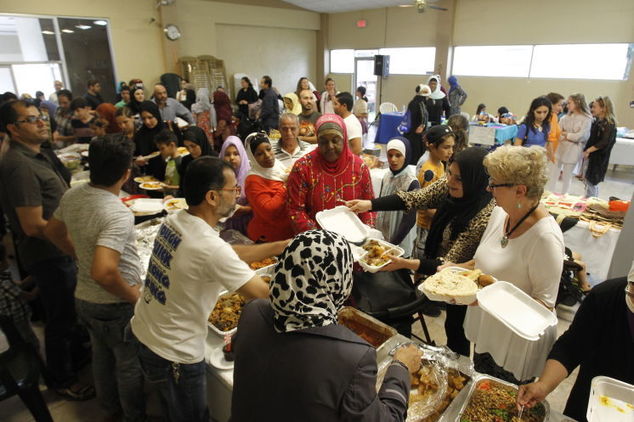
Vendors selling perfume, henna and crochet were lined up. Children giggled and dashed around the influx of people.

Muslim men and women said “peace be upon you” in Arabic to each other as they came to buy tickets for food and make donations to Radiant Hands, a nonprofit helping to resettle refugees.

Radiant Hands president Magda Saleh, 49, ran back and forth in the hall Sunday afternoon setting up hijab donations, food, crafts and tables. With the heat and rain, the venue was moved into the hall instead of the open courtyard.

The event was a celebration of food, crafts and entertainment to raise funds for resettlement of refugees in the area, and it was hosted at Masjid Al-Qassam mosque at 5910 E 130th Ave.

Radiant Hands initially provided individual counseling for women and families. But now 80 percent of the nonprofit’s clientele are Muslim and Arabic-speaking refugees.

Saleh, an Egyptian Muslim raised in the United States, said she never expected to be serving the refugee community, a group she never knew existed. She is also the director at Bayaan Academy Home School Co-op.

Her clientele shifted in August 2015 when CAIR, the Council on American-Islamic Relations, a civil rights group that works to promote a positive image of Islam and Muslims in America, asked her to help refugees from Muslim or Arabic-speaking countries. She got her first family in October and her organization has now taken in and helped 110 refugee families. The newest family came in on Wednesday, she said.

Most refugees are from Afghanistan, Somalia, Ethiopia, Sudan, Iraq and Syria. Radiant Hands helps the families settle in for up to a year.

Many are either severely ill or have disabilities, Saleh said.

“They’re coming for health and education,” she said.

The hardest part is getting the refugees to learn English, she said.

A partnership with Lutheran Services Florida helps the refugees find jobs. The CARIBE program, an adult education project funded by the Florida Department of Children and Family Services, offers free English classes and Radiant Hands provides transportation for them, Saleh said.

Safiullah Masoubi, an Afghanistan refugee, said Sunday that the hardest part was getting used to American culture. He said the program helped him integrate into the United States and rebuild his life.

“I am very confident in the situation in which I am living in,” Masoubi said.

He said it’s hard for refugees because they don’t have any family here and they don’t know much about the community. But, he said he enjoys his new life.

“I am so happy,” he said, “I didn’t face any discrimination with my family.”

Even with Gov. Rick Scott asking Congress to halt refugees to Florida, Saleh said her organization still receives donations and volunteers.

“Everybody understands that it’s politics and it not the public’s views,” she said.

Kalimah Ujaama, a 20-year-old civil rights activist and poet who gave a performance Sunday, expresses her views on the refugee crisis and Islam through her poems.

The University of Florida junior goes by the stage name Lady K, her alter ego who “transitions into someone who is more confident, elegant and fierce.”

Lady K “stands up for people who don’t have a voice.”

Ujaama said she hopes people understand the refugee crisis and that the newcomers are just trying to escape persecution. People shouldn’t be afraid of Islam, she said.

“We bleed the same,” she said. “We’re all human.”

Source: web.tampabay.com

20 Arabic Proverbs We Love

By: Yusra Al Shawwa/Contributing Writer Proverbs have played a meaningful role in Arabic literature, poetry, and everyday conversation. Here are some of the most timeless proverbs translated from Arabic to English.          

Iraq native offers Arab culture classes 

By KEITH COUSINS

CDPRESS.COM


One of Michael Paul’s fondest memories of the beginning of his American journey took place after he drove his Jeep through a car wash in Post Falls.

When the wash was complete Paul, a native of Iraq, got out to dry the Jeep off and inadvertently locked his keys, wallet and phone inside. Unsure of what to do, Paul told The Press that he walked into a nearby laundromat, where the employee suggested he use their phone to call 911.

An officer Paul described as an amazing guy with a big smile arrived shortly after and quickly assisted him with getting into his car. The small act of kindness, Paul said, changed his life.
“Where I come from, the cop is against me because we do not have freedom,” he said. “The concept of a cop helping me open my car was something so different.”
Paul, who worked with the Navy as a cultural adviser and interpreter during Operation Iraqi Freedom, said there are countless examples of people in North Idaho helping him bridge the gap between the culture of his homeland and his new home in America. Now, he wants to return the favor.
On June 16, Paul will lead the first of a three-week seminar entitled “Language and Culture Series: Arabic” at The Salvation Army Ray and Joan Kroc Center, located at 1765 W. Golf Course Road, in Coeur d’Alene. The seminar, which lasts two hours each Thursday and begins at 6 p.m., will focus on the language, culture, art, music, and architecture of the Middle East.
“We’ll end it with a session on food and the nutrition we put on our tables,” Paul said. “I will make a demonstration for them, I cook very well.”
Paul said he recognizes that he is a minority in North Idaho, and quickly realized there is a natural cultural barrier. The idea for the seminar, which he plans to eventually bring to other parts of the country, is to share the beauty of his culture with the community he has grown to love, he added.
“The majority of people in our community doesn’t realize how much we have in common,” Paul said. “I love the Northwest because there is a lot of similar things here. For example, people here are very generous of their time and effort — they want to invite you to their house and share their food with you.”
The beauty Paul hopes to share, he added, is lost when individuals adopt a “They vs. I” attitude about others. Paul said he believes no human being wants to offend another person, but sometimes perception and the outside world paint others in a way that separates.
“There is bias everywhere in the world. But, I’ve always believed that explanation and understanding can fix any problem,” Paul said. “I want to be a bridge that connects the two and fills those gaps.”
For more information, or to register for the seminar, contact the Kroc Center at (208) 667-1865.

Source: cdapress.com

Bernie Sanders event in Clifton to feature prominent Arab American speakers 

BY HANNAN ADELY
NORTH JERSEY.COM

Prominent Arab-American activists will speak at the Palestinian American Community Center in Clifton Thursday evening to stump for Sen. Bernie Sanders.

Jim Zogby, founder and president of the Arab American Institute, and Linda Sarsour, executive director of the Arab American Association of New York, will talk about “why Bernie is the best candidate for Arab Americans.” Palestinian-American comedian and writer Amer Zahr also will speak.

The event is sponsored by Sanders’ campaign for the New Jersey primary and by Muslim Americans for Bernie Sanders.

In his bid for the Democratic nomination, Sanders has courted Muslim Americans, who come from diverse ethnic backgrounds, and Arab Americans, the majority of whom are Christian. Although their overall numbers aren’t large in the U.S. – Muslims make up about 1 percent of the population, and many live in electoral swing states like Florida, Ohio and Michigan.

Political pundits say that a strong Arab American vote for Sanders helped him pull off a surprise victory in Michigan’s Democratic primary. According to news reports, Arabs voted for Sanders by a 2-to-1 margin. The Sanders campaign is hoping to tap into that kind of support in New Jersey in the primary on Tuesday.

Zogby, a member of the Democratic National Committee, has fought for Arab American political empowerment, for Palestinian rights, and for other causes important to the Arab community for three decades.

Last week, Sanders appointed Zogby to the 15-member committee that will write the Democratic Party platform.

Sarsour,, of Brooklyn, has been a vocal of police surveillance of Muslim communities and discrimination. She and Zahr have been active in Sanders campaign events across the U.S.

The event takes place at 7 p.m. at the Palestinian American Community Center, 388 Lakeview Ave., Clifton. It is open to the public, but RSVPs are encouraged.

Source: www.northjersey.com

WhoIsHussain? Hosting a Hot Meal for Homeless in Detroit

Press Release from WhoIsHussain? In honor of the holy month of Ramadan, international organization, Who Is Hussain?, plans a hot meal lunch for the homeless at Cass community services on Saturday, June 11, at 12pm at 11850  Woodrow Wilson, Detroit, Michigan. Ramadan marks days of fasting from sunrise to sunset. The month is celebrated by Muslims giving to the needy … Continued

863 Results (Page 51 of 72)