By Brian Schaefer
The New Yorker
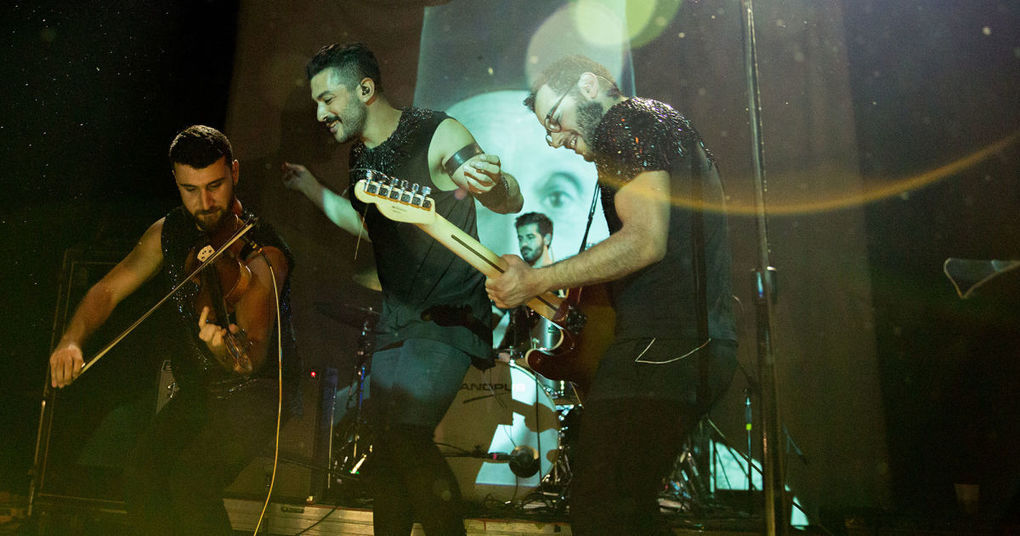
Two weeks ago, members of the Lebanese indie-pop band Mashrou’ Leila took the stage in front of a packed crowd at the Music Hall of Williamsburg, wearing a flamboyant yet minimal uniform of black sequinned shirts. They were in Brooklyn to kick off a month-long tour of the United States promoting their recently released fourth album, “Ibn El Leil,” Arabic for “Son of the Night,” which explores the escapism of Beirut’s aggressive, all-encompassing night life. The band’s twenty-eight-year-old songwriter and lead singer, Hamed Sinno, who met his fellow-bandmates eight years ago, at the American University of Beirut, is openly gay, and many of the band’s songs confront topics of gender equality and L.G.B.T. rights. In the crowd at the Music Hall, men held hands near women in hijabs.
After the Brooklyn show, Mashrou’ Leila’s U.S. tour moved on to Chicago, Detroit, Boston, and, on June 10th, Silver Spring, Maryland. The following night, Omar Mateen, a twenty-nine-year-old Afghani-American, opened fire at Pulse, a gay night club in Orlando, murdering forty-nine people in the largest shooting in U.S. history. A day and a half later, Mashrou’ Leila was back onstage, this time at the Hamilton, in Washington, D.C., one block from the White House. “It’s a very particular position to be in . . . to be queer and Arab and Muslim and in the U.S. when this happens,” Sinno told me when we spoke several days later.
Mashrou’ Leila’s blend of progressive lyrics, club beats, and indie sensibility has generated excitement across the Middle East for its fresh vision of what Arab pop can be, distinct from the dominant radio hits that are, as Sinno puts it, mostly the same “regurgitated” attempts at “cultural authenticity with an ethnic edge.” With the help of the Internet, Mashrou’ Leila has found a global audience. The new album, which the band débuted at the Barbican, in London, in November, hit No. 1 on the iTunes charts in the Middle East, and reached No. 13 on Billboard worldwide.
Despite this success, though, the group is still considered underground at home, where both its message and its sound are considered subversive. “We’re always played on the radio in Israel. We’re never played on the radio in Lebanon,” Sinno told me. In April, the band was slated to play the famous Roman amphitheatre in Amman, Jordan, where it had performed three times before. Then the Jordanian government cancelled the show and barred the group from performing in the country. Amman’s district governor told the Associated Press that the band’s lyrics “contradict” the religious beliefs of the monotheistic faiths. On Facebook, the band members wrote that they were being censored because of “our political and religious beliefs and endorsement of gender equality and sexual freedom.” The resulting outcry from fans ultimately led to a reversal of Jordan’s decision and a burst of global publicity that the band has continued to enjoy on the current U.S. tour. Before the show in Williamsburg, the line stretched halfway down North Sixth Street.
Sinno told me that he wrote an album about night clubs because, for two years, that is where he mourned his father, who died in 2013. As part of the Brooklyn set, the band played two songs from the album that exemplify its brand of political pop. “Tayf (Ghost),” which has a melancholy disco feel, refers to the name of a popular gay club in Beirut that Sinno used to frequent, until it was raided, and subsequently closed, in 2013, by local authorities. “I poured tears—neon—on swollen pupils,” Sinno sings. And a deceptively danceable tune, “Maghawir,” is about two innocent bystanders who were shot on their birthdays during conflicts at Beirut night clubs: “Number one, happy birthday, beautiful,” the song goes. “Number two, you’re in for a long night; tell your mother to chill: the club’s a bullet’s throw away . . . shoop shoop shot you down.”
When I spoke to Sinno after Orlando, the band had just performed in Los Angeles and was preparing to head to San Diego. He sounded exhausted and wary. “We were sort of afraid before we came here about how the audience would react to the band, given that Trump is a candidate, and then this happened, and then all those questions, they just multiply,” he said. “I don’t know how to talk about it because, quite frankly, I haven’t digested it yet.” As American politicians scrambled to control the attack’s narrative and Trump patted himself on the back for “being right on radical Islamic terrorism,” Sinno had to stand at a mike in his sparkly black shirt in front of hundreds of fans who were feeling shocked, sad, scared, and skeptical—and looking to him to say something. “Obviously, some of that expectation came from a very friendly place, but also some of that expectation came from a very strange place, which is: You are Arab, so what do you think of all this?” he said, noting the peculiarity of lumping together Arabs with those, like Mateen, of Afghan descent.
For many Mashrou’ Leila fans, the concert in D.C. served as an impromptu communal catharsis. “A bunch of people kept calling it a therapy session,” Sinno said, referring to comments he read on social media. Following the Orlando massacre, many members of the L.G.B.T. community paid tribute to gay bars as vital oases of community and acceptance. “Concerts are the same thing, in that sense,” Sinno said. “Sometimes you just need spaces where you can actually address certain questions comfortably.”
Since the shooting, security at Mashrou’ Leila shows has been heightened, including a police presence, metal detectors, and, in one instance, even dogs. The band returns to New York this week, on the eve of gay-pride festivities, for two performances, Friday and Saturday, at Le Poisson Rouge, in Greenwich Village. The playlist will be similar to the earlier New York show, but Sinno says that the meanings of his songs have changed. “Playing the entire album onstage feels totally different, at this point,” Sinno said. “Everything means something else right now. Everything feels like it’s relevant in its own way.” He wrote the new album at a time in his life when “the only thing I could write about was being sad in the club,” he said. Now, unexpectedly, his audience can empathize with his experience in a new way. “It’s one of those very strange instances where you just have to acknowledge that everything you think is personal is actually very shared.”
Source: www.newyorker.com


 Loading ...