Khaled A. Beydoun
Newsweek
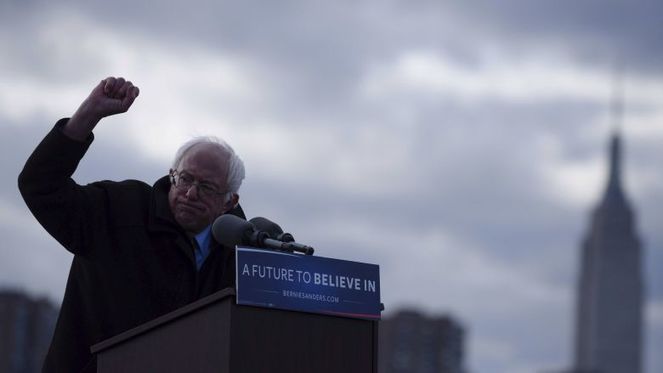
On April 15, the Bernie Sanders campaign will make a visit far from the presidential electoral map: The Vatican. Pope Francis invited the presidential hopeful to a conference addressing social and economic inequality, acknowledging Sanders’ relentless campaign against structural poverty and its attendant perils.
While the presidential field is comprised of five self-identifying Christians, Sanders – a democratic socialist and “proud Jew” – was the lone candidate invited to the Vatican. Yet, a kindred commitment to dismantling systemic poverty, not faith, extended the Pope’s hand to Sanders.
Like Sanders, whose central campaign message is ending poverty, Pope Francis’s Papacy centers on the very same mission. Both harken the socialist and egalitarian principles of the Catholic liberation theology that swept through Latin America in the 1950s and 60s, and the black Muslim philosophy of economic empowerment that emerged during the same period.
This mission to undo systemic poverty is absent within mainstream Muslim American organizations, and seldom uttered from the mouths of its prominent leaders. Until a Muslim American liberation theology remerges, the vast number of Muslims living in poverty, or dangerously close to its bounds, will have to hear this message from a Jew and a Christian.
The Michigan Miracle
Nearly a month ago, the Sanders campaign traveled into Michigan: a key battleground state, also home to a sizable poor and working class Muslim American population. Sanders’ economic talking points, which include a progressive income tax, free public education, and a federal $15 minimum wage, resonated deeply with poor, black and blue-collar Muslim Americans.
In addition, his grand message of “income inequality [as] the great moral issue of our time” spoke directly to the living conditions and core concerns of Muslim Americans – 45 percent of whom live below or dangerously close to the legal poverty line.
Sanders campaigned in the heart of East Dearborn, where “We Accept E.B.T.” signs are just as ubiquitous as the Arabic script adorning store signs, meeting with Muslim American youth and community leaders. His outreach culminated with a raucous rally where Sanders decried the economic neglect, robust unemployment, and predatory Wall Street policies that ravaged the metropolitan Detroit area.
His message was heard, loud and clear. Sanders won the Muslim American vote in Metro-Detroit by a resounding 67 percent clip. A tally that pushed him past the heavy favorite Hillary Clinton, and delivered him a victory that resuscitated his campaign. Trite headlines about “ Muslims voting for a Jew” aside, it was Sanders’ commitment to dismantling structural poverty and equality that resonated deeply with Michigan’s Muslim American voters. Not religion, nor embedded tropes about a religious rivalry.
Indeed, the very message that secured Sanders’ historic Michigan victory will land him in the Vatican this coming Friday. A visit that means far more than collecting delegates or garnering headlines, but re-centering the political focus back on poverty and against the “idolatry of money.”
A meeting, although featuring a Christian and a Jew, Muslim Americans should pay close attention to.
Ignoring Muslim American Poverty
The Pope and Sanders’ shared mission to dismantle poverty also exposes a glaring vid within mainstream Muslim American institutions. During a moment of great sociopolitical and civil rights crisis, Muslim America’s most vulnerable population are those living on the fringes of poverty, economic despair and political neglect. For indigent and working class Muslim Americans in cities like East Dearborn and Philadelphia, Minneapolis and New York City, liberation from poverty is as important a civil right as any.
Poverty not only compounds injury inflicted by Islamophobia and intensifies the scrutiny of government surveillance, but is the core civil rights issue that precedes all other civil rights issues. Poverty exacerbates every imaginable harm, and exposes those bound to it to enhanced violence from the state and private citizens.
Mainstream Muslim Americans organizations have failed, over and again, to include an anti-poverty message and mission to their work. Although nearly half of Muslim America is either mired by poverty or reside dangerously close to its margins, the commitment to undo the vestiges of poverty championed by Sanders and Pope Francis is virtually non-existent within Muslim American institutions.
The democratic socialism driving the Sanders campaign, or the Catholic liberation theology inspiring Francis’s Papacy, is not foreign to Islam. In fact, both are central to it. Dalia Mogahed, the Director of Research at the Institute for Social Policy and Understanding, observes:
“Islam invented this concept [of the “moral economy”], developed and implemented it in real life over continents and centuries, and even created modern banks and investment firms to reflect it. We call it ‘Islamic economics’ and it is the moral economy spelled out and executed, not just theoretical.”
Both classical and modern Islamic scholars, including Columbia University’s Hamid Dabashi, have articulated an “Islamic liberation theology” from the core baselines of economic egalitarianism, communitarianism, and philanthropy. Yet, Muslim American advocacy and civil rights organizations have largely set them aside, and in the process, sidelined the inclusion and interests of poor Muslim American
This failure is, in part, a reflection of their leadership and base constituency – which is overwhelmingly wealthy and middle class, South Asian and Arab. As a result, mainstream Muslim American institutions are not only disconnected from poor Muslim American communities, but are yet to build meaningful grassroots inroads or institute committed efforts to mold leadership from these neglected spaces.
The Sanders campaign, over a course of months, has filled an institutional void that has persisted for decades. Indigenous black Muslim leadership and movements, driven by the precepts of black liberation theology, were the last to prioritize poverty as a primary civil rights issue.
No such urgency exists today, and mainstream Muslim American organizations not only operate far from the Muslim American enclaves stricken by poverty and its disabling effects, but are emaciated by an institutional culture more likely to frown upon, instead of fight, poverty.
Toward A Muslim American Liberation Theology?
Yes, Sanders is Jewish. No, he is not Muslim. But he speaks the language of economic justice and enfranchisement that supersedes religious lines. This is why Muslims in Michigan voted for him in droves, and why, this week, Muslim New Yorkers from Brooklyn, Harlem, Astoria and working class enclaves beyond and in between will seek to help him pull off another historic upset.
During his presidential campaign, Sanders’ message has penetrated deep within poor and working class Muslim communities long neglected by mainstream Muslim American organizations. He has stepped into spaces these organizations have long forgotten about. In the process of seeking to dismantle structural poverty, he has helped to demystify the trope that Muslim Americans are an upwardly mobile, wealthy, economic model minority by politically empowering poor and working class Muslim Americans.
Sanders’ upcoming Vatican visit, for Muslim American leadership and organizations, extends an opportunity to revisit their failure of poor and working Muslim Americans. And perhaps, put into practice a liberation theology native to our faith, but foreign to our institutions.
Source: newsweekme.com



 Loading ...