Advertisement Close

Politics

State Department Funds Group in Israel that Tried to Oust Netanyahu

BY: Andrew Hansen/Contributing Writer On Tuesday, an Investigations Subcommittee of the United States Senate released a report revealing that the State Department had sent around $400,000 to an Israeli group that aims to remove Prime Minister Benjamin Netanyahu from office. Reportedly, money was sent to the OneVoice group over a 14-month span, ending in November … Continued

How Donald Trump’s Republican Party Veered to Right of Benjamin Netanyahu on Israel

Jane Eisner

Forward

Several weeks ago, the Republican Jewish Coalition unleashed an online advertising campaign with three dramatic, 30-second ads asserting that radical, anti-Israel extremists had taken over the Democratic Party.

One ad focused on Cornel West, the firebrand who called Israeli Prime Minister Benjamin Netanyahu a war criminal, another on the Arab-American activist James Zogby, and the third on U.S. Rep. Keith Ellison, claiming that he supports Hamas. All three served on the 15-member committee drafting the platform for the Democratic National Convention.

“Sadly, this isn’t the Old Democratic Party,” each of the ads intoned as a blurry photo of John F. Kennedy morphed into a smirking Hillary Clinton. “It’s today’s Democratic Party.”

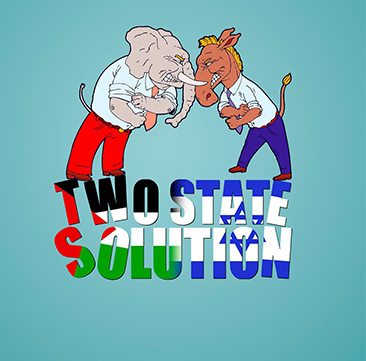
Oh, the irony. The “radical” positions of West, Zogby and Ellison — who were chosen by Bernie Sanders for the platform committee — were later soundly defeated by Democrats. Instead, it’s the GOP that has broken with the long-standing bipartisan approach to the Israeli-Palestinian conflict by rejecting a call for a two-state solution and further rejecting “the false notion that Israel is an occupier.”

Sadly, this isn’t the Old Republican Party anymore. While a party platform is a largely symbolic document, this development puts to rest the notion that a common vision of what’s best for Israel’s future is shared across the political spectrum.

Liberal Democrats are increasingly concerned more about the plight of the Palestinians than about the needs of Israel, and conservative Republicans are increasingly skeptical that there’s a way for Israel and an independent Palestinian state to coexist peacefully. In a recent Pew Research Center poll, 61% of Democrats believed a two-state solution was possible; only 38% of Republicans did.

This gulf has been building for some time, of course. President Obama, determined to forge a Middle East peace agreement, entered office reckoning that he’d hasten that agreement by creating “daylight” between himself and Netanyahu. The prime minister exacerbated their differences by openly defying Obama, first on expansion of settlements and then on the Iranian nuclear deal. Meantime, liberals (especially young liberals) are growing impatient with an Israeli government that seems not to budge on dealing with a Palestinian occupation that is now nearing the half-century mark.

But the political implications of this divergence are lopsided this year. Growing Democratic concern for Palestinians has not forced a change in language in the proposed party platform under Candidate Clinton. In fact, Democrats recently voted to reject an amendment to the platform that would have called for an end to occupation and illegal settlement building.

Under Candidate Trump, however, the Republican Party seems unmoored. With the apparent acquiescence of the presumed nominee, the GOP flat-out rejected endorsement of a two-state solution, which has been the official policy of U.S. administrations under both parties for decades and has been supported, at least rhetorically, by Netanyahu himself.

Even though the American Israel Public Affairs Committee, the powerful Israel lobby, has veered to the right politically — vociferously and unsuccessfully opposing the Iran deal, for instance — its embrace of a two-state solution was roundly ignored by the Republican platform writers. AIPAC is now philosophically closer to the party of Obama and Clinton on this key issue. And the Republican Party has positioned itself to the right of Netanyahu. Who could have imagined that?

Ironies aside, this move does not bode well for Israel or for American Jews.

If the Middle East stalemate continues, faith in a peaceful resolution to grant Palestinian sovereignty while ensuring Israeli security will further erode, with pressure from both left and right. Clinton’s forces may have forestalled a major shift in her party platform this year, but brewing resentment toward an unending occupation leaves that position understandably vulnerable.

Meanwhile, the Republicans are clearly wooing evangelical Christian conservatives by means of the shift on Israel (and so many other reactionary changes in the platform) How else to explain the new language in the GOP plank that describes support for Israel as an “expression of Americanism” — whatever that means?

Israeli settlement expansion and the debilitating vacuum in Palestinian leadership have made a two-state solution less and less viable. The critics’ doubts are warranted. Trouble is, no one — on the left or the right — has offered a compelling alternative, and distrust in any resolution only furthers the possibility that in the long term, either the Palestinians will never get their own state or the Israeli Jews will lose theirs.

Republicans are playing with fire here. Democrats should steer clear of the flame.

Source: forward.com

Arab American Muslim comics make Trump their punch line

By Dean Obeidallah 

Washington Post

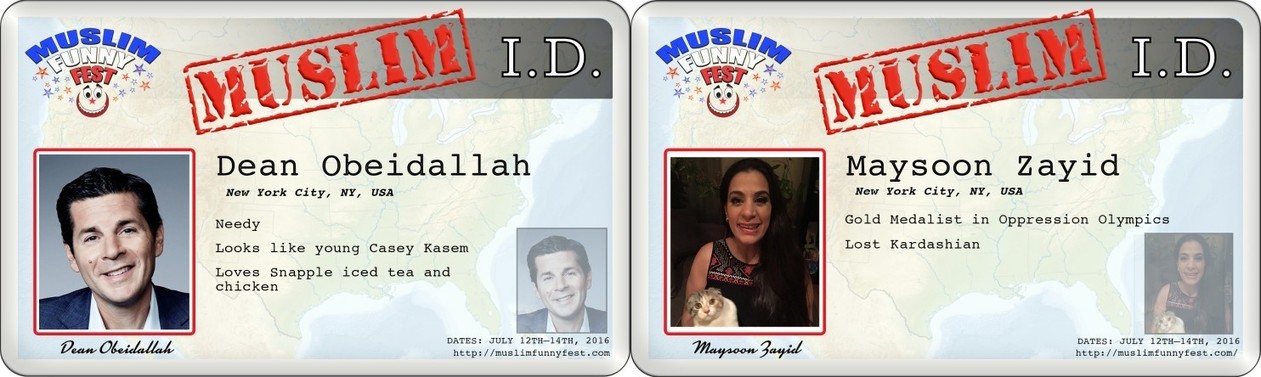
Producers of the Muslim Funny Fest have created fake “Muslim ID” cards for comics, a commentary on Donald Trump’s controversial 2015 comment on possible IDs for American Muslims. (Handout)
Like many American Muslims, Maysoon Zayid wants to obliterate Donald Trump’s presidential bid. But her chosen way to accomplish this feat is a little nontraditional — it’s with punch lines.

“Good thing I got married before Trump’s Muslim ban went into effect,” one of her jokes goes. “My husband is an Arab Muslim refugee who came here on a K1 fiance visa. If Trump had his way, I would die a virgin.”

Comics have always used jokes as a means of entertainment, catharsis and social change. But in 2016, Muslim American comedians see their art as a tool for survival.

This week, Zayid and a few dozen other comics (including myself) will unite in New York City for a comedy festival with a mission. Several of the comedians are coming from other countries out of fear that a President Trump might keep them out of the country for next year’s fest.

The goal of these Muslim comedians is to comically fillet Trump, poking fun at his divisive rhetoric, inflammatory proposals and, of course, his Muppet-inspired hairstyle. It’s only fair considering Trump’s “jihad” on Muslims, from his infamous declaration calling for “a total and complete shutdown of Muslims entering the United States” to indicating his openness to profile Muslim Americans to even suggesting the need to close American mosques.

How long until Trump proposes a Muslim Hunger Games?

Azhar Usman, one of the stars of the “Allah Made Me Funny” tour, playfully looks at the bright side of Trump with this bit: “Muslims should not be mad at Donald Trump. Because Islamophobic hate just makes reasonable people investigate Islam, some of whom end up converting. One day, Donald’s grandson, Abdullah Trump, will probably end up apologizing for him.”

In my act, I take on one of Trump’s other campaign staples: “Trump has made some outrageous proposals this campaign, but one thing he has talked about will definitely happen. If Trump is elected president, Mexico will build a wall. I’m pretty sure Canada will build one as well. In fact, maybe they will team up to build a dome over America to keep him out.”

There’s something both empowering and cathartic about having a roomful of people laugh at the person who is causing so much angst in our community. Mel Brooks once explained why he wrote a Hitler character into his iconic musical “The Producers.” The goal, he said, was to use “the medium of comedy” to rob Hitler of his power. It is the same for us.

To be clear, I’m not equating Hitler and Trump — Hitler obviously had bigger hands. (Sorry, I can’t help myself.)

We have even poked fun at Trump’s openness to requiring Muslim Americans to carry special identification cards by designing satirical versions of Muslim IDs. My Muslim ID notes that I look like a young Casey Kasem and am needy. (Both are true.)

There will of course be jokes about topics other than Trump at this week’s Muslim Funny Fest. From pop culture to family to racism, the comedians will crack wise on a broad range of topics. But given today’s political climate, Trump will be the target du jour. And given that Trump’s rhetoric has stoked the flames of hate against the Muslim community (as well as other minority groups), we are only too happy to respond with our comedic barbs.

The comedic approach in taking on Trump, however, will vary by comedian.

Some are subtler, such as Los Angeles-based comedian Ramy Youssef: “Statistically, if you have any level of education you don’t support Donald Trump — even if that education is from Trump University.” It’s funny, and it also reminds people about the Trump University fraud claims.

New York City comic Atheer Yacoub is far more direct.

“Donald Trump says women who have abortions should be punished. All women are being punished for his mom not having one.” No doubt some will be upset with that joke, but if you think we are going be politically correct when mocking a person who has spewed so much bigotry, let me quote the Italian side of my family: “fuhgeddaboudit.”

Will these jokes defeat Trump? Obviously not on their own. But if we can get Americans to view Trump not as a president but rather as a punch line, we will have done our small part in making sure that the only time Trump is in the White House is when he’s on a White House tour.

Source: www.washingtonpost.com

After Orlando, American Attitudes Toward Muslims More Favorable than Before

BY: Kristina Perry/Contributing Writer WASHINGTON, DC: On Monday, renowned researcher Shibley Telhami presented his team’s updated findings on American attitudes towards Middle Eastern immigrants and priorities of American foreign policy at the Brookings Institution. Telhami presented data that was collected two weeks before the tragic Orlando shootings, and then tested again two weeks after, to … Continued

Arab America Picks A President: Your Arab American Delegates

BY: Fred Shwaery/Contributing Writer Delegates For months, we’ve been looking forward to the Republican and Democratic conventions.  We voted in the primaries and caucuses and counted the presidential delegates as the results rolled in.  Our wait is almost over.     Next week, the Republican delegates meet in Cleveland and the following week, the Democratic delegates … Continued

Mosque Removed as Polling Site #HummusHaters

In the wake of the horrific Orlando shootings at a gay nightclub perpetrated by a supposed ISIS sympathizer, Florida is struggling with reaffirming ties with their Muslim community. Tensions arose when Susan Bucher, a Congresswoman in Boca Raton decided to remove a Mosque as a polling place for the upcoming presidential election. As a result … Continued

BDS is a war Israel can’t win

Israel’s apologists would call the BDS campaign “immoral”, but the slander is laughably false. A pro-Palestinian protester supporting the BDS campaign against Israel takes part in a demonstration in Cape Town, South Africa [Getty] by Stanley L Cohen Al Jazeera Stanley L Cohen is an attorney and human rights activist who has done extensive work in … Continued

How AIPAC Is Using Black Leaders to Erase Palestinian Suffering from the Democratic Party Platform

By David Harris-Gershon / Tikkun 

Alternet.com

This is the story of how a powerful lobbying organization enlists black Americans – victims of oppression and state violence for centuries – to mask the suffering of another oppressed people. It is the story of how the American Israel Public Affairs Committee (AIPAC) strategically recruits and educates black leaders to defend Israel from critique. And it is the story of how Palestinians living under Israel’s occupation suffer in ways that reverberate upon America’s streets – where black bodies are bruised, bloodied and destroyed under the weight of police violence, mass incarceration, and disenfranchisement.

It is a story which begins – for our purposes – on June 9 at the Omni Shoreham Hotel in Washington, DC, where a public hearing on the Democratic Platform convened for two days of discussion and debate in advance of the Drafting Committee’s work in St. Louis at the end of June.

At this hearing, the DNC’s 15-member Platform Drafting Committee heard public testimony on and debated many aspects of the platform, working through domestic policy and foreign policy and finally arriving at Israel. When they did, Robert Wexler, President of the S. Daniel Abraham Center for Middle East Peace, sat before the committee and presented Hillary Clinton’s version of what the DNC platform should look like, making sure to list Israel’s legitimate security concerns while neglecting to articulate the suffering Palestinians endure. Needless to say, absent from Wexler’s testimony were the words “occupation” and “settlements.” Though he did make sure to condemn Palestinian civil society’s nonviolent Boycott, Divestment, Sanctions (BDS) movement, noting that Democrats must oppose outside forces pressuring Israel.

Sitting opposite Wexler was Cornel West, a prominent author, academic and BDS supporter, who resides on the Drafting Committee as one of five members appointed by Bernie Sanders. (Six were appointed by Clinton.) When Wexler finished his testimony, West had this to say:

“I think both of us can agree that a precious Palestinian baby in the West Bank has exactly the same value as a precious Jewish baby in Tel Aviv … A commitment to security for precious Jewish brothers and sisters in Israel can never be predicated on an occupation of precious Palestinians. If we’re concerned about security, it seems to me we’re going to have to talk seriously about occupation. I don’t know if you would allow the use of that word … but occupation is real. It’s concrete.”

[…]

“For too long, the Democratic Party has been beholden to an AIPAC that didn’t take seriously the humanity of Palestinian brothers and sisters. We’re at a turning point now, though of course it’s going to be a slow one in the Democratic Party … So my first question would be: one, would you argue for the use of the word occupation in the platform? And two, how would you respond to those who say for so long the United States has been so biased toward Israeli security and has not accented the humanity of Palestinians, such that to talk about evenhandedness is always a version of anti-Semitism as opposed to a struggle for justice?”

Wexler responded, saying “what you refer to as occupation” should be absent from the DNC platform. Why? To include mention of occupation and settlements would be to litigate sensitive issues which must be negotiated by Israelis and Palestinians themselves, not the Democratic Party. An absurd answer made even more so given Wexler, on Clinton’s behalf, advocated minutes before for Jerusalem to be recognized by Democrats as Israel’s capital, one such ‘sensitive’ issue.

When the public hearing had concluded, the Clinton camp’s position was known: it opposed West’s proposal to acknowledge Palestinian suffering in the Democratic Party Platform, as well as the nonviolent movement he champions. What wasn’t known was just who would prevail on this issue. What also wasn’t known at the time was that in a matter of days, AIPAC would quietly aid Clinton by enlisting black politicians and church leaders to counter West’s efforts on the Drafting Committee, as though the only natural way to counter a black intellectual is with other black intellectuals.

Bakari Sellers and the DNC Letter
Three weeks later, on June 25 in St. Louis, the 15-member Drafting Committee met to hammer out the Democratic Party’s platform, finalizing a number of issues before arriving at Israel. It was time to consider West’s proposal, to consider whether the security concerns of both Israelis and Palestinians would finally be articulated by the Democratic Party, whether the humanity of both peoples would be acknowledged.

The debate revolved around a motion proposed by West and James Zogby, President of the Arab American Institute and another Sanders appointee. It sought to have included in the platform a call for “an end to occupation and illegal settlements so that [Palestinians] may live in independence, sovereignty and dignity” as well as an acknowledgement that Palestinians “deserve security, recognition and a normal life free from violence, terror and incitement.”

Debate on the motion was emotional, with West and Zogby pleading for the Democratic Party to simply acknowledge Palestinian suffering. Here’s Zogby:

The term occupation shouldn’t be controversial. George Bush said there is an occupation, Ariel Sharon said there was an occupation, Barack Obama has said there is an occupation. There is an occupation. It denies people freedom … It’s an occupation that humiliates people, that breeds contempt, that breeds anger and despair and a hopelessness that leads to violence.

We have to be able to call it what it is. Reality has moved way beyond just recognizing Palestinians [exist]. It’s hearing their voices, understanding their pain.

West and Zogby, who pushed for the motion in committee late into the night, were fighting an uphill battle, in large part because AIPAC had already been invisibly working to ensure the motion would fail.

Days before the vote, a letter addressed to Platform Committee co-chairs Governor Dannel Malloy and Shirley Franklin made its way to members of the Drafting Committee. Written by Bakari Sellers and signed by over 60 black leaders, the letter closely mirrored Wexler’s language from his June 9 testimony. Indeed, Sellers’ letter implored members not to stray from past language on Israel, with the exception of adding a condemnation of the BDS movement. It was a thinly veiled and direct response to West; a clear effort to undermine his efforts by demonizing Palestinian nonviolence and opposing mention of the state violence done unto them.

In the letter, Sellers wrote:

“I believe that the Mideast planks of the previous platform … have served us well as a party and a country. As Democrats and proud supporters of our presumptive nominee, we would be well served to stick closely to our previous platform language.”

When newsof Sellers’ letter leaked, questions were immediately raised: Who was Sellers? Who were these black leaders opposing West by echoing Wexler, a man AIPAC recently described as “one of the stalwart leaders of the American-Israel alliance“? Why were they invested in keeping Palestinian suffering out of the DNC’s platform? And how exactly had the previous platform on Israel served these black leaders well?

In pursuit of answers, I would end up receiving a call from Sellers as I started digging, climbing down a rabbit hole at the end of which stood AIPAC and years of deeply-funded recruitment efforts in historically black colleges, universities and churches across America. Recruitment efforts about which others before me have warned, recruitment efforts now paying dividends via a Clinton-AIPAC alliance working to stem a progressive shift on Israel within the Democratic Party. An alliance now using black leaders to help erase Palestinian suffering from the party’s articulated vision of justice in the Middle East.

From Morehouse College to AIPAC
Bakari Sellers is the son of Cleveland Sellers, a famed civil rights activist widely known for his leadership role in the Student Nonviolent Coordinating Committee, one of the most impactful civil rights organizations in the 1960s.

He grew up around Denmark, South Carolina, where he resides today. It’s also where his father now lives after many years serving as Director of African American Studies at the University of South Carolina. Sellers considers his father his “number one inspiration” for the elder’s long-standing pursuit of social justice and equality, and stands committed to “creating change that benefits all persons – no matter race, color, or creed,” in large part due to his father’s influence.

If this sounds like an unlikely biography for one now deeply involved with AIPAC – an organization which denies Palestinians their humanity as a political strategy – that’s likely the point.

So how did Sellers connect with AIPAC? In 2004, after he’d been elected to the SGA presidency at Morehouse College, Sellers got a cold call from two strangers inviting him to a policy conference. These strangers, AIPAC staffers Jonathan Kessler and Michael Glassman, were reaching out to student political leaders at historically black colleges and universities across the country and inviting them to Washington, DC as part of a larger recruitment effort. (More on that later.) Sellers, who didn’t know anything about AIPAC, but loved the idea of rubbing shoulders with US lawmakers, jumped at the chance.

“The voice on the other end sounded kind of nurturing and understanding, and I said I don’t have anything to lose,” Sellers recalled thinking after the call. And so he went to DC on AIPAC’s dime. And as with many young students recruited by AIPAC, he ended up being overwhelmed by the access and experiences he gained:

There might have been ten black people at the whole [AIPAC] conference of 7,500 [in 2004], and I remember one moment that they had the roll call, but I was just so enthralled that we went to this huge dinner that they have and every member of Congress, or at least 75 percent of them, were there and I got to see Steny Hoyer again who has the best hair in Congress and, you know, I got a chance to see Condoleezza Rice and see George Bush. And the unique thing is they had this huge role call where they notified and they let the crowd know who was there and they let them know the SGA presidents they had there, but they left out the only two HBCU presidents they had.

I didn’t even recognize it, but afterwards, the staff, the executive direction of this huge organization, came and apologized and said, “We’ll make it up to you.” And I was like, “You know, don’t worry about, I don’t care.” So the next morning we’re sitting in a huge forum waiting on the president, at that time, George Bush, to speak, and after they introduced the president, they had a pause and they said, “We would also like to recognize” – as President Bush stands and waits – “We would like to recognize the SGA presidents from Morehouse College and Spelman College, Bakari Sellers and Adeola Adejobi. May they please stand.” So that attention to detail and that we made President Bush wait even just for that moment. It meant a great deal.

Sellers’ connection to AIPAC would end up meaning a great deal more. Two years later, he would become one of the youngest congressmen ever elected to the South Carolina House of Representatives, where he served the 90th district from 2006-2014. And if it weren’t for AIPAC’s fundraising and networking support, his political career may never have gotten off the ground.

“The way I’m able to communicate, the exposure, the people that I’ve met – a lot of people I’ve met at the AIPAC policy conference became a huge part of my fund-raising base,” Sellers admitted in 2009.

Now, in 2016, he sits on AIPAC’s National Council. The son of civil rights icon Cleveland Sellers, penning letters to keep the Democratic Party from recognizing that Palestinians’ rights are violated by Israel.

Or perhaps Sellers didn’t even pen the letter, but rather signed his name after an ask from AIPAC. Shaun King, a writer at the New York Daily News, emailed me that an acquaintance of his, an AIPAC staff member, had texted to say the letter had been hisbrainchild, and that every signatory had been recruited by AIPAC via its educational wing, the American Israel Education Foundation (AIEF).

Though I was unable to confirm this with King’s source, my research certainly indicates the latter to be accurate, for nearly every individual who signed Sellers’ letter, from school superintendents to state senators, have deep AIPAC roots. And as I reached out to Sellers and dozens of these signatories, asking about their connections to AIPAC and reasons for signing, I came to learn just how deep the lobbying outfit’s reach into the black community extends.

The Optics of Black Leaders Defending Israel
For over 10 years, AIEF has been recruiting students like Sellers at historically black colleges and universities through its Campus Allies Mission program, funded by Adam Milstein, an Israeli real estate investor who was convicted for felony tax evasion in 2009, and who sits on AIPAC’s National Council alongside Sellers. Milstein, it should be noted, not only has a history of rather ugly Islamophobia. He also has a history of promoting attacks against President Obama which some feel have racist undertones, and opposes solidarity between Black Lives Matter and Palestinian movements. As for the missions Milstein funds, they send black students to AIPAC policy conferences and on Israel trips, where students are given crash courses on Israeli politics and history which, impressive as they may seem to the uninitiated, are rife with right-wing propaganda. These missions also wine, dine and provide students with the type of access to US lawmakers and world leaders about which most people dare dream.

These students, some of whom come from disadvantaged backgrounds, are often swept off their feet. Sellers certainly was. So too was Vincent Evans, who as a politically-active freshman at Florida A&M University was recruited by AIPAC, and ended up traveling to DC over 10 times with the lobbying outfit during his college career. Just listen to him talk about the experience with Colorlines reporter Seth Freed Wessler:

“You’re talking about a lot of students who grew up in a socio-economic place that does not give them these opportunities,” said Evans. “We met amazing people. I met Netanyahu. In 2007 or 2008 I met all the Democratic candidates for president. My dad cried when I met Obama. [AIPAC] opens your eyes to things you’ve never seen.”

Another group which works closely with AIPAC is the Atlanta-based Vanguard Leadership Group, which has effectively connected Morehouse College students with AIEF, funneling them to conferences and into Israel advocacy roles.

So why has AIPAC strategically chosen to focus heavily on recruiting black students and leaders to be Israel advocates and defenders? Part of the answer might be simple: AIPAC is incredibly thorough. However, that cannot be the entire story, for of all the potential communities from which to draw, its non-Jewish student recruitment and engagement only has three foci: African-American, Hispanic, and Christian colleges. And AIPAC views its African-American Outreach program as a particularly important tool.

Which leads many to wonder if the lobbying organization has intentionally developed a community of black leaders to visibly shield Israel from charges of racism and aparthied. At a time in which Israel is being targeted with South-African styled boycotts, a time in which young activists see parallels between the extra-judicial killings and indefinite detentions Palestinians face and the police shootings and mass incarcerations black Americans face, are AIPAC’s determined outreach efforts a mere matter of public relations? Is AIPAC most interested in developing political connections in the black community, or in defending Israel from charges of unequal treatment through the optics of black leaders standing upon a stage?

Or writing and signing letters?

The Motion Fails
Late into the night on June 25, after debate had finally ended, the Drafting Committee defeated West and Zogby’s motion by an 8-5 vote. The platform’s initial draft would not mention occupation, nor settlements, nor any acknowledgement of or concern for the violation of Palestinian rights. What would make it into the draft, however, were calls to fight BDS and for Jerusalem to be the “undivided” capital of Israel:

A strong and secure Israel is vital to the United States because we share overarching strategic interests and the common values of democracy, equality, tolerance, and pluralism. That is why we will always support Israel’s right to defend itself, including by retaining its qualitative military edge, and oppose any effort to delegitimize Israel, including at the United Nations or through the Boycott, Divestment, and Sanctions Movement.

We will continue to work toward a two-state solution of the Israeli-Palestinian conflict negotiated directly by the parties that guarantees Israel’s future as a secure and democratic Jewish state with recognized borders and provides the Palestinians with independence, sovereignty, and dignity. While Jerusalem is a matter for final status negotiations, it should remain the capital of Israel, an undivided city accessible to people of all faiths. Israelis deserve security, recognition, and a normal life free from terror and incitement. Palestinians should be free to govern themselves in their own viable state, in peace and dignity.
While AIPAC, with an assist from Sellers and over 60 black leaders, had repelled progressive efforts for a more balanced platform plank, some progressive inroads were made, despite the BDS language. For the first time, Palestinian “dignity” and “sovereignty” were articulated, as well as their deserving “peace.”

Baby steps, to be sure. Though AIPAC hadn’t won quite yet. The full, 187-member Platform Committee still needed to vote on – or amend – what the 15-member Drafting Committee had created. This would happen on July 9 at the DoubleTree Hotel in Orlando, where the fight for a more balanced, more just platform plank, one demonstrating equal concern for Israeli and Palestinian security, would continue.

Bakari Sellers Calls
While reaching out to several black leaders who signed the DNC letter, Sellers called unexpectedly on July 5 – a day after emailing him and just four days before final deliberations by the Platform Committee.

And so I asked Sellers why he had written the letter, a letter he insisted was his idea.

“I felt that more perspectives were needed on Israel,” he said, likely referring to West. “I wanted to lend mine as somebody concerned about the security and safety of Israel and who also has compassion for Palestinian brothers and sisters?”

“If you care about Palestinians, why not support acknowledging their suffering and the occupation in the DNC Platform alongside Israeli security concerns and traumas?”

“I do think that when you talk about terms like occupation – they’re loaded,” he said. “They debunk some of the history; there are 1.8 million Arabs living in Israel – ”

“Debunk history?” I asked. “Do you not think there is an occupation in the West Bank?”

His answer was both troubling and telling. For while Sellers had preceded my questions by noting his studying the relevant issues for over10 years, his answer revealed the influence of AIPAC’s education and a tenuous handle on the nature of occupation.

“That’s a loaded question about the occupation,” he replied. “How do I want to phrase this since you are writing? There are ways to get to a two-state solution, and one is a serious discussion about settlements. Now, I don’t have all the answers. There are definitely settlements, and we have to have that discussion. For example, will Israel have to pull back? There is a military presence, yes. But there are also – how many? – some thousands of missiles being fired – ”

“That’s Gaza,” I said. “We’re talking about the West Bank.”

“Oh, right. That’s Gaza,” Sellers offered, continuing to talk about Israel’s security needs without mentioning a single Palestinian concern.

I then moved to the AIPAC’s recruitment of black leaders. “What are your thoughts on the idea AIPAC may be using black leaders to shield Israel from racism charges?”

“That’s not fair, I’m not a puppet,” Sellers responded before suggesting that he doeschallenge AIPAC when things come up, such as police brutality against Ethiopian Jews. Though as I made clear, my contention was never to suggest that Sellers, or black leaders involved with AIPAC, are mere puppets. For not only are there obvious political and financial benefits to being involved with the organization, everyone develops their own political stances. I asked about AIPAC’s principle goal in recruiting black leaders.

But Sellers, who was busy, needed to run, and I thanked him for deciding to reach out.

The next day, video emerged of Baton Rouge police literally executing Alton Sterling, a black man merely selling CDs in a parking lot. When sellers Tweeted video of the incident, as disturbing as it is essential, a follower requested that he put trigger warnings on such difficult material.

“No. This country needs to see it,” he wrote, a sentiment with which I agreed.

Though his response prompted my asking Sellers, “Why do you feel Americans should witness state violence committed against black Americans, but feel the DNC should not even acknowledge the word “occupation,” much less the incredible suffering endured by Palestinians? Do these two positions not seem incongruous to you?”

I never received a response.

Signatories Silenced by AIPAC Questions?
Over the course of a week, I sent interview requests to 30 of those who signed Sellers’ letter, nearly all of whom have associations with AIPAC. Of those, approximately a dozen replied (or in one case, staff replied) indicating they would be happy to answer written questions. And so I submitted them:

Why did you decide to sign Bakari’s letter? (Or, why do you think excluding language about settlements and the occupation from the DNC platform wouldadvance peace for both sides?)
How long have you been associated with AIPAC, did you first connect with AIPAC via AIEF, and has AIPAC funded either your campaign or any legislative trips you’ve taken to Israel?
Why do you think AIPAC strategically recruits black leaders via its African-American Outreach and Campus Allies Mission programs?
When you received Bakari’s letter to sign, who was the first person to present it to you for signature?
Even with follow-up, seeking to confirm that the questions submitted were acceptable, not a single leader chose to answer them. Including Tennessee State Senator Lee Harris, who promotes his AIPAC affiliation, Louisiana State Representative Ted James, who has traveled to Israel with AIEF, and Augusta (GA) Mayor Hardie Davis, who has gone on legislative junkets to Israel, most likely via AIPAC.

What was it about these questions which moved so many leaders to silence? I cannot say, particularly given the AIPAC affiliations of many are matters of public record and, sometimes, proudly promoted by the leaders in question. Were they taken aback by inquires about AIPAC? Inquiries about who actually asked them to sign Sellers’ letter? Inquiries about turning their backs on another oppressed people?

I wish I knew.

A Final Chance as Platform Committee Votes
As evening descended upon the full Democratic Platform Committee in Orlando on July 9, debate finally centered on foreign policy. It was time for the full committee to wrestle with whether or not the party’s platform would formally acknowledge Palestinian suffering.

Maya Berry, executive director of the Arab American Institute, rose to offer an amendment which mirrored language the Drafting Committee had already rejected.

Palestinians deserve “an end to occupation and illegal settlements so that they may live in independence, sovereignty and dignity.”

She spoke on the fact that this should not be a contentious issue – recognizing occupation – before quoting Hilary Clinton extensively, both in 2010 and in her 2014 book, in which she explicitly acknowledged occupation, named its violations, and recognized its need to end for both Israelis and Palestinians to realize peace and security.

West then rose and, with signature passion, noted that young Americans are beginning to view this issue as the South Africa of our time. He also noted that if the Democratic Party could not demonstrate balance by valuing equally the lives and aspirations of both peoples, it would be mirroring what happened some 80 years ago, a reference to its moral failures in the lead-up to and during the civil rights movement.

After West finished, Stephen Benjamin – Mayor of Columbia, South Carolina – rose in opposition as a representative of Clinton. Benjamin, a black leader from Sellers’ home state, has long been associated with AIPAC. Which is why his opposition was predictable: he argued that inclusion of the word occupation would undermine efforts for a negotiated peace, and would also reverse the hard work of the drafting committee, though that’s precisely the point of an amendment.

While he said little, his association as a Clinton delegate said too much. The amendment failed, 95-73, toppled with the help of a black leader educated and supported by AIPAC.

After the amendment’s defeat, Berry offered yet another amendment, this time focusing on Gaza and adding language calling for action to help those in distress:

“We call for an international effort to rebuild Gaza, which the UN warns could be uninhabitable by 2020, where poverty and hopelessness undermine peace and security for both Palestinians and Israelis.”

After again being passionately supported by Berry and West, another Clinton delegate, Mark Stanley, rose to oppose it, offering one of the more callous and obtuse reasons, arguing that were Democrats to open up Gaza for debate, what else would they then have to open up for debate?

It failed, 95-72.

Shouting and protests broke out. Screams and cries. It was the only time before discussion of any amendments the Chairman, Governor Malloy, had warned people things would be contentious.

After the vote, rather than contention, there was anguish.

Marc Lamont Hill
I knew what I had been witnessing, and what I had been learning about, was wrong. Though as a Jewish, ‘white’ American, I also felt some guilt, legitimate or not, about implicating black leaders in this immoral, political game. After all, the Black-Jewish alliance is strong, and goes back not just to the Civil Rights movement, but to our connection as two peoples upon whom hatred are continuously heaped.

And so I decided to speak with Marc Lamont Hill – Distinguished Professor of African American Studies at Morehouse College, author and television personality – about all of this. About AIPAC, Palestinian suffering and leaders like Bakari Sellers doing the work of a lobbying organization I believe is not just harming Palestinians, but Israel as well. Below is part of our exchange, and just some of his profound insights:

Me:

“Should African-Americans, given our country’s history of oppression, have any particular responsibility for recognizing the suffering of Palestinians?”

MLH:

Yes! The short answer is yes. Black people like all people have a responsibility to fight for justice and struggle against injustice, wherever it is. I think that the historic connection between blacks and Jewish Americans during the civil rights struggle has created a cultural connection that has, combined with the hasbara(propaganda) approach to representing the conflict, obscured the conflict for African-Americans and made them view it in a certain way. So if you already have a natural connection to Jewish brothers and sisters, and then the conflict is misrepresented, it makes it easy for black people to unreflectively attach themselves to Israel. Now, I’m not advocating that black people switch teams. We should still be interested in fighting anti-Semitism and be on the side of justice when it comes to Jewish people, because they matter. But at the same time we have to open our eyes and recognize that the kind of historical struggle that black people often liken themselves to – dislocation, marginalization, state violence – is the struggle of Palestinians. We’re much closer to where Palestinians are right now than where Israelis are. But again, that doesn’t mean that we dismiss Jewish suffering or Israeli suffering. What it does mean is that we don’t have to conflate Jewishness with Israeli state practices, and we don’t have to choose between fighting anti-Semitism and for Palestinian rights. We can do both.

Me:

“Speaking of misrepresentation, this brings me to AIPAC’s role in all of this. I’m sure you’re aware that Bakari and everyone who signed the letter are affiliated with AIPAC, most through AIEF. How do you personally feel about AIPAC enlisting black leaders to thwart attempt to have Palestinian oppression recognized by the DNC?”

MLH:

“There’s a twisted irony here that black people, who have always been the vanguard of social justice struggles in America, who have been a moral compass in terms of political action, are now being used to underwrite social injustice. It’s a dark irony which brings a great sadness. AIPAC has modeled what it means to have an organized, deeply rooted, systematic commitment to a particular worldview. It’s breathtaking how efficient and powerful AIPAC is and how effective they are. I think the key for those of us on a different side of this issue is to be equally organized and to let the truth and facts speak for themselves in full public view. Right now, I’m watching so many young students, so many black ministers, so many black politicians have their intellectual and physical labor be used in service of a project I believe is anti-democratic and counter to social justice ideals.”

Me:

“Do you think Bakari and other black lawmakers are being used by AIPAC rather than valued and if so, given these are intelligent people, why do you think they’re allowing themselves to be used in this way?”

MLH:

“First, I think there’s a willful ignorance. Saying you want to be a friend of Israel is like kissing a baby, politically. Everyone does it, everyone believes it, and there are no stakes attached. Some of it is opportunism, and a lot of it is our failure to represent the conflict in a way that is balanced and nuanced. I don’t think most black American politicians are corrupt or engaged in some kind of venal act, I think they believe the narratives they’ve been told. I do think there’s ample evidence to contradict those narratives, though when you’re being well funded, and when your election or re-election status hinges on it, it’s easy to not look for counter evidence. I just think they’re wrong, and when being wrong is lucrative, it’s easy to not try to be right.”

Me:

“There are some who claim AIPAC has targeted traditional black colleges and universities and churches to try and recruit black leaders not because of any power associated with these leaders but because having black faces on stage at AIPAC conferences hides the racism and oppression of Palestinians. People can point to a state representative on stage and say, ‘Look, black Americans love Israel. Israel’s not racist.’ Do you buy into that critique?”

MLH:

“I think that’s exactly right. Some of it is the optics of it, showing a multi-racial coalition of people fighting for a Zionist project because then it nullifies to some extent the racial issue, particularly when part of Israel’s narrative is it’s the one state in the Middle East where you can be gay, where you can be shielded from racism, where you can be protected from anti-democratic practices. So if you can model this mini-democratic experiment on stage at an AIPAC conference then it makes it harder to point out racism. People will say, ‘What are you talking about?’ … There is an important desire to have a civil rights tradition in America confirming the Zionist project. How many times have you heard, ‘Well Dr. King supported Zionism.” So the patron saint of civil rights in America supported it, so of course we want Cleveland Sellers and his son, Bakari Sellers, to support it.”

Me:

“Hypothetically speaking, given your perspective, what would you say to Bakari or to the DNC Platform Committee which you didn’t get to say, because you weren’t there, on the topic of why mentioning occupation and settlements in the DNC Platform would advance peace?”

MLH:

“We can’t have justice unless all sides are recognized and respected. In the same way that we want the PA and Hamas to recognize the State of Israel and its legitimacy, which is exactly what should happen, and the reason for that is because if we can’t recognize that Israel has a right to exist, then we’re not starting from a place of fairness or justice, or a recognition of their humanity. Similarly, if we begin our platform by not acknowledging the plight of Palestinian people, and the very real political circumstances they live under, we can’t redress it. How can we talk about reparations for Jewish brothers and sisters if we don’t talk about the Holocaust? It’s a real and human tragedy, and we need to always remember it and address it. If we don’t do that, then we can’t fix the problem. We can’t fix the problem of occupation if we pretend it’s not an occupation but a dispute, which is the language many people use. We can’t stop Israel from building and expanding settlements and further displacing people if we pretend settlement expansion isn’t happening. It’s no different than when Democrats get pissed off at the right for denying climate change. Democrats are denying the problem exists, which then undermines our ability to fix the problem. Except the difference is this isn’t an abstract, scientific argument or a historical event we’re trying to come to terms with, this is an active project … If I were on the platform, I’d tell Democratic leaders that we’re compromising our moral authority as a party.”

Why it Matters
If this were just about moving the United States closer to being about to end the occupation and Palestinian suffering, it would be enough. If this were just about moving a future Clinton administration closer to helping Palestinians suffering in Gaza, it would be enough.

But this is about, for me and for many others, not just Palestinian suffering and survival, but the suffering and survival of Israeli Jews as well.

I have long held that the only world arbiter powerful enough to compel Israel to end its occupation, dismantle settlement blocks, and reach an accord with Palestinian leaders, is the United States. I have also long held that if the US were to wield its unbelievable influence – $3 billion in military and foreign aid annually – things could change rapidly. Nonviolent Palestinian resistance, such as BDS, is partly a response to our failure as a country to be an arbiter of justice. Palestinian civil society’s move to pressure Israel through nonviolent, and likely constitutionally-protected, boycotts is not only entirely legitimate, but in many ways made necessary due to our inaction.

That organizations like AIPAC continue to support the right-wing policies of Israeli leaders like Binyamin Netanyahu, policies which are destroying both the lives and futures of Palestinians and Israelis, angers me to no end. As Israel slides farther to the right, wisps of fascism taking root, leaders rejecting two-states while also rejecting an end to occupation, it’s not difficult to see where we’re headed. And that’s worse than where we are, for both sides.

Like Marc Lamont Hill, I’m outraged that AIPAC has chosen to enlist black leaders to defend the status quo and help ensure things only get worse. And I’m disappointed with such leaders, not as a member of the black community, but as one invested both in Israel and in the realization of full rights, dignity and sovereignty for Palestinians.

As Hill stated, all we can do is educate ourselves and organize to combat AIPAC’s efforts and realize justice for all involved. After all, the Democratic Party must vote on this platform at the convention in Philadelphia soon.

I welcome that call, and stand with anyone who wants to stand with me.

Source: www.alternet.org

Occupation Isn’t Democratic: Platform Debate Over Israel Obstructs Peace

Naomi Dann
The Huffington Post

On June 24, as the Democratic Party platform drafting committee meeting in St. Louis, Missouri debated late into the night over whether to call Israel’s nearly half-century-old military rule over the Palestinians an ‘occupation,’ the Presbyterian Church USA’s General Assembly meeting in Portland, Oregon voted to adopt some of the most progressive policies on Palestine of any major U.S. institution. Sitting in the back of that convention center surrounded by an interfaith, intergenerational group of human rights advocates, including Jews, Palestinian Christians and Muslims, Presbyterians, and Quakers, I caught a glimpse of what might be possible if leaders and policymakers admitted the truth.

The message of the Church was clear: in the absence of a just peace, what is needed are concrete steps to end the egregious injustices and human rights abuses taking place in Israel/Palestine and lay the groundwork for a future with equality and justice for all.

Yet, as I sat in the back of that hall, my phone lit up with tweets about the #DNCPlatform debate over Israel/Palestine, reminding me once again of just how far many U.S. political leaders are from taking the necessary action to make that future possible.

If you can’t even name the problem, how can you expect to solve it? As the Arab American Institute’s James Zogby told his fellow members of the platform drafting committee: “We have to be able to call it what it is. It is an occupation that humiliates people; that breeds contempt; that breeds anger, and despair and hopelessness that leads to violence.” That reality has certainly been on display in the region in recent months, as Israel’s repressive policies, including expansion of illegal settlements on Palestinian land, extrajudicial killings, arbitrary imprisonment, and collective punishment in the form of restrictions on movement and home demolitions have escalated in response to attacks by frustrated individuals.

The debate over the Democratic Party’s approach to Israel/Palestine during the platform committee process is a clear illustration of just how out of touch many US politicians, including leaders of the Democratic party, are with both the situation on the ground and changing public opinion on Israel/Palestine. Recognition that Israeli policies, including occupation, dispossession, and siege, are underlying causes that drive the conflict, along with support for efforts to protect Palestinian human rights, has been growing among Democratic voters over the last several years, particularly among liberals, young people, and people of color. A recent Pew Poll found that liberal Democrats sympathize more with Palestinians than Israelis, while a poll released by the Brookings Institution in December 2015 revealed that 49% of Democrats would support sanctions or stronger action against Israel over settlement construction.

The draft of the Democratic Party platform being debated in Orlando this weekend fails to represent these growing constituencies that care about Palestinian human rights. As it currently reads, the platform omits any reference to the occupation regime that has dominated the lives of millions of Palestinians for nearly 50 years, or the daily violence Israel inflicts on Palestinians to enforce that occupation.

Naming the reality of the occupation is the bare minimum necessary for taking any realistic steps towards ending it.

Moreover, the platform now contains a clause attacking the grassroots Boycott, Divestment and Sanctions (BDS) movement for Palestinian rights. The condemnation of BDS is part of a broader campaign to suppress BDS in the US, which has escalated in recent months. Eleven states have passed bills intended to suppress BDS, and just last month New York Governor Andrew Cuomo signed an executive order requiring the state to create a blacklist of institutions that abide by BDS campaigns. These various measures threaten the civil liberties of all Americans to engage in boycotts and other economic acts of conscience in support of human rights and social justice struggles, as noted by the American Civil Liberties Union, Center for Constitutional Rights, the National Lawyers Guild, and others.

Growing constituencies of Americans recognize that a just peace between Israelis and Palestinians will require the U.S. to give equal weight to concerns for Palestinian security and freedom as it does to Israeli security. There can be no real security for anyone in the region while Israeli policies continue to incite pain, anger and frustration.

In truth, the platform itself is primarily symbolic, and the final language matters less than the policies actually implemented by policymakers and leaders once in power. However, the much-publicized fight over Israel/Palestine in the platform has made it clear that, even as the public conversation on Palestinian rights has advanced significantly in recent years, many politicians from both parties are still standing in the way of ending the unjust status quo. In the absence of a just peace, the very least the Democratic Party can do is admit that there is an occupation, and that it has to end.

Naomi Dann is a writer focusing on Israel/Palestine and U.S. foreign policy, and the media coordinator at Jewish Voice for Peace. She is writing in her personal capacity, Jewish Voice for Peace is a non-partisan 501 (c) 3 organization and does not support or endorse candidates or parties.

Source: www.huffingtonpost.com

Zogby: Putting Middle East Christians At Risk

James Zogby

The HUffington Post


This week a coalition of mostly far-right “Christian” organizations hosted a conference in Washington that claimed to be defending persecuted minorities in the Middle East. Given the very real threat facing vulnerable ancient religious communities at the hands of barbarous groups like ISIS, one might be inclined to commend the organizers for their timely initiative. However, after examining the groups involved and list of invited speakers, the conference’s purposes appear to be dangerously provocative and even sinister.

Among the featured speakers are a handful of notorious Islamophobes and a strange collection of individuals who claim to have been “radical Muslims”, of one stripe or another, all of whom say they have now converted to Christianity and have come forward to tell their conversion stories.

One of the headliners is Frank Gaffney who heads an organization which the Southern Poverty Law Center (SPLC) identifies as an “anti-Muslim hate group”. Gaffney is one of the main propagators of the notion that President Obama “may be a Muslim” and that Hillary Clinton aide, Huma Abedin, is a secret operative of the Muslim Brotherhood. Another speaker representing an SPLC-listed hate group is Retired General William Boykin, a Bush-era Pentagon official who gained notoriety when it was revealed that he had repeatedly compared the Iraq war to the Crusades boasting that the US/Christian side was bound to win because “our God is bigger than theirs”. Boykin has also said that “Islam is evil” and should not be protected by the First Amendment.

Among the others scheduled to address the event were a number of evangelical preachers, Trump supporters, and Christian missionaries devoted to converting Muslims.

To inspire the attendees, organizers invited a number of “converts” to share their stories. One of them, Tass Saada, claims to have been a “PLO sniper” until he saw the light and converted to Christianity. He founded “Hope for Ishmael” to lead other Muslims to convert. Joining him will be Daniel Shayesteh, an Iranian American who claims to have been an “Islamic extremist” at age 9. He later became a Christian and has since founded “Exodus from Darkness”.

It was especially troubling that a number of conservative Republican Members of Congress and State Department officials were scheduled to speak to the conference. Their presence was intended to give legitimacy to the event.

On being made aware of the conference, my organization, the Arab American Institute, crafted a letter to the congressmen urging them to withdraw their support, detailing the dangers this gathering posed for the very people it claimed to be supporting. Endorsed by the Holy Land Christian Ecumenical Foundation, the American Arab Anti-Discrimination Committee, the Muslim Public Affairs Council, and the Catholics in Alliance for the Common Good, our letter, in part, read,

“We write to you to convey our deep concern with an upcoming conference, “The Bridge: The Annual Conference on the Persecuted Church”… The conference’s program gives a platform to well-known anti-Arab and anti-Muslim activists whose work advances a dangerous agenda of fear and misunderstanding.

“We share with you the belief that it is of utmost importance to defend the rights of persecuted Christians and other vulnerable faith communities across the Middle East. Moreover, we believe that it is critical that we work to ensure that these faith communities not merely be protected as minorities but guaranteed full and equal citizenship rights in every country in the region. While some in Washington, D.C. believe that the interests of persecuted Christians can be advanced through bashing Islam and its adherents, the truth is that these tactics do nothing to advance or defend the rights of persecuted Christians.

“At a time when the public discourse in the United States has looked at Arab and Muslims across the world with acute suspicion, it is critically important that our public officials help combat hateful rhetoric and elevate leaders who speak to our highest ideals of mutual respect and understanding… We are concerned that this conference may have the unfortunate consequence of legitimizing the anti-Arab and anti-Muslim messages and policies that are associated with its speakers and will in the end do more harm than good to the persecuted communities the conference organizers claim to be defending.

We believe that your participation and/or endorsement of this event would empower these voices of bigotry, not defend the rights of religiously persecuted Christians, as the conference claims to do. With these considerations in mind, we respectfully request that you withdraw from participating in this event.”

The Members of Congress did not withdraw, but on the day the before the conference was to begin Frank Gaffney’s name was removed from the speaker’s list.

Source: www.huffingtonpost.com

Vice President Biden: “This violence has to stop”

This has been a trying week for America. As Americans, we are all wounded by the targeting of the police force in Dallas and the deaths in St. Paul and Baton Rouge. Now, I know a lot of you might ask, “What can I do?” You can do a lot—right now, this weekend. This weekend, … Continued

1,530 Results (Page 89 of 128)