Advertisement Close

Religion

Under pressure from Presbyterians, RE/MAX announces it will no longer profit from sales of Jewish settlements

Press Release from The Israel/Palestine Mission Network (IPMN) of the Presbyterian Church (USA):  During its 222nd biennial General Assembly, which took place in Portland, Oregon this week, the Presbyterian Church (USA) continued its strong support for Palestinian rights with the passage of a series of overtures. An overture calling on real estate company RE/MAX to … Continued

Orlando tragedy can serve as a teaching moment for Muslim Americans

Ra’fat Aldajani  

National Catholic Reporter

My first recollection of a religious holiday as a Muslim child in the Middle East was actually of Christmas. My parents, not wanting me and my siblings to feel out of place or “different” in the British expatriate school we attended, placed gifts under our beds for us to wake up to on Christmas morning.

This did not mean we were Christian or agnostic — far from it. We were fully aware we were Muslims, yet we were part of an Arab Muslim middle class in the Middle East, who along with fellow Arab Muslims of more or less means, were tolerant, open-minded and completely oblivious to any radical or extremist distinctions between Muslim and Christian or between Muslim Sunni and Shiite.

This attitude continued through our teenage years in Lebanon, even during the Lebanese Civil War of 1975-1992. While there was a Muslim vs. Christian element to that conflict, it was always at a political level and never really seeped into or established roots in the thinking of the general population. While fewer Muslims resided in the “Christian” half of Lebanon during the war, on the “Muslim” side many Christians lived and worshipped freely and safely, and it was not uncommon to hear church bells tolling on Sunday in “Muslim” West Beirut.

This is the silent but largely unheard majority often spoken about among Muslims. We don’t necessarily pray five times a day, nor do women in our families usually wear a hijab (although the hijab has seen a resurgence in the past 20 years or so but more as part of a religious re-awareness as opposed to adhering to radical thought).

Many of us do fast during Ramadan and are very proud of being Muslim, yet we remain moderate and open-minded in our thinking and way of life. Among our friends, mates and wives/husbands are Christians and Jews, homosexual and heterosexual. We don’t judge or discriminate, we just live and let live.

We have watched over the years the many different manifestations of the extreme minority of radical extremists who have severely tarnished our religion, most lately culminating in the Islamic State, and we feel absolutely no connection to them or their beliefs. They are foreign and repulsive to us. They do not represent us or the religion of peace that Islam fundamentally is.

Instead, they have grotesquely distorted religion and Scripture, ignorantly cherry-picking verses from the Quran to justify the unjustifiable. They are no more Muslim than any violent group who professes adherence to Christianity is Christian, such as the KKK, the Lord’s Resistance Army in Uganda or the Oklahoma federal building bomber Timothy McVeigh.

My family immigrated to the United States in the late 1980s, to Orlando where we established roots and the city became our new American hometown. While I personally moved on to the Washington, D.C., area, my immediate family remained there and I still refer to Orlando as “home.”

It is because of this feeling of home that the horrific massacre at the LGBT club Pulse in Orlando has struck me so deeply. All violent deaths are equally tragic and senseless whether in Orlando or elsewhere, but this particular outrage felt like someone had violated me personally, had entered the sacred space of home we all feel and desecrated that space. It is for this reason that because of this particular horror I’ve felt not only sadness but also grief.

Millions of words, spoken and on paper will be dedicated to analyzing, probing and pontificating on the reasons for the massacre at the Pulse nightclub. Most of the writing will be way off mark, offensive to Muslims in general and bigoted, and will play right into the hands of radical extremists preying on confused, weak and vulnerable Muslims.

This we cannot control. What we can control as Muslim Americans, whether immigrant or American-born, is to shape the narrative of who we are and what we stand for. It is not enough to simply condemn the acts of violence committed in our religion’s name and then shake our heads when demagogues like Trump recommend a ban on all Muslims entering our country, the United States.

We must be proactive in defining what our religion really stands for in word and in action. We have a tendency to get defensive when such violent acts are committed in Islam’s name, and retreat into our own communities. Or we simply react in shame and sorrow at the latest act, while waiting for a future one to inevitably follow, wincing when we hear of an attack on TV, hoping that the name of the perpetrator or group will not be Arab or Muslim. While understandable, that is not the answer.

We chose the United States as our adopted home because our homes in our former countries became unlivable for one reason or the other, and we must fully embrace our being American along with our roots and unique culture. One does not negate the other.

Despite the tragedy, Orlando, my American hometown, can serve as a teaching moment for Muslim Americans. If we focused on three small objectives that are achievable for us both as individuals and as a community, I believe we can make a measurable difference.

The first objective is embracing being American. Too often we confuse being American with an erosion or rejection of our native culture and mores. It is quite the contrary. America is the land of immigrants, a melting pot of many diverse cultures and peoples, all contributing to what makes this country unique and strong.

Assimilation means developing a hybrid of what is good from our mother countries (family values, importance of education, respect for elders) and our adopted home (democracy, justice, rule of law) and engaging in every aspect of American life as Muslim Americans, rather than retreating defensively into our own culturally fenced-off communities.

Assimilating also means understanding and respecting that all are equal in America — black, white, Muslim, Christian, Jew, atheist, agnostic, or LGBT. It means standing shoulder to shoulder with communities that are discriminated against, as we are discriminated against today. One of the largest Muslim-American organizations, the Council on American-Islamic Relations, took an admirable stand in the wake of the Orlando tragedy by expressing solidarity with the LGBT community in the wake of the attack and even urged Muslims to donate blood for the injured victims.

The second achievable objective is in educating our fellow non-Muslim Americans to the fact that Islam is not a “foreign” religion but part of the Abrahamic tradition; in fact, it is the third pillar of the Abrahamic monotheistic line of faiths, alongside Judaism and Christianity.

As such, one critical step to take is to stop inserting the Arab translation for the word God, “Allah,” into conversation or writing related to Islam that is conducted in English. Allah is simply the translation in the Arabic language of the word “God.” Arab Christians and Muslims use “Allah” when referring to God in Arabic, both in word and in Scripture, in mosque and church, and in personal prayer. What Allah is not is the Muslim God, no more than “Dieu” is the “French God” or “Dios” the “Spanish God.”

It is bad enough that the U.S. media, politicians and pundits routinely reinforce this dangerous and misleading fallacy. As Muslim Americans we should not be adding to it ourselves.

Finally, we should encourage critical thinking in Islam that makes us think rather than fall back on feel-good narratives that create comfort bubbles and inhibit thought. This is not to say that we should doubt the words of the Quran, which to Muslims is the literal word of God as passed on by the angel Gabriel to the prophet Muhammad. Instead it is to follow in the steps of Muslim philosophers such as Al-Farabi, Ibn Rushd, Ibn Arabi and Ibn Khaldun and engage in healthy debate about women’s rights, sectarian divisions, diversity, violence conducted in our name, and, yes, even homosexuality.

It is astonishing that since the last of these great philosophers Ibn Khaldun, died in 1406, over 612 years ago, there has been little to show in terms of mainstream critical thinking and Islamic philosophy. It is time for that silent majority of Muslims, who overwhelmingly make up the world’s Muslims, to pick up the mantle of these philosophers, and in both action and word, wrest away our beautiful religion from the poisonous few among us who have so tarnished its image.

Source: ncronline.org

The Struggles Of Fasting For Ramadan In A Non-Muslim Office

By Carol Kuruvilla  The Huffington Post   Ramadan is a holy month of fasting for many of the world’s Muslims. Followers of the faith are encouraged to abstain from eating food or drinking water during the daylight hours. The fast is meant to be both a spiritual and physical challenge — one that isn’t made … Continued

Maronite patriarch visits

By Paul Tennant 

Eagle Tribune


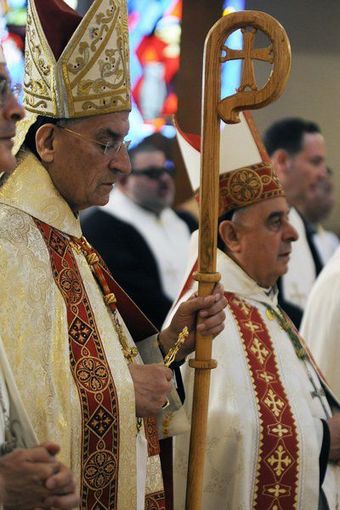
The Maronite community literally rolled out the red carpet for their patriarch, Cardinal Bechara Peter Rai, who visited the Merrimack Valley on Friday.

After landing at Lawrence Municipal Airport, the patriarch was greeted by dozens of well-wishers. Many displayed Lebanese and American flags and Rai received quite a few bouquets of flowers. Rai, patriarch of Antioch and All the East, is the leader of Maronite Christians all over the world.

The majority of Lebanese Christians belong to the Maronite rite, which is united with the Catholic Church. Others belong to the Melkite rite, which is also Catholic.

Both the Maronite and Melkite rites claim substantial numbers in the Merrimack Valley.

“We’re so glad to have you here,” said Mayor Daniel Rivera, who presented the patriarch with a proclamation. The city that Rivera leads has had a large Lebanese community for well over 100 years. Near the beginning of the 20th century, thousands of Lebanese immigrants came to Lawrence to work in the textile mills.

More recently, large numbers have left Lebanon and immigrated to the Merrimack Valley to escape the civil war that devastated that nation. St. Anthony Maronite Church, believed to be the oldest Maronite parish in the United States, serves about 1,200 families, according to the pastor, Monsignor Peter Azar.

Rivera expressed the wish that the patriarch will “bring blessings to everybody.”

State Sen. Barbara L’Italien, D-Andover, and Rep. Marcos Devers, D-Lawrence, presented Rai with citations from their respective branches of the Legislature, as well as greetings from Gov. Charlie Baker and Congressman Seth Moulton, D-Salem.

Rai, speaking in Arabic while Azar translated his remarks into English, spoke highly of the “mingling of two communities” – Lebanese and American. He also expressed his gratitude for “such a family welcome.”

Many of the well-wishers said the Lebanese are very family-oriented.

After his welcome at the airport, where they indeed rolled out a red carpet for him, Rai went to the Atkinson Country Club in Atkinson, N.H., for another reception, escorted by motorcycle-riding police officers from the Lawrence, Methuen, North Andover and Atkinson departments.

Methuen police Chief Joseph Solomon, a Lebanese-American, and North Andover police Lt. Charles Gray, who will soon become chief of his department, were among the public safety officials present.

After the visit to Atkinson, the patriarch, again escorted by the police motorcycles, journeyed to St. Anthony Maronite Church, where he received a rock-star welcome from parishioners of all ages. Rai, who cuts a regal yet humble figure, cheerfully granted numerous requests for photographs.

“No selfies,” Monsignor Azar ordered.

Rai celebrated the Divine Liturgy (Mass) along with several Catholic prelates and other priests, including Azar, Bishop Gregory Mansour, head of the Eparchy (Diocese) of St. Maron of Brooklyn, the Most Rev. Robert Hennessey, Latin rite regional bishop for the Merrimack Valley and the Rev. Martin Hyatt of St. Basil’s Salvatorian Center, a Melkite Catholic priest.

If one seeks a short, watered-down Mass, the Maronite Divine Liturgy doesn’t offer it. Friday evening’s Mass, on the occasion of the Feast of St. John the Baptist, was celebrated in Arabic and Aramaic – the language spoken by Jesus and his disciples – with some prayers and readings in English.

The choir, directed by veteran director Camil Saade, sang in both Aramaic and Arabic, at times accompanied by a lute, violin and keyboard. The St. Anthony Maronite choir, which has achieved nationwide acclaim, spent months in preparation for this celebration, according to Azar.

He praised the choir’s “angelic voices.”

Rai delivered his homily in both Arabic and English. Besides those languages, he also speaks French, Spanish and Italian.

“I bring you warm greetings from Lebanon,” he told the congregation, which overflowed from the sanctuary into the hallway. “We ask for your prayers and support.”

He noted that the Lord’s Prayer ask that God’s will be done – not ours. In the spirit of Pope Francis’ proclamation of the Year of Mercy, he urged those present to “endeavor to practice mercy every day.”

During an interview, Rai said the Middle East is beset by three conflicts: The strife between the Israelis and Palestinians; the rivalry between two Islamic nations, Saudi Arabia and Iran; and the violence that terrorists perpetrate against innocent people.

“We need a solution,” he said. The Israeli-versus-Palestinian conflict can be resolved by giving the Palestinians a state of their own and returning the refugees to their land, he said.

Reconciliation between Shiites, who are dominant in Iran, and Sunnis, who make up the majority in Saudi Arabia, would put an end to that conflict, he said.

As for the terrorists, he said, they need to be fought.

“The poor and innocent people are paying a heavy price,” he said.

Rai participated in the conclave that elected Francis as pope in March 2013. He is now the only cardinal eligible to vote for a pope in the Middle East.

Asked to describe the pope, he called him a “marvelous” and “humble” man who champions the poor.

“He is a university all by himself,” he said.

Manny Boustani and his wife, Kronfli, were among the many parishioners who greeted their patriarch and were photographed with him. Boustani, who came to the United States from Lebanon 40 years ago and operated the Gourmet Take Away in Salem, N.H., for many years, said Rai’s visit was an opportunity to express “solidarity” among Maronite Christians.

“This was a historical visit that will not be forgotten,” said Elias Azzi, a member of the Knights of Columbus Council 16204 who served on the altar during the Divine Liturgy. The Knights led the procession into the church and served as an honor guard for the patriarch and other prelates and priests.

Source: www.eagletribune.com

Photos: Hundreds Of NYers Celebrated Ramadan Outdoors At One Long Table

By Scott Heins Gothamist Hundreds of Muslim, Jewish, Christian, Sikh, and non-believing New Yorkers gathered at a single long table in the East Village last night for Iftar in the City, an enormous outdoor celebration of the Muslim fast-breaking dinner that takes place each night during Ramadan. “Look at this long table that you’re sitting … Continued

Queer, Arab and so rocking the message

Kevin Richie 

Now Toronto


Mashrou’ Leila’s music is suddenly timelier than ever.

The Beirut-based indie rock band’s dancey fourth album, Ibn El Leil (Son Of The Night), explores the ways grief and escapism converge in the nocturnal world of the Lebanese capital’s clubs.

The line between those two states of mind is particularly blurry in Beirut, which is considered the Middle East’s hedonistic party -capital but also has reputation for violence and suicide bombings.

“Beirut’s one of those strange cities where you have two ends of the spectrum,” guitarist Firas Abou Fakher tells NOW over the phone from a tour stop in San Francisco. “On one hand it’s one of the top places to party, and on the other hand is another narrative: dangerous city, always lots of trouble, always lots of -violence. For us, the nighttime brings a very -interesting negotiation of those two things.”

When news broke that a gunman killed 49 people in a gay club in Orlando, Florida, on June 12, the tragedy reverberated eerily in their own music. 

The next day, the five-piece performed the song Maghawir (Commandos) on NPR. The lyrics were inspired by a shooting in a club in Lebanon and, more broadly, the masculine urge to assert dominance through violence.

At Mashrou’ Leila’s gig in Washington, DC, later that night, the band’s singer, Hamed -Sinno, who is gay, took aim at the way the massacre became part of the Islamophobic rhetoric that’s marked the GOP presidential primary race.

“Suddenly, just because you’re brown and queer, you can’t mourn, and it’s really not fucking fair,” he told the audience, according to CNN. “There are a bunch of us who are queer who feel assaulted by that attack, who can’t mourn because we’re also from Muslim families and we exist. This is what it looks like to be called both a terrorist and a faggot.”

They then played Tayf (Ghost), a ballad about a police raid on a gay club. It was a powerful moment for a band that has faced down pre-judice on home turf for making music tackling sexual and religious freedom,

Their name, which means “the night project,” is a testament to the very idea that nighttime and nightlife can become places of refuge for people unable to express their identities freely during the day.

“I like the idea that a club can be more meaningful than just music and gathering,” says Fakher. “I felt that very much at a our show at the Hamilton in DC after the shootings. It was a time when people were nervous, anxious and afraid. For those people to still come to our show and support us is an incredible way of resisting.”

More and more fans are heeding the message from the Lebanese underground. Mashrou’ Leila have amassed a large following in the Middle East and are in the midst of their second North American tour. Their headlining gig at Toronto Pride on July 2 will be their third local appearance and first performance at a Pride festival.

The band’s original members met while studying architecture and design at the American University of Beirut eight years ago. 

All self-taught musicians, Fakher, Sinno, violinist Haig Papazian, drummer Carl Gerges and bass guitarist Ibrahim Badr are atypical in Lebanon – not only because they write satirical songs about taboo subjects like sex, partying, religion, nationalism and patriarchy, but because their collaborative process runs counter to the apolitical pop-factory model that’s dominated Arab pop for decades.

Ibn El Leil, which came out last November, is their most personal album yet. Sinno deals with his grief over the death of his father in many of the songs. 

The album adds heavy synth sounds into the mix and structurally is inspired by classic pop of the 60s, 70s and 80s. 

In much the same way as Sinno poses questions around identity in his lyrics, the rest of the group grapples with what it means to make a pop album in the Arab world today.

“How is it accepted that pop music sung by superstars is considered very Arab, but anything that’s influenced by anything else is suddenly non-Arab or very Western? What does it mean to have compositions to reflect that?” says Fakher.

“In the 30s and 40s, there were French and classical influences in music that is now considered very Arabic,” he continues, adding that a lot of Arab music is traditionally based on monophony and melodies repeated simultaneously across instruments and vocals.

“There’s an ambiguity always as to where the listener stands with respect to the music,” he says.

Despite their subversion of pop norms in the Arab world, Mashrou’ Leila have largely -escaped state censure, but that may not continue to be the case as their profile grows.

In the past two years they’ve worked with Nile Rodgers on an Arabic cover of Daft Punk’s Get Lucky and graced the cover of Rolling Stone in the Middle East, and their album release concert for Ibn El Leil at the Barbican in London was simulcast on MTV Lebanon.

By April, they were famous enough that -Jordanian officials banned them from playing a concert in a historic Amman amphitheatre because their songs “contradicted” the beliefs of Christianity, Judaism and Islam.

Artists and fans were swift to condemn the cancellation as censorship, and the government quickly reversed the ban.

“It was really ridiculous – there’s no other way of putting it,” says Fakher. “It was a smear campaign. It was ill informed. It was badly written. It was everything you expect from somebody who wants to pass a decision off without causing trouble.”

Given that Mashrou’ Leila had performed in Jordan six times before, he considers the latest controversy a mark of success.

“Some people are [now] less willing to let things slide. [Before] we were not worth their trouble,” he says. “Now people are starting to realize [we are worth their] trouble, which is a bad thing for us but also flattering. It’s quite a compliment.”

Source: nowtoronto.com

Tambourine In Hand, A Christian Wakes Up Acre’s Muslims For Ramadan

Hue Wire


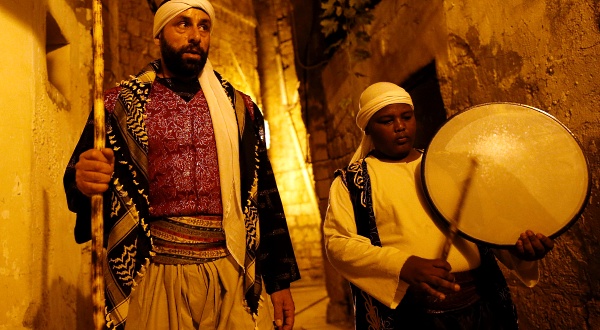
Michel Ayoub’s holy racket begins each day at 2:00 am, when he steps into the cobbled streets of Acre’s old city with tambourine in hand, awakening Muslims for Ramadan.
His role as the city’s “mesaharati” is a traditional one during the sacred fasting month, but Ayoub is by no means a traditional holder of the position: He is Christian.

The 39-year-old Arab Israeli sees no contradiction in that, and neither do the Muslim residents of this ancient city in northwestern Israel, overlooking the Mediterranean Sea.

“We are the same family,” says Ayoub, who wears traditional Levantine dress as he meanders the alleyways, a keffiyeh draped over his shoulders, baggy sirwal pants held around his waist with an embroidered belt, a black-and-white turban tied around his head.

“There is only one God and there is no difference between Christians and Muslims.”

His voice rings out as he chants, piercing the silence of the empty streets decorated with traditional colourful lamps for Ramadan.

“You, sleeping ones, there is one eternal God,” he chants.

Houses begin to light up one by one. Some stick their heads out of their windows to greet him and tell him they have heard the call, awakening them for the “suhur,” the traditional Ramadan pre-dawn meal.

During the holy month, which began on June 5, Muslims abstain from food and drink from sunrise to sundown, making the suhur an important meal before the long day ahead.

– ‘We Would Be Lost’ –

Acre’s population of more than 50,000 includes Jews, Muslims, Christians and Baha’is.

It has been continuously inhabited since the Phoenician period, which began around 1500 BC.

It was the main port of the medieval Crusader Kingdom of Jerusalem and a major Ottoman walled city.

Napoleon tried to conquer the heavily fortified town in 1799 but was repelled by the Ottomans and a small British Royal Navy force.

The walled old city, complete with a well-preserved citadel, mosques and baths, is listed by UNESCO as a World Heritage site.

Today it is part of Israel, which captured it in the 1948 Arab-Israeli war surrounding the state’s creation.

About 28 percent of its population are Arab Israelis, who are Palestinians and their descendants who remained after the 1948 creation of Israel.

Most of the city’s Arabs are Muslims, but a minority, like Ayoub, are Christians.

The mesaharati tradition had disappeared from Acre until Ayoub, who usually works in construction, revived it 13 years ago. He says it was his way to preserve his grandfather’s heritage.

He says his grandfather, a fervent Catholic, listened to readings of the Quran every Friday during the main weekly Muslim prayers.

Partly for that reason, Ayoub says he grew up with the idea of coexistence, respect and knowledge of other religions.

By carrying on the mesaharati tradition, he says he was “only doing my duty by helping our Muslim brothers who endure hunger and thirst” during the fasting month.

Sabra Aker, 19, says she “grew up with Michel Ayoub’s wake-up calls during Ramadan.”

“If he didn’t come one day, we would be lost,” she says through the window of her home.

Safia Sawaid, 36, exits her home to ask if she can take a photo with Ayoub and her children.

“It’s great to see someone so attached to our culture and our traditions,” she says. “I hope that he will continue every year.”

Ayoub may even be grooming a successor to ensure the tradition does not end with him.

Ahmed al-Rihawi, 12, accompanies him on his nighttime mission, wearing sirwal pants, a black vest and a turban.

“He is a promising mesaharati,” Ayoub says. “He is very talented.”

Source: www.huewire.com

Lawmaker Brings Ramadan to His Office, Where ‘You Can’t Hate Up Close’

By BENJAMIN SIEGEL
ABC News

Rep. Dan Kildee worked around the clock when he first ran for Congress in 2012 — a grueling schedule his staff had to match.

So the Michigan Democrat was surprised when he realized that one of his Washington, D.C., staffers, Ghada Alkiek, was keeping up while fasting for the Muslim holy month of Ramadan.

“It’s, like, 18-hour days and, at one point we said we have to try this,” Kildee, 57, said in an interview Monday.

Kildee and several non-Muslim staffers fasted with her for one day of Ramadan that year, not eating or drinking from sunrise to sunset.

They have continued the tradition in Washington, and Kildee’s entire office fasts with Alkiek, now a staff assistant, for one day of Ramadan, a month when adherents strive to purge their sins and cleanse their spirit.

“It’s something we kind of look forward to now,” he said. “It’s a good way to understand one another, to at least take a moment to experience the ritual.”

His staff awoke just before 4 a.m. Monday — the second longest day of the year, Kildee noted — and shared photos of their breakfasts in an email chain that continued throughout the day. Staffers shared words of encouragement and videos about the meaning of Ramadan.

Kildee and Alkiek said the ritual has brought the office closer together.

“We’re counting down the hours together,” she said. “It’s really special to know that your whole team is fasting with you.”

She hosted Kildee’s office at her home Monday evening for “iftar,” with roughly 40 people breaking their fast with dates, soup and a full meal.

For Kildee, who represents the Flint area’s sizable Arab-American community in Congress, the tradition has taken on an added significance during the 2016 election cycle, in which presumptive GOP nominee Donald Trump has called for a temporary Muslim immigration ban and voiced support for profiling Muslims after the San Bernardino, California, and Orlando terrorist attacks.

“You can’t hate up close,” Kildee said of Trump’s “ignorance.”

“When you get to know somebody,” he added, “you realize how similar we are.”

Source: abcnews.go.com

The Muslims Are Coming! The Muslims Are Coming!

By Lawrence Pintak Foreign Policy American Islamophobia is as old as Plymouth Rock. But we’ve never seen anything quite like this before. They are “terrorist savages” and “mongrels,” part of the “rubbish from the desperate and criminal populations of the Third World” who have “backfilled” America. We are talking, of course, about Muslims. It’s the … Continued

American Muslims see Trump rhetoric fuelling prejudice, hate incidents 

Reuters


About three months ago, Sarah Ibrahim’s son came home from his fourth-grade class at a Maryland school with a disturbing question.

“Will I have time to say goodbye to you before you’re deported?” he said, according to Ibrahim, a Muslim Arab American who works at a federal government agency in Maryland.

“The kids in his classroom were saying: ‘Who’s going to leave when Trump becomes president?’” said the 35-year-old mother.

The incident happened a few months after Republican presidential candidate Donald Trump — now the presumptive nominee — first called for a ban on Muslim immigrants and for more scrutiny at mosques after 14 people were killed in San Bernardino by a Muslim couple whom the FBI said had been radicalised.

Trump intensified his anti-Muslim rhetoric after last week’s mass shooting in Orlando, in which a US-born Muslim man killed 49 people at a gay nightclub, calling for a suspension of immigration from countries with “a proven history of terrorism”.

He reiterated his call for more surveillance of mosques and warned that radical Muslims were “trying to take over our children.”

While Democratic and several Republican leaders have distanced themselves from Trump’s comments, many American Muslims say his stance has fuelled an atmosphere in which some may feel they can voice prejudices or attack Muslims without fear of retribution.

“What Trump did was make these hidden thoughts public. He gave people permission to speak out loud, he removed the shame associated with being prejudiced. People know that they won’t be punished,” Ibrahim told Reuters at a community iftar, the sundown meal during the Muslim fasting month of Ramadan.

Trump’s campaign did not respond to Reuters’ request for comment. Trump has rejected the criticism that his rhetoric is racist, and has said he is often misunderstood by the media and his opponents.

A report by the Council on American-Islamic Relations and University of California, Berkeley released on Monday said the number of recorded incidents in which mosques were targeted jumped to 78 in 2015, the most since the body began tracking them in 2009. There were 20 and 22 such incidents in the previous two years, respectively. The incidents include verbal threats and physical attacks.

Corey Saylor, CAIR’s director of the department to monitor and combat Islamophobia, said there had been a spike in Islamophobic incidents in the wake of Orlando, including those targeting mosques.

“Trump’s rhetoric is a direct threat to American principles. He has mainstreamed anti-Constitutional ideas like banning or surveilling people based on faith,” Saylor told Reuters.

“Such divisive rhetoric contributes to a toxic environment in which some people take the law into their own hands and attack people of institutions they perceive as Muslim.”

“DIVIDING THE COUNTRY”

CAIR says the last big spike in incidents targeting mosques was seen in 2010 following the controversy over locating an Islamic centre near the site of the Sept. 11 attacks in New York.

It said that lent “additional weight to the argument that levels of anti-Muslim sentiment follow trends in domestic U.S. politics, not international terrorism”.

American rabbis and preachers have also denounced Trump’s rhetoric. Anti-Semitic incidents in the United States still outstrip those against Muslims. The Anti-Defamation League said last year there were 912 anti-Semitic incidents across the United States during the 2014 calendar year, up 21 percent from 2013.

“If Muslims are not free and safe in America, then Christians and Jews are not free and safe in America,” said Rabbi Eric Yoffie, president emeritus of the Union for Reform Judaism.

Trump has also drawn criticism for his rhetoric against Latino immigrants, saying early in his campaign that Mexican “rapists” and other criminals were coming across the border and calling for all undocumented immigrants to be deported.

Manal Omar, a Muslim-American author based in Washington, said she has stopped taking the metro and walking alone late at night.

“I can’t dismiss the tweets and angry messages I’ve received from right wing militants,” said Omar, who says she has grown especially vigilant after last week’s murder of British lawmaker Jo Cox, whom she knew.

A few days after the San Bernardino attack, Ilhaam Hassan’s family restaurant was burned down in an arson attack in Grand Forks, North Dakota.

Matthew Gust pleaded guilty in May to federal hate-crime and arson charges. He admitted to setting the fire because of the national origin of the employees and customers at the restaurant — a focal point of the local Somali-American community.

“I don’t know what to expect if he (Trump) becomes the president,” Hassan said. “He is against minorities. He is against Islam. It’s not a message of unity, it’s a message of dividing the country and that is not what America is based on.”

Source: thehimalayantimes.com

How One Queer Muslim Activist Combats Islamophobia After Orlando

BY ORIE GIVENS
Advocate.com

Mirna Haidar sounds exhausted but determined. And she and her community of LGBT and allied Muslims are overwhelmed, both personally and as a group of people working to represent for themselves in the face of Islamophobia while in solidarity with fellow communities in grief. And it’s the holiest month on the Islamic calendar, Ramadan, a time for fasting, reflection, and study.

“So many things are frustrating about this,” Haidar, a board member for the Muslim Alliance for Sexual and Gender Diversity, tells The Advocate. “It’s taking a lot away from us and moving us backward instead of forward.” 

She’s volunteered to be a spokeswoman for the organization, to ensure that the media narratives are fair concerning queer Muslims and the Muslim population in general. This is a job that, sadly, must be done each time someone of Arab origin commits a criminal act.

As an advocate for LGBT people and a gender-nonconforming Muslim, Haidar would rather be supporting the victims and the communities she feels are most vulnerable.

“I blame Islamophobia,” Haidar says as she bikes to another vigil across New York City. “It’s distracting us from the real problems we need to deal with … trans Latina lives, access to guns in the country, and lack of access to mental health for people of color.”

Islamophobia comes from a lot of places. At a rally, when she was trying to show solidarity and speak for her community, a heckler screamed at her. The commotion interrupted her speech, but the crowd shut the heckler down with chants of “No hate.” 

Haidar wants to counter not only the media narrative that erases or others LGBT Muslims but also the mainstream’s resistance to respecting the intersectionality and existence of LGBT Muslim identities. The speeches, reports, memes and social media posts after the Orlando massacre have only intensified her effort to affirm that Muslim doesn’t equal terrorist. 

“When the United States is dealing with this horrible thing, we’re focused on the language of extreme jihadism or extreme Islamism, rather than focusing on the root problem,” says Haidar, who works with the Arab American Association of New York as well as on MASGD’s steering committee. “That’s what Islamophobia is doing, it’s distracting us from the real problems we should be dealing with.” 

National conversation about gun control is being detoured by Islamophobia. In one of his speeches on Orlando, for example, President Obama dedicated most of his time to touting the effectivness of his strategy to combat ISIS and railing against the anti-Muslim rhetoric of Donald Trump and his supporters.

“We want to be able to comfort people and say, ‘Oh, this is the problem — we identified it as this whole one body that is alien to us and we attack it,” says Haidar. She adds, “I hope we can really remember not to treat hate with more hate.”

Source: www.advocate.com

464 Results (Page 19 of 39)