Advertisement Close

Religion

Obama Issues Ramadan Message as Muslims’ Holy Month Begins
Marissa Melton
Voice of America

President Barack Obama has issued his annual Ramadan greeting as Muslims around the world are preparing to observe the holy month, which is expected to begin late Sunday or Monday, depending on the first sighting of the new moon.

“As Muslim Americans celebrate the holy month,” he said in a statement issued by the White House, “I am reminded that we are one American family. I stand firmly with Muslim American communities in rejection of the voices that seek to divide us or limit our religious freedoms or civil rights.”

Obama urged Americans to remember the millions of people whose lives have been displaced by conflict and struggle across the world.

Muslims are expected to spend the month fasting during daylight hours, eschewing even water, and spending more time in prayer and study of the Quran. They are supposed to avoid bad habits and indulgences, such as smoking and sex.

Cultural differences and even geography have led to differences in the ways Muslims observe the holy month. Fasting during daylight hours has proven difficult for people living near polar regions during the long days of the summer. Muslim clerics have in the past few years issued fatwas allowing Muslims in regions where the sun does not set in summer — or, when Ramadan falls in winter, where the sun does not rise — to follow the sunrise and sunset times of Mecca.

Like their fellow worshippers around the world, Muslims in the United States are watching the skies and preparing for the holiest month.

Jibril Hough, spokesman for the Islamic Center of Charlotte, North Carolina, says Ramadan is different in the United States than in countries with larger Muslim populations.

Hough says because there are fewer Muslims in the United States, Ramadan is a time to gather at the mosque with fellow believers, rather than at home, as the faithful might do elsewhere.

“The Ramadan experience is more collective,” he says. “We are a religious minority in America and …  especially toward the end of Ramadan, we bring food to the masjid (mosque), it becomes more like a family reunion. A lot of times you see brothers and sisters that you haven’t seen all year.

Like most Muslims, Hough continues to work during Ramadan, which is challenging when one’s job is physically demanding and the North Carolina summer is in full swing.

It is also not easy to explain to his non-Muslim coworkers why he can’t have a drink of water when he gets thirsty. But he says his religious commitment makes the sacrifice worth it.

“You know you have to do it,” he says. “God has commanded you to do it. That’s half the battle right there. A lot of it is mental.”

Different paths

Even among U.S. Muslims, there are different paths toward the same goal. Amani Elkassabany, a teacher in Bethesda, Maryland, says she has modified her fasting practices over the years.

Elkassabany says fasting all day can make a person too focused on breaking the fast at the end of the day, and result in overindulgence after sundown — a practice Muslim writings discourage.

“Recently, I’ve tried to observe what is best about the fast without following it to the letter,” she says. “So this year, I won’t be not eating or drinking from sunrise to sunset. But I will be eating only two meals a day instead of three.

“I will stop eating meat, poultry, and dairy products for ethical, health and environmental reasons. I will seek out opportunities to build spiritual community with others. I will work on building more compassion and kindness into all my interactions with others,” Elkassabany says.

Building spiritual community is an important part of the observance of Ramadan, Hough says. And not just among the faithful.

During the evening “iftar” meal after sunset, some mosques open their doors to non-Muslims, who are invited to come and eat, to observe or participate in prayers, and to engage in conversation.

Open house

The open house idea is one way to help allay people’s fears about Islamic extremism. French mosques opened their doors in January for a weekend-long event after the November 13 attacks in Paris.

One might expect that Ramadan observers would be relieved when the month of fasting and discipline is over. But Hough says it is a little bittersweet.

“Even though you’re glad you can eat and be more leisurely, it’s like a family member has been visiting you for the last month and you’re sad that the visit is over,” he says.

But Hough says he tries not to let everything slip away. “Coming out of Ramadan, you try to hold on to some things you gave it. Hold on to the good habits.”

Source: www.voanews.com
9 questions about Ramadan you were too embarrassed to ask

  A Palestinian man decorates his shop with fairy lights in the old city of Jerusalem on June 3, 2016, as Muslims around the world prepare for the announcement of the fasting month of Ramadan.AHMAD GHARABLI/AFP/Getty Images Jennifer Williams Vox.com The Muslim holy month of Ramadan starts this week, and most of the world’s 1.6 … Continued

Q&A: What Is Ramadan and Why Do Muslims Fast All Day?

Associated Press


Millions of Muslims around the world on Monday marked the start of Ramadan, a month of intense prayer, dawn-to-dusk fasting and nightly feasts. Others will begin fasting a day later, Tuesday, due to a moon-sighting methodology that can lead to different countries declaring the start of Ramadan a day or two apart.

Here are some questions and answers about Islam’s holiest month:

___

WHY DO MUSLIMS FAST?

The fast is intended to bring the faithful closer to God and to remind them of the suffering of those less fortunate. Ramadan is a time to detach from worldly pleasures and focus on one’s inner self.

It’s seen as a way to physically and spiritually purify, refraining from habits such as smoking and caffeine. Muslims often donate to charities during the month and feed the hungry. Many spend more time at mosques during Ramadan and use their downtime to recite the Quran.

London’s new Muslim mayor, Sadiq Khan, wrote in the Guardian that he plans to use Ramadan to “build bridges” and break bread with Muslims and non-Muslims around the city at synagogues, churches and mosques, though he acknowledged that 19-hour-long fasts during the longer summer days in Europe and forgoing coffee will be challenging.

Fasting during Ramadan is one of the five pillars of Islam, along with the Muslim declaration of faith, daily prayer, charity, and performing the hajj pilgrimage in Mecca.

___

HOW DO MUSLIMS FAST?

Observant Muslims abstain from eating and drinking from dawn to dusk for the entire month of Ramadan. A single sip of water or a puff of a cigarette is enough to invalidate the fast.

However, Muslim scholars say it’s not enough to just avoid food and drinks during the day. Ramadan is also an exercise in self-restraint. Muslims are encouraged to avoid gossip and arguments. Sexual intercourse between spouses is also forbidden during the daytime fast.

Just before the fast, Muslims have a pre-dawn meal of power foods to get them through the day, the “suhoor.” Egyptians eat mashed fava beans called “ful,” spiced with cumin and olive oil, while in Lebanon and Syria, popular suhoor food is flatbread with thyme, cheese or yogurt. In Afghanistan, people eat dates and dumplings stuffed with potato and leeks, first steamed, then fried.

___

HOW DO MUSLIMS BREAK THEIR FAST?

Muslims traditionally break their fast like the Prophet Muhammad did some 1,400 years ago, with a sip of water and some dates at sunset. That first sip of water is the most anticipated moment of the day.

After sunset prayers, a large feast known as “iftar” is shared with family and friends. Iftar is a social event as much as it is a gastronomical adventure. Across the Arab world, apricot juices are an iftar staple. In South Asia and Turkey, yogurt-based drinks are popular.

Every night of Ramadan, mosques and aid organizations set up tents and tables for the public to have free iftar meals.

But large crowds at mosques can also be targets for extremists. As the war with the Taliban intensifies, Afghan and U.S. military officials have said they expect attacks to increase during Ramadan. Nigerian intelligence officials also say the extremist Boko Haram group plans to attack Muslims during morning and evening prayers.

___

CAN MUSLIMS BE EXEMPTED FROM FASTING?

Yes. There are exceptions for children, the elderly, those who are ill, women who are pregnant, nursing or menstruating, and people traveling, which can include athletes during tournaments.

Many Muslims, particularly those living in the United States and Europe, are accepting and welcoming of others around them who aren’t observing Ramadan.

However, non-Muslims or adult Muslims who eat in public during the day can be fined or even jailed in some Mideast countries, such as Saudi Arabia and the United Arab Emirates, which is home to large Western expat populations in Dubai and Abu Dhabi. In many predominantly Muslim countries like Indonesia, karaoke bars and nightclubs are closed across much of the country for the month. Restaurants there use curtains to conceal customers who eat during the day.

And in Egypt, the Dar al-Ifta, which is the main authority in charge of issuing religious edits, on Monday warned against eating in public, saying this is not an act of “personal freedom, but chaos — an assault on Islam.”

In China, minority Uighur Muslims complain of heavy restrictions by the Communist Party, such as bans on fasting by party members, civil servants, teachers and students during Ramadan, as well as generally enforced bans on children attending mosques, women wearing veils and young men growing beards.

___

WHAT ARE SOME RAMADAN TRADITIONS?

Typically, the start of the month is welcomed with the greeting of “Ramadan kareem!” Another hallmark of Ramadan is nightly prayer at the mosque among Sunni Muslims called “taraweeh.”

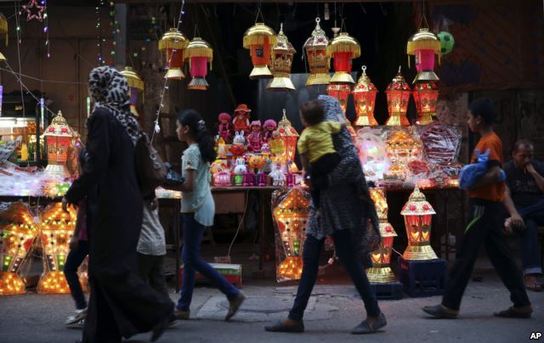
Egyptians have the tradition of Ramadan lanterns called the “fanoos,” often the centerpiece at an iftar table or seen hanging in window shops and from balconies. In the Arabian Gulf countries, wealthy families hold “majlises” where they open their doors for people to pass by all hours of the night for food, tea, coffee and conversation.

Increasingly common are Ramadan tents in five-star hotels that offer lavish and pricey meals from sunset to sunrise. While Ramadan is a boon for retailers in the Middle East and South Asia, critics say the holy month is increasingly becoming commercialized.

Scholars have also been disturbed by the proliferation of evening television shows during Ramadan. In Pakistan, live game shows give away gifts promoting their sponsors. In the Arab world, month-long soap operas starring Egypt’s top actors, rake in millions of dollars in advertising.

___

HOW DO MUSLIMS MARK THE END OF RAMADAN?

The end of Ramadan is marked by intense worship as Muslims seek to have their prayers answered during “Laylat al-Qadr” or “the Night of Destiny.” It is on this night, which falls during the last 10 nights of Ramadan, that Muslims believe that God sent the Angel Gabriel to the Prophet Muhammad and revealed the first versus of the Quran.

The end of Ramadan is celebrated by a three-day holiday called Eid al-Fitr. Children often receive new clothes, gifts and cash.

Muslims attend early morning Eid prayers the day after Ramadan. Families usually spend the day at parks and eating — now during the day.

Source: www.nytimes.com

Western designers court Arab clientele with Ramadan collections

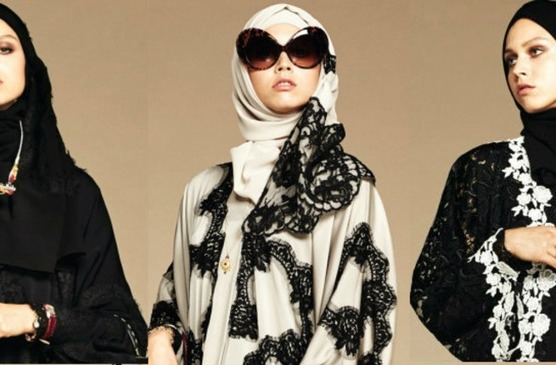
Dolce and Gabbana launched their first abaya collection in January 2016 and have released their second collection for Ramadan. 


By Jamilah Halfishi

Albawaba 

Several Western designer houses are clashing in their trials to attract the Arab client before the start of the Ramadan month, but fail to understand Arab’s shopping needs, and only look at these clients’ capacities to spend large amounts of money on daring accessories and expensive products.

In Great Britain and every year during this period, designers get prepared for Arab clients by offering new products and getting rid of the old, before their arrival in the summer.

There are some designer houses that understand, or at least understand the culture of their Arab client whose need for shopping increases during the month of Ramadan due to women’s need for elegant clothes and accessories 

These houses are now targeting the client in his own ground, by offering a unique collection specially designed for the month of Ramadan. Such attempts witness an acceptable success, because the designs often respect the eastern milieu and the Ramadan spirit, and at the same time, offer women new choices, instead of providing designs that only look at financial profits.

In other terms, many Arab women saw nothing different in the abayas designed by Dolce & Gabbana from the ones already made by Arab designers. The mistake of Dolce & Gabbana was their interest in iconic pieces with deep cultural meanings, that could only be understood by people living in this region or orientalists who had spend years studying Arab culture.

Such mistake drove Burberry fashion house to take a totally different policy by using a more simple language in dealing with the Arab client. The British fashion house decided to celebrate the opening of its immense shop in the U.A.E. last April with its traditional iconic trench-coat, by photographing leading Arab figures, wearing it, each in its own way.

Burberry also offered a unique collection ahead of the month of Ramadan, without referring to the abayas or caftans to reach Arab women’s wardrobe, but, instead, it kept its style as a British designer brand by respecting the Arab environment and the spiritual milieu of Ramadan.

Burberry Creative Director Christopher Bailey suggested a collection of long evening dresses, in addition to silk scarfs, stone embellished sandals, and expensive leather handbags, all designed in London and produced in Italy in small quantities.

In the month of Ramadan, Burberry and other designer houses discovered the increase of selling in the region. Therefore, some of these brands knew how to please their clients by offering modern styles that could be appreciated by Arab women rather than using traditional Arab pieces to reach Arab clients’ pockets.

Source: www.albawaba.com

Art Can Combat Islamophobia

By Anisa Mehdi Islamic Monthly “It’s important for mainstream Americans to hear Muslim voices,” says Omnia Hegazy, a singer-songwriter. Hegazy is not talking about political commentary, debunking Donald Trump or how some Muslims try to explain away the horrors of Daesh; she is talking about artist voices. With her acoustic guitar and bluesy lyrics backed up … Continued

WhoIsHussain? Hosting a Hot Meal for Homeless in Detroit

Press Release from WhoIsHussain? In honor of the holy month of Ramadan, international organization, Who Is Hussain?, plans a hot meal lunch for the homeless at Cass community services on Saturday, June 11, at 12pm at 11850  Woodrow Wilson, Detroit, Michigan. Ramadan marks days of fasting from sunrise to sunset. The month is celebrated by Muslims giving to the needy … Continued

The Citadel rejected her hijab, but another military school embraces Muslim student’s request

By Susan Svrluga 

The Washington Post

Norwich University, a nearly 200-year-old private military college in Vermont, has granted an accepted student’s request to wear hijab in keeping with her Muslim faith, a decision that was welcomed by some but also provoked outrage for some alumni and cadets.

The same student requested a similar exception to the required uniform from The Citadel, touching off a highly charged debate at the public military college in South Carolina where loyalty to the corps is a fundamental value and individual preferences are set aside to encourage unity. The idea that the first exception might be for a Muslim student was particularly polarizing, given the national discussion and starkly divergent views about the role of Islam in U.S. culture.

The Citadel denied her request.

It was the first formal request for a religious accommodation to the uniform at Norwich, spokeswoman Daphne Larkin said, so they reached out to peer institutions “and came to the conclusion that it makes sense for Norwich to continue to be dynamic in how we serve our students.”

“Regardless of their spiritual or religious affiliation, all students and employees should feel welcome and comfortable at Norwich University,” Norwich President Richard Schneider wrote in announcing the exception to the required Corps of Cadets uniform. “Norwich University is a learning community that is American in character yet global in perspective.”

Jewish cadets will also now be allowed to wear a yarmulke.

[Not just a head covering: The Citadel may be considering other exceptions for accepted Muslim student, cadet says]

Ibrahim Hooper, a spokesman for the Council on American-Islamic Relations who has worked with the student and her parents, said, “She wants to go to The Citadel. But without the religious accommodation which now has been denied, she needed a backup plan to attend a university in the fall.  Now that she has obtained that accommodation at another school, that opens up the possibility of her going there if The Citadel decision is not changed.” Hooper has said in the past that a lawsuit challenging that decision is possible.

Of the Norwich decision, he said, “It’s just a clear indication that this is not some real problem for a military college. That this college can grant an accommodation and seems to have no problem with it, there’s no reason The Citadel can’t. …

“It’s clearly not a matter of good order, good discipline… just a matter of stubbornness and unwillingness to accommodate our changing and increasingly diverse society.”

On the response to Norwich’s decision, Larkin said “those who are in the position to lead generally are giving a more positive response.”

Some alumni were quite upset. “It’s the first private military academy” in the country, said Spencer Jacobs, who just graduated from a place that has been abiding by “the same guiding values for the last 200  years. The fact that this is changing right now is totally crazy.

“We have a common goal: Allegiance to the Corps of Cadets. …  You have to live by the Norwich founding values. We encourage service to the nation and to others before ourselves. We put our uniformity before our self and work as a team.”

Jacobs, who was raised Jewish and converted to Christianity, said he respects the student’s religious convictions and her desire to practice her faith, and he respects the decision of the commandant. He loves Norwich, which he said taught him leadership, courage, honestly and selflessness. “But if you allow one person to come in and wear the hijab I’m sure anyone can come in and request any kind of accommodation.”

The university has a civilian program, he said, but those who elect the challenge and unity of the Corps of Cadets arrive on campus with little other than a few pairs of white boxers, white T-shirts and socks. “If you have a cross outside of your uniform you’re out of uniform…. Everyone is supposed to look the same because everyone is the same. Everyone is treated the same.”

Benjamin Polizotti, who attend Norwich for his undergraduate and graduate education, designed a multicultural center in Boston for his master’s thesis for the architecture degree he just received; “I’m all for diversity, all for coexistence, all for equality among all people,” he said. “… But my overall stance is the military is not a social experiment. It serves a single purpose – to ensure the safety and freedom of Americans and humans around the world. Norwich is no exception. It’s an asset to the U.S. military. Its job is to train responsible and capable leaders, not to cater to special interests.”

Allowing one exception will inevitably lead to more, he said. “It’ll start to spiral out of control … eventually people will say, ‘I don’t want to wear the uniform because it’s uncomfortable, or infringes on my right to express myself.”

Arriving on campus is like basic training, he said. “It strips one of individuality in order to promote being part of a dynamic team. It instills service before self as a guiding value of Norwich University. Camaraderie and cohesiveness, in my opinion, are the two traits that bind the team together. And individuality is corrosive to those values. This isn’t an argument against Islam or wearing a hijab. It’s all cultures, Judaism, Christianity, Hinduism, Buddhism. The reason everyone in the military and at Norwich wears a uniform is everyone is equal – everyone is the same – and everyone is part of something bigger than themselves.

“I don’t think that’s an infringement on their right to practice their religion because no one is forcing them to join the Corps of Cadets or the ranks of the U.S. military.”

Fathia Mohammed, a rising junior at the Virginia Women’s Institute for Leadership at Mary Baldwin College who wears hijab with her uniform, said she was shocked to learn that most military colleges had not granted such accommodations. “In my opinion it’s not just an Islam thing, it’s religion in general… I feel there should be an exception for a person sincerely wants to practice their religious belief — because they are citizens, after all, too.”

Here is the full letter from the Norwich president:

Norwich University received a letter requesting religious accommodations with respect to the Norwich University Corps of Cadets uniform from a female student accepted into the Corps of Cadets and the Class of 2020.

Her request to the Commandant of the Corps of Cadets specifically addressed a religious accommodation to observe the hijab, a broad term that defines modest dress by Muslim women. She requested the University’s permission to wear religious head covering to cover her hair and neck at all times in uniform, and for uniform accommodations that would enable the covering of her arms and legs.

Norwich University granted the student’s request for religious accommodations respective to the Corps of Cadets uniform and will amend the Corps of Cadets Standard Operating Procedures to permit her observation of the hijab. The student has been advised that the religious headgear, in authorized colors and fabrics, must be of a style and size that can be covered by standard issue Corps of Cadets headgear and that she may wear Norwich issued long sleeve shirts and pants.

Norwich is not the first senior military college to grant such a religious accommodation respective to a uniform. The Corps of Cadets Standard Operating Procedures will also be amended to permit the observation of the yarmulke.

The Corps of Cadets at Norwich University places a high value on the rights of its cadets to observe tenets of their respective religions or to observe no religion at all. Our cadets come from all walks of life. Regardless of their spiritual or religious affiliation, all students and employees should feel welcome and comfortable at Norwich University.

Norwich University is a learning community that is American in character yet global in perspective. Our country and our institution are dynamic. As educators of future leaders, it is our duty to matriculate a diverse student body that reflects our society. Norwich prepares traditional students and the young men and women of our Corps of Cadets to welcome and respect diversity and to be inclusive of all people.

Norwich Forever,
Richard W. Schneider
RADM, USCGR (Ret.)
President

Source: www.washingtonpost.com

Scores rally against Islamophobia in Houston Texas

By Fabian Van Onzin 

Fight Back! News

Houston, TX — On May 21, right-wing groups attempted to intimidate the Muslim community in Houston by holding an armed rally outside of the Islamic Daw’ah Center. The fifteen white supremacists displayed racist symbols, including the confederate flag, and chanted racist and anti-Muslim slurs. However, scores of people came out to fight back and confront the white supremacists’ message of hate and fear.

Over eighty people showed up to protest the white supremacists Islamophobic hate speech. Arab-Americans, Chicanos and progressive white activists joined together to defend Muslim Americans. The activists guarded the Islamic Daw’ah Center so that the Islamophobes could not get near the building. A huge line of cops stood between the white supremacists and the protesters. The chants of the Center’s defenders could be heard for blocks, “When Muslims are under attack. What do we do? Stand up fight back!” and “Islamophobes go home!”

Angelica Hernandez with the Freedom Road Socialist Organization said, “Wall Street, Trump, and his fascist supporters promote Islamophobia at home in order to wage their imperialist wars abroad. They create fear of the Muslim community in order to get the public to support their wars. These wars have one purpose, and one purpose alone: to expand US imperialist hegemony in the Middle East and gain access to new markets. To oppose Islamophobia is to oppose US imperialism and stand with oppressed peoples in their struggle for liberation”.

Ian Cox, with Students for a Democratic Society, said, “Islamophobia is designed to strengthen the State of Israel, which only exists so that the US can continue its wars and domination in the Middle East. These fascist crooks across the street are no different than the Zionists in Israel who create fear of the Palestinian people in order to legitimate their occupation.”

Source: www.fightbacknews.org

464 Results (Page 22 of 39)