
Subscribe
to receive news by email

Poll
Will the Trump Administration Shift U.S. Policy in Favor of Palestine?
- No (87%)
- Yes (13%)
 Loading ...
Copyright © 2026 Arab America
Go topChe Guevara’s Relation to the Arabs
By: Taim Al-Faraje / Arab America Contributing Writer
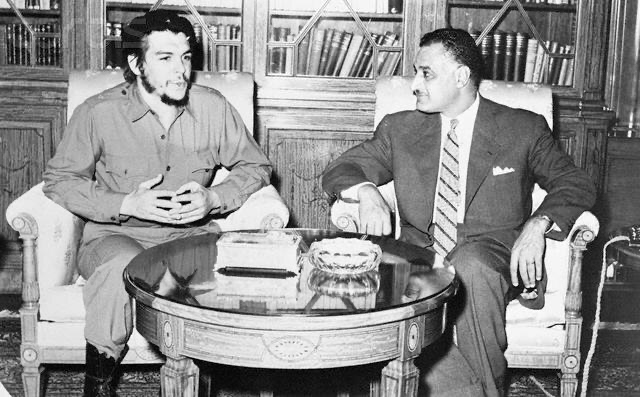
“The final hour of colonialism has struck and millions of inhabitants of Africa, Asia, and Latin America rise to meet a new life and demand their unrestricted right to self-determination.” The name Che Guevara struck terror into the hearts of Western leaders, frightened by his breathtaking ability to rally and inspire people to rise up against injustice, similar to that of Jamal Abdel Nasser of Egypt. Although alarming to the West, he was loved by the East- those who often were fighting the imperial West. His country, Cuba, of which he led the 1953-1959 struggle and became the subsequent President of the Ministry of Industry, maintained good relations with many groups in the East, including the Soviet Union, China, and most importantly for the topic of this paper, the Arabs.
Guevara, like other revolutionary Socialists, believed anti-imperialist struggles didn’t stop at the liberation of one’s own people. If one man is chained and enslaved, then every man is chained and enslaved, and the free man must take responsibility to unchain and free him. It was for this reason that Guevara held high views of the revolutionary Abdel Nasser and the Free Officers of Egypt, and supported the Arabs in their anti-imperialist struggles. This led to the eventual visit to Egypt, Syria, and the Egyptian-administered Gaza Strip, made by Guevara in 1959, months after he and Castro officially took over rule of Cuba.
Guevara’s visit to the Arab World
In 1959, Che Guevara visited the leading countries of 1950s Arabism, Syria and Egypt. The most substantial area he visited was the Gaza Strip for several reasons. His trips to Syria and Egypt, although of major importance due to the successive growth in legitimacy of the Arab struggle against imperialism, were not of the same level of significance. The principal reason was that much of the international community hadn’t firmly taken a side on the Palestine issue and instead followed whichever side of the Cold War they belonged to. Western aligned countries sided with the Western aligned Israeli state, and Eastern or non-aligned countries backed the Palestinians and their cause, viewing it as an anti-colonialist struggle.
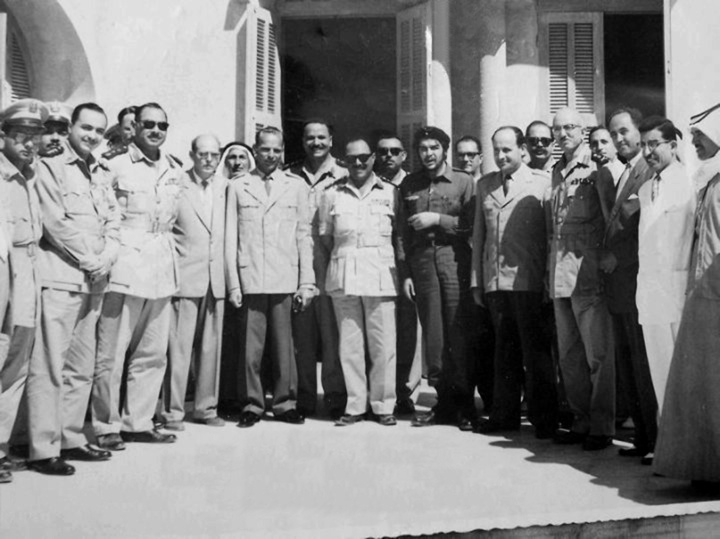
However, Guevara’s visit changed the worldwide view of the Palestine issue. Rather than blindly following a side, people and governments from countries in Asia, Africa, and Latin America became attentive to Palestinian affairs. Not only did it secure Cuban support, it reached the hearts of those worldwide- particularly his visits to refugee camps while in Gaza. Seen as the representation of anti-imperialist armed struggle worldwide, he gave hope to the East to persist through their struggles.
Furthermore, Guevara’s visit impacted the Palestinians, inspiring many within Palestine to advance their struggle. He reportedly met with Palestinian Fedayeen, or guerrilla fighters, to pledge his support and encourage them to keep going. For the Palestinians, it was inspiring to see such a renowned and important figure, known internationally for being a beacon of light in the darkness of resistance, supporting their endeavor. They now knew what they were encountering wasn’t impossible to overcome, as they had now seen the proof in front of their eyes; although it may have seemed that way before.
Cuba’s Support to the Arabs During the Arab-Israeli Wars.
During the 1967 Arab-Israeli War, Cuba supported the Arabs, although the war was over within just a number of days. This left the Cubans unable to send physical support to the Arabs during the War. However, immediately after the war concluded, Cuba offered military support to the Arabs if they chose to continue fighting. They also sent advisors and pilots to Egypt during the War of Attrition, aimed at regaining the Sinai after the Arab defeat. Although they had been ramping up their support for the Arabs before the war, it was these events that really made Cuba pro-Arab bloc.
In 1973, Algeria held the 4th Summit of the Non-Aligned Movement (NAM). At this point, an overwhelming majority of NAM countries supported the Palestinian cause and supported UN Resolution 194, calling for the right to return home for Palestinian refugees. Held in September, just a month before the October Arab-Israeli War, Cuba completely severed ties with Israel for the first time in their history. Although not publicly confirmed, this could’ve been in preparation for a perceived Arab-Israeli aggression, as at this point, the leaders of Egypt and Syria made it clear that 1973 would be the year for war. Once the war started on October 6, Cuba sent numerous troops and aid, in part leading to a win for the Arabs in the Final Arab-Israeli War.
Modern Day Cuban-Arab Relations
In recent years, Cuba has remained a close partner to the Arab states. This is characterized by their increased trade with the UAE, tourism and health agreement expansions with Egypt, and the hosting of Sahrawi students to study in Cuban universities. They continue to advocate for Palestinian sovereignty in the UN and condemn Israeli aggression and illegal actions.
Want more articles like this? Sign up for our e-newsletter!
Check out our blog here!