
Subscribe
to receive news by email
Poll
Will the Trump Administration Shift U.S. Policy in Favor of Palestine?
- No (86%)
- Yes (14%)
 Loading ...
Copyright © 2026 Arab America
Go topCouscous: A Unifying Yet Dividing Dish of the Maghreb
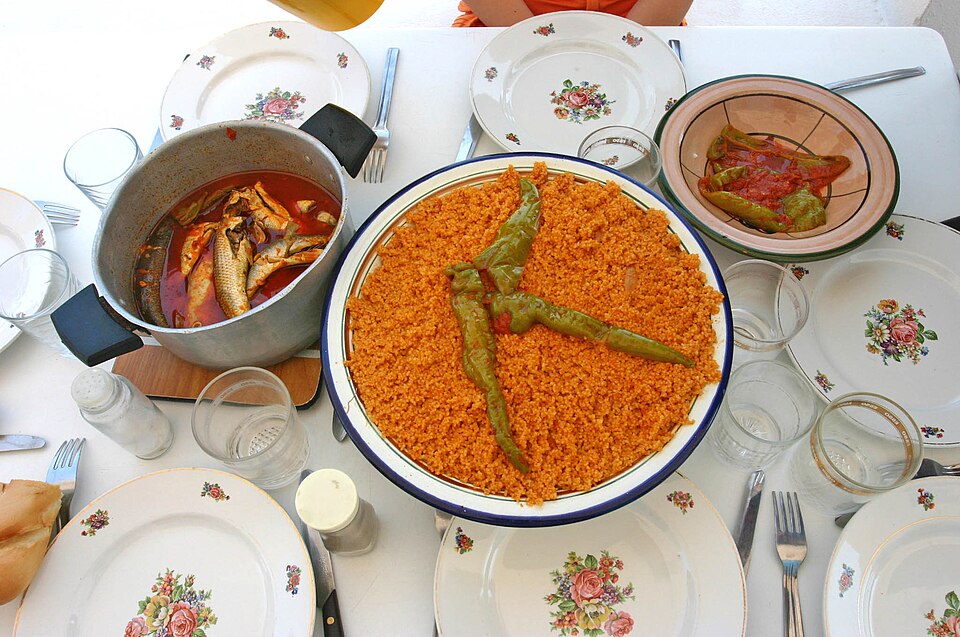
Photo Credit: Wikicommons
By: Nadia Boughanmi / Arab America Contributing Writer
Couscous is infamously linked to the Maghreb region of North Africa, that includes Morocco, Algeria, Tunisia and Libya. All 4 of the countries have variations of the dish and have couscous as one of the key dishes of their cuisine. To the outside regions, couscous seems like an invisible string tying the cuisines of the region together. However, to North Africans a “simple” dish creates a rocky division.
From the origins of couscous to what elements actually belong in the dish, there have been divisions over this throughout the region for decades. Morocco and Algeria have tensions over which country can claim “ownership” of the dish. While Tunisians and Libyans are questioned for the addition of fish to their couscous.
Divides over Origin
For decades, Moroccans and Algerians have bickered over which country is the origin of the dish. Moroccans claim that it is a traditional dish of the Amazigh people. Algerians also claim the dish as a part of their tradition and identity. It may seem as if it is a simple “dispute” over a culinary dish, but cultural foods run deep into the identity and traditions of the Maghrebi region. The clash over couscous is not just a cultural aspect, but also a diplomatic one, as Algeria attempted to register couscous as exclusive to its cultural heritage under UNESCO.
This sparked rage across the region. Morocco became enraged because they claim the origin of couscous, while Tunisia and Libya remained upset due to couscous being a staple in both countries. The countries have a long history of accusations of misappropriating shared customs, so couscous is just one of many diving issues.
It has remained difficult to “reward” one country with making couscous because of the variations and differing traditions that have made up the dish. Algeria, Morocco, Tunisia and Libya all have unique variations to make the dish equally as delicious and tailored to the taste buds of the people. To ease further tensions, the Maghreb and Mauritania registered the consumption and making of couscous as shared heritage and customs of the broader region.
What “Makes” Couscous
From the size of the couscous grain to the meat placed on top, tensions about what “make” couscous are very alive in the Maghreb region. There are heavy conversations and debates in the region on whether fish belongs in couscous. Moroccans and Algerians stand in opposition to fish on couscous, typically using lamb. While Tunisians and Libyans are “teased” for their fish couscous dishes. Tunisia and Libya also have spicy couscous cooked in a red sauce which raises eyebrows to Moroccans and Algerians, who have a savory-sweet dish cooked in a “clearer” sauce.
Looking at a breakdown of what “makes” each country’s couscous, there is a lot more similarity than the divide makes it seem. The usage of semolina based grains, chickpeas, carrots and cabbage are a tradition throughout all 4 nations. The dish itself brings unity through similarity, but the individual countries create a divide over which is the “right” or “original” way of preparation.
The Key to Each Country’s Couscous
Morocco: Moroccan couscous is known for using slightly bigger grains than the rest. The grains are then typically cooked and flavored with a hint of saffron. Lamb is typically the meat of choice, slow cooked to perfection to be placed on top. It is then layered with chickpeas and seven vegetables, typically carrots, zucchini and cabbage.
Algeria: Algerian couscous tends to have much finer grains. It is then served with stew called marqa, which is a hearty almost clear in color stew. Like Morocco, lamb is the typical meat of choice on top of Algerian couscous. Carrots, chickpeas, cabbage, zucchini, potatoes and onions are typically cooked in the marqa and served on top of the couscous grains.
Tunisia: Tunisian couscous uses a medium sized grain, between the sizes of the Algerian and Moroccan grains. Tunisian couscous varies from the previous two with the sauce being spicy and red in color. It features harissa, a spicy pepper paste that is used in almost every Tunisian dish. What makes Tunisian couscous unique is that lamb isn’t the only popular meat of choice, fish is also widely used. Similar to Algerian couscous though, it is topped with carrots, chickpeas, cabbage, potatoes and onions. The addition of pumpkin is also extremely popular in the country.
Libya: Libyan couscous uses a medium sized grain, similar to Tunisian couscous. It features a 5 spice mix called hararat, which consists of cinnamon, coriander, cumin, cayenne, and allspice, as well as tomato paste for the sauce. Like Algeria and Morocco, lamb is the most popular meat of choice. However, just like Tunisia, Libya also features a fish couscous and pumpkin in the vegetable mix. It is then topped with carrots, chickpeas, cabbage, potatoes and onions.
Want more articles like this? Sign up for our e-newsletter!
Check our blog here!