

Subscribe
to receive news by email

Poll
Will the Trump Administration Shift U.S. Policy in Favor of Palestine?
- No (86%)
- Yes (14%)
 Loading ...
Copyright © 2026 Arab America
Go topThe Arab Vote Could Reshape Israel’s Political Future
By: Ghassan Rubeiz / Arab America Contributing Writer
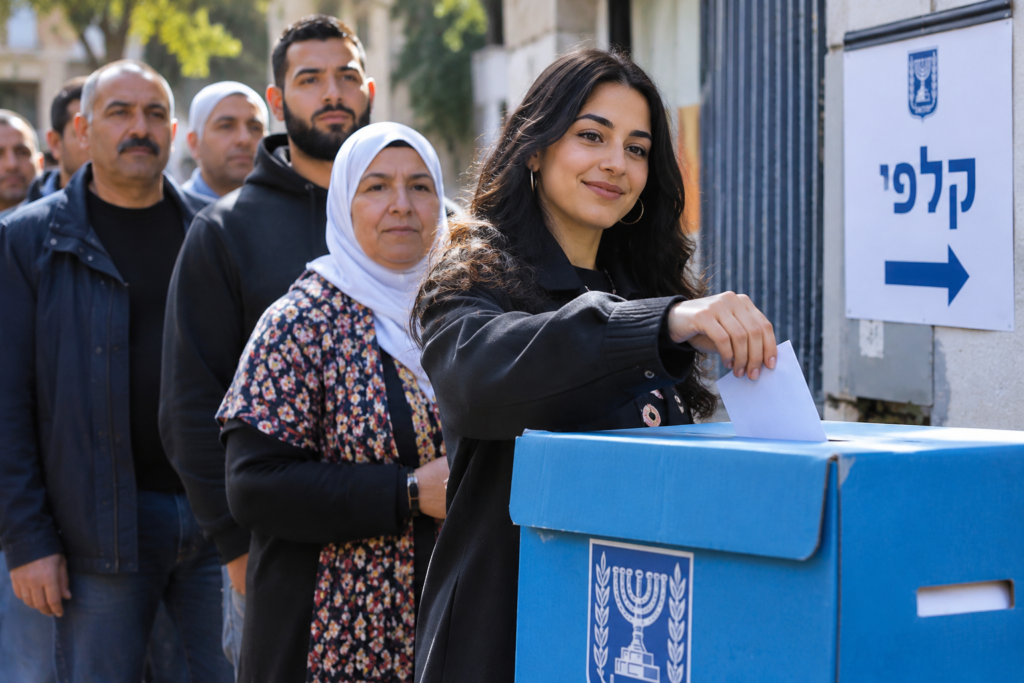
What matters most in Israel’s October 27 election may not be the identity of the next prime minister or the shape of the next coalition. It is the rise of Arab electoral activism, a new force in Israeli politics and, potentially, a new path out of a frozen conflict.
Palestinian citizens of Israel voted in record numbers, and their parties helped make Gadi Eisenkot prime minister-designate. The morning after the vote, Joint List chairman Yousef Jabbareen called his alliance a “large, strong list that cannot be ignored.” He was right.
The message differs sharply from that of October 7. The attacks deepened fear and distrust. The vote pointed toward a more inclusive future. It reminded Israelis that ballots can speak louder than bullets.
Whether Arab parties will join a coalition cabinet remains uncertain. Netanyahu is now a caretaker prime minister, but the divisive climate he cultivated lingers. Many Jewish Israelis remain uneasy about Arab participation in national decisions after a devastating war and in response to a perceived demographic threat. Eisenkot’s bloc has set conditions for Arab participation in the planned cabinet: acceptance of the legality of a Jewish state, military conscription for all, and Hamas to be treated as a terrorist group. As I argued in last week’s column, Arab parties have offered concessions that could satisfy Eisenkot, but they do not satisfy Avigdor Liberman, head of Ysrael Beiteinu party – who is in Eisenkot’s coalition. Eisenkot may therefore turn to the ultra-Orthodox parties, or even to a national unity government with Likud. Either way, Arab parties could remain outside the cabinet.
Yet even outside the government, Arab citizens have achieved something significant. They have shown that elections work to some extent, and that they can no longer be counted out. Many even voted to choose between the “bad and the worse”.
Demography and resilience matter. Arab citizens make up about one-fifth of Israel’s population. For decades, they expressed resilience by staying on their land and preserving their identity. Increasingly, they express it through organized political participation.
It is no longer reprehensible to vote. Many Palestinians once viewed Israeli elections with suspicion, arguing that participation legitimized an unjust order. Today, more see the vote not as an endorsement of the system but as leverage to change it.
Voting starts a process. If Arab participation stays high, future governments will find Arab parties difficult to ignore. Their influence may reach beyond parliamentary arithmetic, opening debates on citizenship, equality, representation, and the character of the state, while strengthening those who resist prejudice and exclusion.
That sends a message. This form of activism offers a different model for advancing Palestinian aspirations. Instead of confrontation or armed struggle, it stresses participation, coalition-building, negotiation, and incremental change – which marks a clear departure from traditional approaches.
Healthy electoral politics helps both sides of the conflict. Many Israelis share concerns about democratic erosion, perpetual conflict, and prolonged occupation. Such partnership serves Israeli as well as Palestinian interests. It does not require agreement on every national question. It requires recognizing that partnership can oftentimes achieve what confrontation cannot.
Occupation mainly harms the occupied, but it also corrodes the occupier by dulling his sensitivity to doing harm. Arab lawmakers, working with Jewish allies, can keep that harm visible. In doing so, they address not only political injustice but the moral status of Israeli society itself.
This peaceful activism may also impact or even shape future arrangements between Israelis and Palestinians. Whether the final outcome is two states, one state, a confederation, or something else, any durable settlement will require habits of coexistence and power-sharing. Elections cultivate those habits long before a final agreement.
That lesson reaches beyond Israel’s borders. Palestinians in the West Bank, Gaza, and East Jerusalem have gone two decades without a national election. Arab citizens of Israel are now one of the few Palestinian communities able to express a collective will through functioning electoral institutions. Their experience shows how elections, despite their limits, create legitimacy, set priorities, and produce accountable leaders.
Realism is in order. The backlash has already begun: Likud has accused Arab parties of “stealing” the election. A renewed war with Iran could transform the climate overnight, deepening communal tensions and weakening both Arab and Jewish appetite for partnership. Arab confidence in the political process could erode, and recent gains could be reversed. War chances increased this week.
Still, for the first time, many Palestinian citizens of Israel appear to believe not only that they belong in the political system – albeit marginally – but that they can change its direction. That realization may outlast any coalition deal and open a new chapter in the long search for a just and lasting peace. Governments rise and fall. Electoral maps change. But a community that discovers a promising path to political power rarely forgets it.
Ghassan Rubeiz is the former Middle East Secretary of the World Council of Churches. Earlier, he taught psychology and social work in his country of birth, Lebanon, and later in the United States, where he currently lives. He has contributed to political commentary for the past twenty years and delivered occasional public talks on peace, justice, and interfaith subjects. You can reach him at rubeizg@gmail.com
The views and opinions expressed in this article are those of the author and do not necessarily reflect the position of Arab America. The reproduction of this article is permissible with proper credit to Arab America and the author.
Want more articles like this? Sign up for our e-newsletter!
Check our blog here!